[Asia Economy Reporter Bu Aeri] The revised Enforcement Decree of the Electronic Signature Act, which abolishes the status of the public certificate, will take effect from the 10th.
The Ministry of Science and ICT announced on the 1st that the revised Enforcement Decree had passed the Cabinet meeting.
The Enforcement Decree stipulates the criteria and procedures for selecting evaluation agencies, methods for performing evaluation tasks, and methods for verifying the identity of electronic signature subscribers, as delegated by the law following the full revision of the Electronic Signature Act promulgated last June.
The main point of the full revision of the Electronic Signature Act is to delete the concept of the public certification authority designated by the Minister of Science and ICT and the public certificate issued by the public certification authority. The intention is to eliminate the distinction between public certificates and private certificates to create fair competition in the market.
The Enforcement Decree first requires that when an accreditation body recognizes that an electronic signature certification business operator complies with operational standards and issues a certificate, it must announce this on its internet homepage. The validity period is one year from the date of accreditation.
For evaluation agencies, the Minister of Science and ICT stipulates the criteria and procedures for selecting evaluation agencies. Detailed evaluation criteria for assessing whether business operators comply with operational standards have also been established.
Additionally, business operators designated as identity verification agencies under the Information and Communications Network Act are required to verify subscriber identities based on actual names. In unavoidable cases, processing of resident registration numbers and other information is permitted.
Electronic signature certification business operators are allowed various methods for verifying subscriber identities, and if necessary, they may also process 'linked information' generated and provided in connection with resident registration numbers.
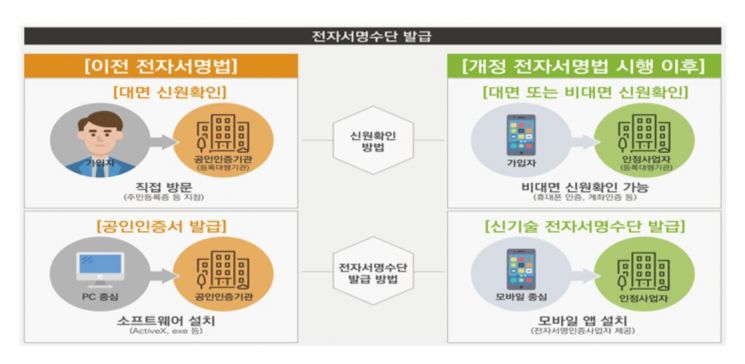
According to the Ministry of Science and ICT, there will no longer be a need to install ActiveX or executable files when using electronic signatures. Identity verification of electronic signature subscribers will also be possible through 'non-face-to-face verification,' expanding beyond the previously allowed face-to-face verification only, and subscriber authentication can be done using simpler passwords such as PINs or biometric information instead of complex passwords of 10 or more characters.
The government has ensured that citizens who used existing public certificates will not experience inconvenience after the revised law takes effect by allowing the use of existing public certificates until their expiration. Furthermore, certificates issued after the expiration (tentatively called joint certificates) will still be usable as one of several private certificates.
Choi Ki-young, Minister of Science and ICT, said, "With the enforcement of the revised Electronic Signature Act, it is expected that various convenient private electronic signatures will be activated. We will operate evaluation and accreditation systems to guarantee the reliability and safety of electronic signatures so that people can use private electronic signatures with confidence."
© The Asia Business Daily(www.asiae.co.kr). All rights reserved.
![User Who Sold Erroneously Deposited Bitcoins to Repay Debt and Fund Entertainment... What Did the Supreme Court Decide in 2021? [Legal Issue Check]](https://cwcontent.asiae.co.kr/asiaresize/183/2026020910431234020_1770601391.png)