Union Starts Strike Demanding Restoration of Overtime Work
Directly Linked to Allowances... "Effective Real Wage Increase"
[Asia Economy Reporter Kiho Sung] As the Kia Motors labor union has once again gone on strike, the restoration of the 30-minute overtime has emerged as a "hot potato." The Kia Motors union argues that since Hyundai Motors is already implementing overtime, Kia should do the same. On the other hand, the management expresses reluctance, stating that implementing the 30-minute overtime would inevitably lead to additional wage increases.
According to the automotive industry on the 1st, the Kia Motors union held a dispute countermeasure committee (Dispute Committee) meeting the day before and decided to strike for 4 hours per day by work shift over three days: the 1st, 2nd, and the upcoming 4th. On the 3rd, normal work will be conducted due to the nationwide executive election of the Korean Confederation of Trade Unions (KCTU). The union had previously conducted a strike for three days from the 25th to the 27th of last month and refused weekend overtime work.
On the 29th of last month, a confirmed case of COVID-19 was reported at Kia Motors' Gwangju plant, leading to the suspension of the morning shift the following day, causing production disruptions. Kia Motors needs to make up for the sales decline caused by the COVID-19 situation earlier this year during the year-end peak season, but the union strike has caused significant production setbacks. The production loss caused by the union's strike and refusal of overtime work is expected to exceed 25,000 units, far surpassing last year's loss of 10,000 units due to strikes.
The core issue in labor-management negotiations is the 30-minute overtime. The union stated ahead of the 14th main negotiation on the 24th of last month that if a proposal to resolve the 30-minute overtime issue was prepared, a provisional agreement could be reached. This was interpreted as meaning that issues such as wages and performance bonuses, which had been contentious, had found some common ground. However, the negotiations ended without results after 3 hours, failing to find a solution to the 30-minute overtime issue.
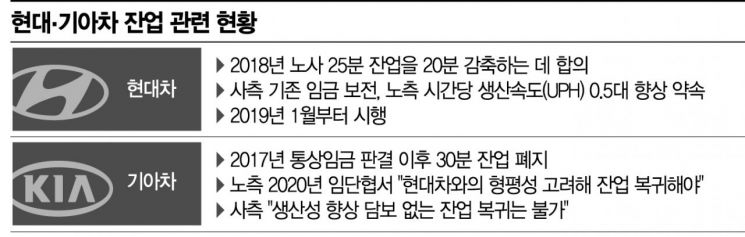
Kia Motors' overtime issue dates back to 2017. At that time, when the court ruled to increase Kia Motors' ordinary wages, the management eliminated the overtime that had to be paid linked to ordinary wages. As a result, the total 30 minutes of overtime?10 minutes in the morning shift and 20 minutes in the afternoon shift beyond the 8-hour workday?disappeared. The Kia Motors union did not strongly oppose the abolition of overtime, considering quality of life issues. However, when Hyundai Motors in 2018 agreed to eliminate the 20 minutes of afternoon overtime from the 5 minutes morning and 20 minutes afternoon overtime but compensated wages equivalent to 25 minutes, the Kia Motors union changed its stance. The Kia Motors union is now demanding the restoration of overtime, citing fairness with Hyundai Motors.
On the other hand, the management's position is that restoring overtime would effectively increase wages and cannot be accepted without guarantees of productivity improvement. In fact, Hyundai Motors agreed in 2018 to improve production speed per hour (UPH) by 0.5 units in exchange for wage compensation. Along with this, facility maintenance work was also carried out to enhance productivity. The fact that Kia Motors' overtime pay is set somewhat higher than Hyundai Motors' is also a burden factor.
An industry insider pointed out, "Overtime is paid at 150% of the hourly ordinary wage, night overtime at 200%. Also, weekend overtime pay is 200%, and late-night weekend overtime is 250%," adding, "Demanding the restoration of overtime is essentially demanding a wage increase."
© The Asia Business Daily(www.asiae.co.kr). All rights reserved.
![User Who Sold Erroneously Deposited Bitcoins to Repay Debt and Fund Entertainment... What Did the Supreme Court Decide in 2021? [Legal Issue Check]](https://cwcontent.asiae.co.kr/asiaresize/183/2026020910431234020_1770601391.png)
















