Severe Conflicts Including Feces Terrorism Due to Interfloor Noise Disputes
Some Public Opinion Says 'It Must Have Been That Bad'
Dispute Resolution Exists but Only Recommendations... No Enforcement Authority
Forced Eviction for Noise Issues in the US, UK, Germany, etc.
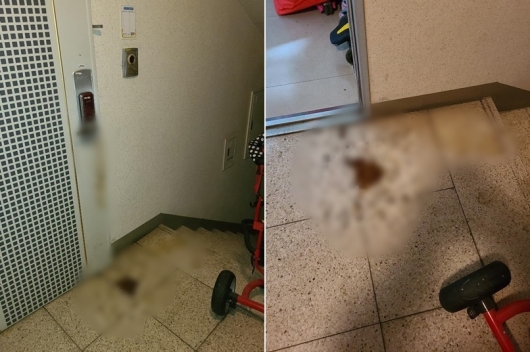 On the 28th of last month, a post titled "I was targeted with feces terrorism in front of my apartment door" was uploaded to an online community, drawing attention.
 /Photo by Online Community
[Asia Economy Reporter Han Seung-gon] "Only those who have experienced the pain of noise between floors can truly understand it." , "It must have been really bad for that to happen."
Recently, in an apartment complex, a severe conflict over noise between floors escalated to the point where human feces were involved, sparking divided public opinion. While some argue that no physical harm, including feces, should ever be inflicted, others sympathize with the extreme actions taken due to the torment of noise between floors, defending the so-called 'feces terror.' The increase in time spent at home during the COVID-19 pandemic, known as 'Jipkok' (staying at home), is believed to have led to more noise complaints and greater public empathy.
On the 28th of last month, a post titled "I was attacked with feces in front of my apartment door" was uploaded on an online community. The author explained, "The downstairs neighbors complained about noise on the day they moved in," and "During a family gathering in August, the police came after a complaint from the downstairs neighbors. The next day, I found out a report had been filed with the Noise Between Floors Center." After discussing with the apartment management office, the issue was resolved amicably, and the author added that several mats were laid down in the home afterward.
Then, on the 30th, a rebuttal post titled "I am the downstairs neighbor in the feces terror news" was uploaded. The writer claimed to live below the person who reported the feces attack and said, "Although I did not do it, I am writing because the post by the upstairs neighbor is really absurd and shameless." They continued, "I moved into this apartment on July 16. The nightmare started from the moving day," and alleged, "They hold running events all day long, not just during the day but until 2 a.m."
Summarizing the situation, the feces attack appears to have been triggered by conflicts arising from noise between floors. Consequently, some cautiously express understanding of the incident, empathizing with the noise issue.
Kim, a company employee in his 30s, said, "While the act itself is wrong, noise between floors is truly painful," and added, "I hope the dispute is resolved well."
Another office worker in his 40s, Park, emphasized, "Noise between floors can never be resolved between neighbors," and stressed, "It should be handled through civil lawsuits or legal measures." He continued, "This is a matter of courtesy," and lamented, "Everyone should be considerate in their daily lives. Apartments are shared living spaces, aren't they?"
As noise between floors escalates into neighbor conflicts severe enough to cause 'feces terror,' according to the Korea Environment Corporation, from January to October nationwide, 31,445 noise complaints were received, an increase of about 48% compared to the same period last year. The number of complaints received by September this year (27,539) already exceeded last year's total (26,257). In October alone, 4,678 noise complaints were filed.

Typically, increased conflicts over noise between floors are handled by △apartment management offices, △noise between floors management committees, and △the Noise Between Floors Neighbor Center under the Ministry of Environment's Korea Environment Corporation.
The problem is that these institutions can only make recommendations regarding conflict resolution but lack the authority to enforce legal measures, meaning they cannot sanction either party if they fail to comply with recommendations.
Given this situation, a petition titled "Noise Between Floors Should Be Legislated" was posted on the Blue House (Cheong Wa Dae) National Petition Board.
The petitioner stated, "Many people suffer greatly due to noise between floors. I believe many have sought help from the Noise Between Floors Neighbor Center," urging the establishment of related laws.
They continued, "If noise between floors is legislated so that when noise measurement confirms the noise, warnings can be issued, and ultimately forced eviction can be enforced, those causing pain will acknowledge their faults and become more considerate," appealing for consideration of residents suffering from noise. The petitioner added, "I want to rest comfortably and sleep well at home."
As requested by the petitioner, other countries impose measures up to forced eviction. In the United States, when noise complaints arise, the management office issues three warnings, and if violated again, forced eviction is enforced.
In the United Kingdom, the Anti-Social Behaviour Act of 2003 and the Clean Neighbourhoods and Environment Act of 2005 were amended to allow local authorities to regulate residential nighttime noise. When a noise complaint is filed, an on-site inspection is conducted, and a first corrective warning can be issued to the noise offender. A fine of 100 pounds (approximately 140,000 KRW) is imposed. If the noise offender does not take measures after the first warning, noise measurement is conducted, and if the standard is exceeded, a fine of up to 1,000 pounds (approximately 1,460,000 KRW) is imposed.
Germany imposes fines (up to 6.3 million KRW) for unnecessary noise emissions under the 'Federal Order Act.' In South Korea, fines for noise between floors are only about 30,000 KRW under the Minor Offenses Act for 'neighborly disturbance.'
Experts suggest that rather than victims taking direct action such as feces attacks, they should seek help from relevant institutions to resolve conflicts. A legal expert advised, "Pressing doorbells or knocking on doors due to noise conflicts are all illegal," and recommended, "Disputes should be mediated through consultation with management offices and related institutions."
© The Asia Business Daily(www.asiae.co.kr). All rights reserved.
![User Who Sold Erroneously Deposited Bitcoins to Repay Debt and Fund Entertainment... What Did the Supreme Court Decide in 2021? [Legal Issue Check]](https://cwcontent.asiae.co.kr/asiaresize/183/2026020910431234020_1770601391.png)

















