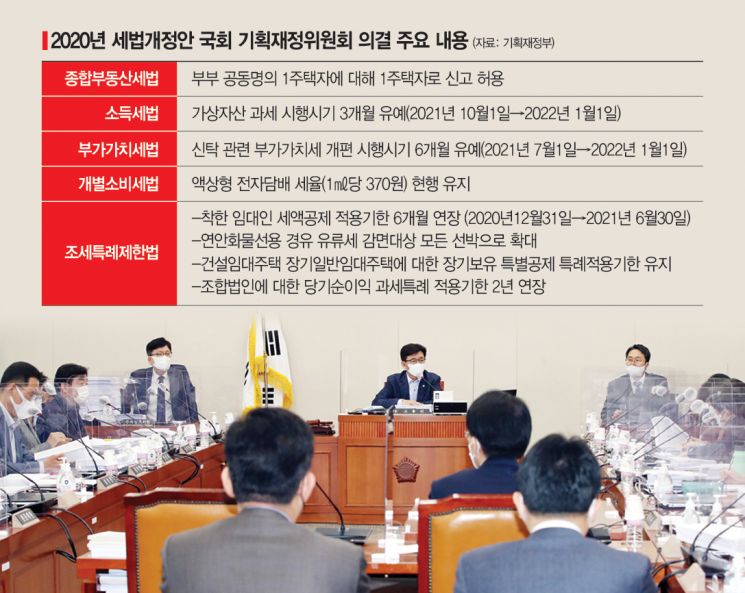
[Sejong=Asia Economy Reporter Kim Hyunjung] From the tax year next year, the deduction range for couples jointly owning a single house will be expanded, easing the comprehensive real estate holding tax burden. Income tax will be imposed from 2022 on gains from virtual asset investments such as Bitcoin, and the tax credit for benevolent landlords who reduce rent to respond to COVID-19 will be extended for another six months. The National Assembly's Planning and Finance Committee passed this tax law amendment bill at a plenary session on the 30th of last month.
◆Allowing declaration as a single homeowner even with joint ownership by spouses= One of the key issues in the approved amendment was whether a house jointly owned by spouses should be considered as 'one house.' Until now, the Ministry of Economy and Finance, the competent authority, had taken the position of excluding elderly and long-term holding deductions for couples jointly owning one house, citing the comprehensive real estate holding tax law (Article 8) which specifies the tax base deduction for a single owner of the house. However, on this day, the ruling and opposition parties agreed on a Planning and Finance Committee alternative that supplemented the bill originally proposed by Rep. Yoon Heesook of the People Power Party.
This amendment newly establishes a special case in Article 10-2 of the comprehensive real estate holding tax law to allow couples jointly owning one house to declare as a 'single homeowner.' The gist is that a couple owning one house jointly can receive a deduction of 600 million KRW each, pay tax on the portion exceeding a publicly announced price of 1.2 billion KRW, or pay tax on the portion exceeding 900 million KRW like a single household owning one house, and among the elderly and long-term holding deductions, choose the method most advantageous to themselves. Under the current comprehensive real estate holding tax law, elderly deductions are applied at 20-40% for those aged 60 or older, and long-term holding deductions are applied at 20-50% for holdings over 5 years. It is expected that once the amended law is implemented, the comprehensive real estate holding tax burden for couples who have jointly held one house for a long time could be reduced by up to 80% starting next year.
◆Bitcoin, 20% income tax if income exceeds 2.5 million KRW= From 2022, if income from virtual currencies such as Bitcoin exceeds 2.5 million KRW annually, a 20% tax must be paid. This postpones the originally planned application from October next year by three months, with the Ministry of Economy and Finance explaining that "the preparation period for virtual asset taxation infrastructure must be considered."
According to the amended Income Tax Act, the taxation method classifying virtual assets such as virtual currencies as other income will be implemented from January 2022. The key point is that other income earned from selling virtual assets will be aggregated annually and taxed separately at a 20% rate. Income up to 2.5 million KRW is tax-exempt. For example, if one earns 1 million KRW annually from buying and selling Bitcoin, no tax is paid, but if one earns 10 million KRW, income exceeding 2.5 million KRW (7.5 million KRW) will be taxed at 20%, resulting in 1.5 million KRW income tax.
Along with this, the Planning and Finance Committee approved the Special Consumption Tax Act to impose an individual consumption tax of 370 KRW per 1ml of nicotine solution on liquid-type e-cigarettes as currently applied. This is half the government's proposed rate of 740 KRW per 1ml.
◆Extension of benevolent landlord tax credit for six more months= The application period for the benevolent landlord tax credit, which provides a 50% tax credit on the landlord's income or corporate tax for the amount of rent reduction, was originally scheduled to end this year but was extended by six months until June 30 next year through an amendment to the Restriction of Special Taxation Act approved by the Planning and Finance Committee. This aims to alleviate the burden on small business owners due to the prolonged spread of COVID-19.
Additionally, a separate taxation at a 9% rate with a limit of 200 million KRW will be applied to dividend income from specific social infrastructure collective investment schemes such as New Deal infrastructure funds until the end of 2022. Accelerated depreciation special cases for facility investment assets can be applied temporarily for one year. Large corporations can apply up to 50% for innovative growth investment assets such as new growth technology commercialization facilities, and medium and small enterprises can apply up to 75% for business fixed assets. For long-term general private rental housing, special long-term holding deductions apply until the end of this year for purchased rentals and until the end of 2022 for constructed rentals. The scope of diesel fuel tax reduction for coastal cargo ships has been expanded from converted vessels to all vessels.
Furthermore, the tax credit rate for labor costs of employees returning from parental leave is applied at 30% for small and medium enterprises and 15% for medium-sized enterprises.
© The Asia Business Daily(www.asiae.co.kr). All rights reserved.
![User Who Sold Erroneously Deposited Bitcoins to Repay Debt and Fund Entertainment... What Did the Supreme Court Decide in 2021? [Legal Issue Check]](https://cwcontent.asiae.co.kr/asiaresize/183/2026020910431234020_1770601391.png)















