Significant Revision of Government's Original Proposal
Cancellation of New Tax on Excess Retained Earnings
Postponement of Limit on Local Transfer Tax Reduction
One-Year Allowance for Accelerated Depreciation of Facility Investment Assets
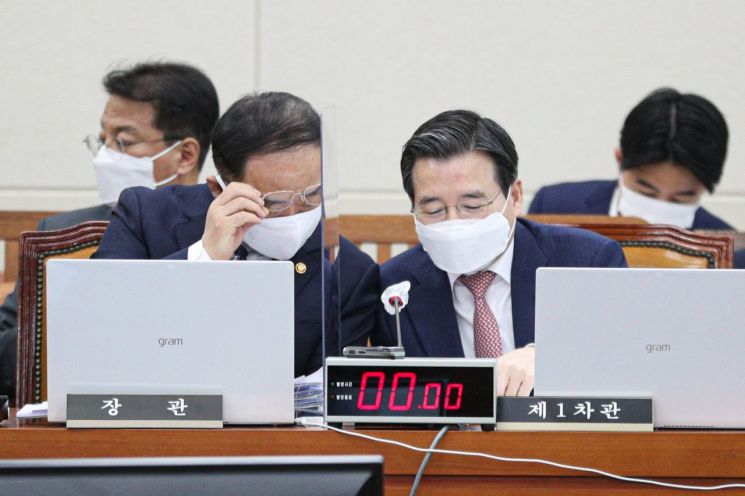
[Asia Economy Reporter Jang Sehee] The tax law amendment bill passed by the National Assembly's Planning and Finance Committee was significantly revised from the original draft submitted by the government. The retained earnings tax, which was to be newly established to prevent income tax avoidance, will not be taxed, and the establishment of a tax reduction limit for the local relocation enterprise tax reduction system was also scrapped. This is analyzed to be because the market's opposition, especially from small and medium-sized enterprises, was very strong, and both ruling and opposition parties felt burdened by expanding the tax base ahead of next year's by-elections and re-elections.
The 'Income Tax Act, Individual Consumption Tax Act, and other tax law amendment bills' approved at the plenary session of the National Assembly's Planning and Finance Committee on the 30th of last month included these contents.
The government's plan to tax excess retained earnings of companies, which was to be implemented from 2022, was scrapped in the National Assembly. The plan was to consider excess retained earnings as dividends distributed to shareholders and impose dividend income tax on them. However, the market opposed this, arguing that some of the internally retained earnings reserved as future investment funds could be considered dividend income and thus subject to taxation. The original government amendment draft included provisions that considered retained earnings exceeding half of the current net income or 10% of equity capital, after subtracting shareholder dividends, as dividends.
The tax reduction limit for enterprises relocating to local areas will not be set. The government had provided income tax and corporate tax reductions for companies relocating to local areas for 10 years?100% reduction for 7 years and 50% reduction for 3 years. The government proposed setting a tax reduction limit considering the cumulative investment amount (50%) and the number of regular employees, citing the long benefit period and high reduction rate of the system, but this was also postponed.
The special accelerated depreciation for facility investment assets, which was not included in the government's tax law amendment bill, will be temporarily allowed for one year. Large corporations have a 50% limit on innovative growth investment assets such as new growth technology commercialization facilities, while medium-sized and small enterprises have a 75% limit on business fixed assets. This was accepted as proposed by Kim Kyung-man, a member of the Democratic Party of Korea, through the 'Partial Amendment to the Restriction of Special Taxation Act.' However, since the effectiveness is not significant and the period is too long, it will be applied temporarily for one year only.
In this regard, it is known that both ruling and opposition parties unanimously opposed the government proposal, which included burdensome contents for companies and individuals ahead of the by-elections and re-elections. A government official stated, "In the past, government proposals were rarely revised, but even parts intended to prevent tax avoidance were scrapped," adding, "Tax law amendments are inevitably sensitive as they are closely related to money."
© The Asia Business Daily(www.asiae.co.kr). All rights reserved.
![User Who Sold Erroneously Deposited Bitcoins to Repay Debt and Fund Entertainment... What Did the Supreme Court Decide in 2021? [Legal Issue Check]](https://cwcontent.asiae.co.kr/asiaresize/183/2026020910431234020_1770601391.png)















