[Asia Economy Reporter Yuri Kim] Last month, the Construction Business Survey Index (CBSI) improved for the third consecutive month, recovering to the mid-80s range. It is analyzed that the increase in housing and non-residential building orders led the index recovery. This month, the CBSI is expected to recover to the 90s range.
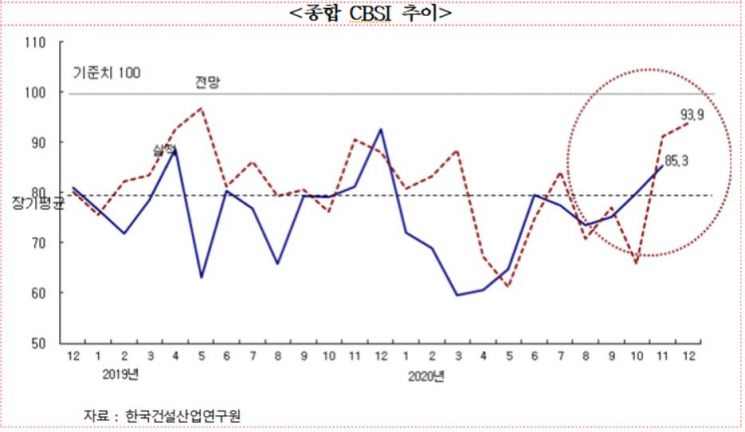
According to the Korea Construction Industry Research Institute on the 1st, the CBSI for November recorded 85.3, up 5.4 points from the previous month. The CBSI had been sluggish in the low 70s but rose by 1.8 points and 4.6 points in September and October respectively compared to the previous month, and increased by 5.4 points in November, marking three consecutive months of index improvement.
If the CBSI falls below the baseline of 100, it means that more companies view the current construction market pessimistically than optimistically, and if it exceeds 100, the opposite is true.
Researcher Park Cheol-han of the Korea Construction Industry Research Institute explained, "The recovery speed has gradually improved, and especially in November, the increase in housing and non-residential building orders compared to the previous month had a decisive impact on the recovery."
Researcher Park added, "Typically, the index rises by 1 to 2 points in November due to seasonal effects, but considering that the increase was larger than in previous years and that the month-on-month increase has grown for three consecutive months, it is judged that the construction market has partially recovered." He continued, "The new construction BSI for November rose 13.3 points from the previous month to 103.0, leading the overall BSI increase. It is analyzed that the increase in housing and non-residential building orders from large and medium-sized companies compared to the previous month had a positive effect on the index rise."
Meanwhile, the CBSI for December is forecasted to rise 8.6 points from November to 93.9. Researcher Park stated, "Typically, at the end of the year, orders increase and the progress of work improves due to seasonal effects, causing the index to rise by 5 to 10 points. It is judged that these effects are reflected in the index."
© The Asia Business Daily(www.asiae.co.kr). All rights reserved.

















