Ministry of Employment and Labor Announces Results of 'October Establishment Labor Force Survey'
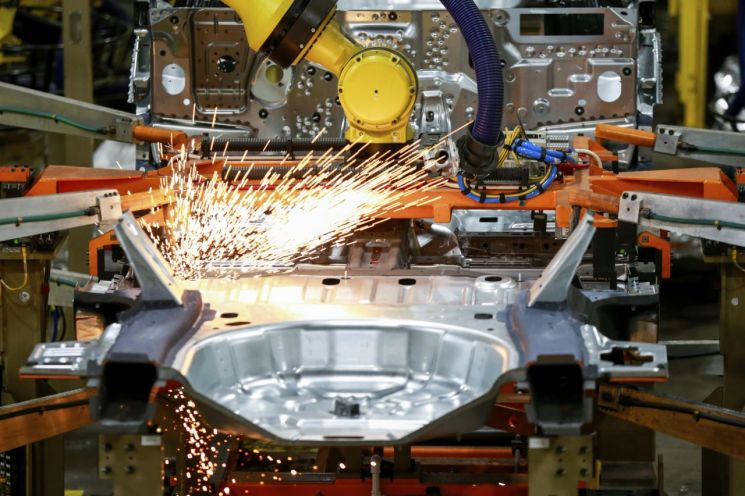
[Asia Economy Reporter Kim Bo-kyung] Due to the impact of the novel coronavirus infection (COVID-19) crisis, the decline in manufacturing workers last month once again broke the record for the largest decrease ever.
According to the 'October Business Workforce Survey' released by the Ministry of Employment and Labor on the 30th, as of the last business day of last month, the number of workers in manufacturing businesses with one or more employees was 3,662,000, a decrease of 79,000 (2.1%) compared to the same period last year.
This is the largest monthly decrease in manufacturing workers since the employment statistics of the Business Workforce Survey began in June 2009.
The number of manufacturing workers turned negative in February this year when the domestic spread of COVID-19 began, and since June, the decrease has continued at the level of 70,000.
The sluggish employment in manufacturing is mainly attributed to the decline in exports caused by the global spread of COVID-19.
In the service sector, accommodation and food service workers, hit hard by 'social distancing,' decreased by 162,000, and business facility management including travel (-64,000), wholesale and retail trade (-56,000), and arts and sports (-38,000) also saw large decreases.
On the other hand, public administration workers surged by 209,000 due to large-scale job projects by the government and local governments in response to the COVID-19 crisis.
Across all industries, the total number of workers in domestic businesses with one or more employees was 18,704,000, a decrease of 40,000 (0.2%) compared to the same month last year.
By employment status, the number of regular workers decreased by 228,000, but temporary and daily workers increased by 236,000. The increase in temporary and daily workers can also be seen as an effect of government and local government job projects. Other workers, including special employment types such as designated drivers, decreased by 48,000.
As of last September, the total average wage per worker in regular employment at businesses with one or more employees was 3,816,000 KRW, an increase of 70,000 KRW (1.9%) compared to the same month last year. The wage for regular workers was 4,039,000 KRW, up 59,000 KRW (1.5%), and for temporary and daily workers, it was 1,647,000 KRW, up 118,000 KRW (7.7%).
In September, the average working hours per worker was 162.2 hours, an increase of 10.1 hours (6.6%) compared to the same month last year. This is analyzed to be due to 1.3 more working days in September compared to the same month last year.
© The Asia Business Daily(www.asiae.co.kr). All rights reserved.

















