2009 Discovery of Pohang Jungseong-ri Silla Monument
"Precious Material Revealing 6th Century Silla Socio-Culture"
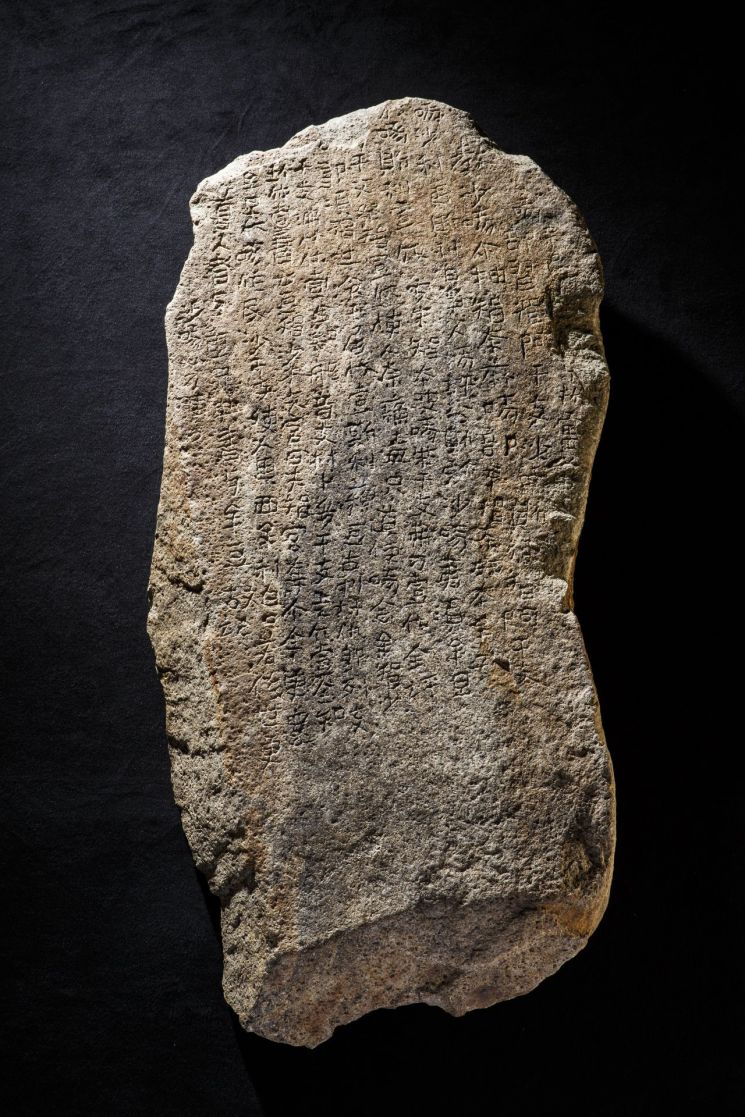
The actual artifact of the 'Pohang Jungseong-ri Silla Stele (National Treasure No. 318)', known as the oldest existing Silla stele, will be unveiled to the public for the first time in two years.
On the 30th, the National Gyeongju Cultural Heritage Research Institute announced that from the 8th of next month, this cultural asset will be on permanent display in Room 3 of the Silla History Hall at the National Gyeongju Museum. It was accidentally discovered in May 2009 at a road construction site in Jungseong-ri, Heunghae-eup, Pohang City. The stele is inscribed with 203 characters that reveal the establishment process of the Silla official rank system, the internal structure of the six divisions, and the relationship between the central government and local regions. Its dimensions are 49 cm in width, 104 cm in height, and 12?13 mm in thickness. It weighs 115 kg.
The Cultural Heritage Administration recognized its historical and academic value and designated it as a national treasure in 2015. The estimated production date is the 2nd year of King Jijeung's reign (501). This is two years earlier than the Pohang Naengsu-ri Silla Stele (National Treasure No. 264), made in the 4th year of King Jijeung (503), and 23 years earlier than the Uljin Bongpyeong-ri Silla Stele (National Treasure No. 242), created in the 11th year of King Beopheung (524).
Over the past decade, the National Gyeongju Cultural Heritage Research Institute has held academic conferences such as the 'Pohang Jungseong-ri Silla Stele Discovery Commemorative Symposium,' '6th Century Epigraphy and Silla Society,' and 'Silla Royal Capital and Pohang Jungseong-ri Silla Stele' to summarize the circumstances immediately following the stele's discovery and research achievements. They have also published materials including the 'Pohang Jungseong-ri Silla Stele Catalog' and the 'Pohang Jungseong-ri Silla Stele Data Collection.'
An official stated, "This is a valuable resource that informs us about the social culture of 6th-century Silla," adding, "It will be made available to the public in line with the reorganization of Rooms 3 and 4 of the Silla History Hall at the National Gyeongju Museum."
© The Asia Business Daily(www.asiae.co.kr). All rights reserved.

















