Nationwide Cold with Seoul at Minus 2 Degrees
Wind Lowers Feels-Like Temperature
Windows Opened Hourly to Prevent COVID-19
Extended Subway Peak-Time Service on the Day
About 19,000 Additional Taxis Operated
Police Deploy 2,700 Vehicles Including Patrol Cars
Support and Safety Management for Exam Takers Underway
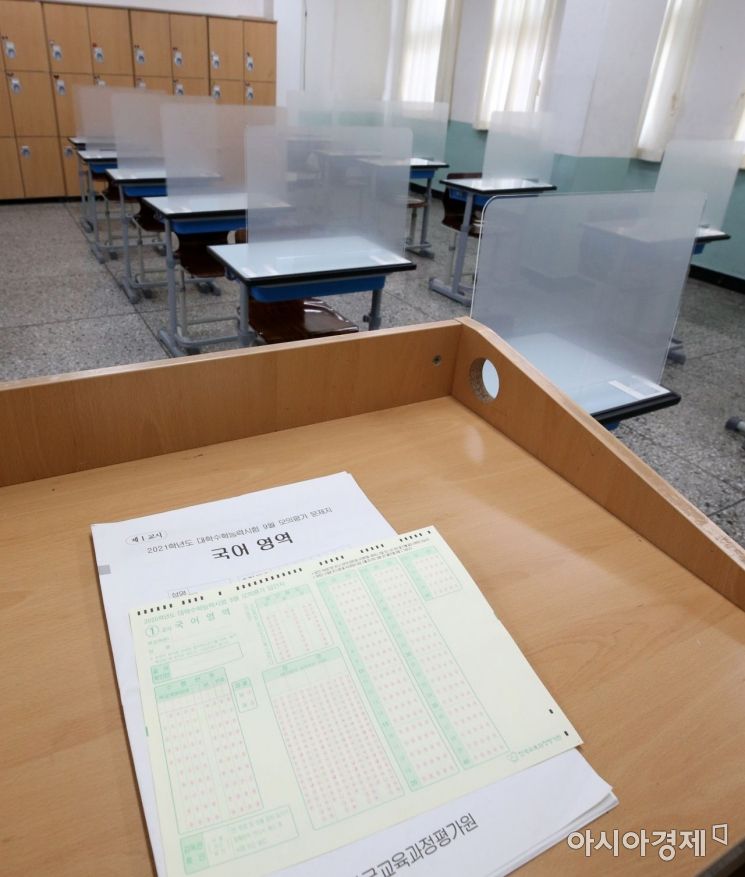 On the 27th, six days before the 2021 College Scholastic Ability Test, partitions were installed in the examination room set up at Jamsil High School in Songpa-gu, Seoul. Photo by Hyunmin Kim kimhyun81@
[Asia Economy reporters Jo In-kyung, Lee Hyun-joo, Lee Kwan-joo] On the day of this year's College Scholastic Ability Test (CSAT), held amid the novel coronavirus disease (COVID-19) crisis, freezing temperatures below zero are expected.
According to the Korea Meteorological Administration on the 30th, on Thursday, December 3, the CSAT day, morning temperatures in most regions nationwide are forecasted to be below zero. Seoul is expected to be -2°C, Incheon and Daejeon -1°C, and Chuncheon -4°C. Although there is no chance of snow or rain, wind will cause the wind chill temperature to drop by about 1 to 3 degrees. Daytime temperatures will also not rise significantly, staying around 5 to 10 degrees Celsius. Especially this year, to prevent COVID-19, windows will be opened for ventilation every hour during the test, so examinees need to wear thin layers of clothing to manage their body temperature carefully. The Korea Meteorological Administration will provide weather information for each test site through the Weather Nuri website until December 4.
The Ministry of Education began distributing the CSAT test papers and answer sheets to 86 test districts nationwide on the same day. Under police protection, the materials are transported to each test district, with about 400 personnel including district receiving officers, related staff, and central coordinators mobilized. The test papers and answer sheets moved to the test districts are stored in separate locations until the day before the exam, with security and safety measures implemented to prevent leaks. On-site command posts (CP) are established at the test development headquarters and printing headquarters to manage the situation 24 hours a day, and coordinated patrols are conducted every two hours in cooperation with local police stations and substations. During transportation of test papers and answer sheets, two armed police officers are deployed to escort jointly with the education office. Around the test sites, 112 patrol cars are stationed as bases to maintain order and prepare for emergencies. The test papers and answer sheets are transported to each test site on the morning of the exam day.
To facilitate transportation for examinees, the Seoul Metropolitan Government extended the subway morning peak dispatch hours on the CSAT day from the usual 7 a.m. to 9 a.m. to 6 a.m. to 10 a.m., adding 28 additional subway runs during this period. City and village buses will operate at minimum intervals from 6 a.m. to 8:10 a.m., and taxi restrictions will be lifted from 4 a.m. to 12 p.m., allowing about 19,000 additional taxis to operate. A total of 729 private and public vehicles marked with 'Examinee Transport Support Vehicle' signs will wait near subway stations and bus stops close to test sites and provide free rides upon request. However, these support vehicles can only be used if the passenger’s normal body temperature is confirmed before boarding. Examinees showing COVID-19 symptoms or under self-quarantine must travel to the test site by private car or 119 ambulance. If examinees request transportation due to concerns about being late or if a patient occurs during the exam, support will be provided upon calling 119. Additionally, to prevent examinees from being delayed due to traffic congestion during school commuting hours, the city, autonomous districts, and public corporations will adjust their start times to 10 a.m., one hour later than usual.
The police will deploy a total of 12,902 personnel and 2,694 vehicles including patrol cars and motorcycles to 1,381 test sites to support examinees and manage test site safety. To ensure examinees arrive on time, main roads within a 2 km radius of test sites will be intensively managed, and rapid response teams will be stationed at congested intersections nearby to maintain traffic flow. Furthermore, during the 25-minute English listening test from 1:10 p.m. to 1:35 p.m. (third period), trucks and other noisy vehicles will be diverted from roads near test sites to help maintain a quiet atmosphere.
© The Asia Business Daily(www.asiae.co.kr). All rights reserved.

















