Development of Photoelectrode Technology to Accelerate Hydrogen Production from Solar Power
Fabrication of Copper Bismuth Oxide Thin Film Electrodes
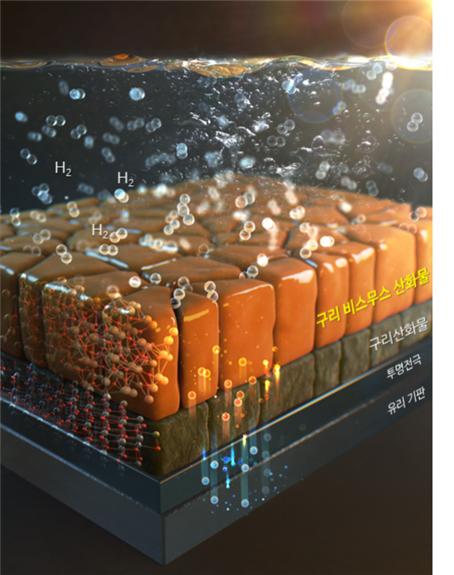
[Asia Economy Reporter Junho Hwang] A technology to convert gray hydrogen into green hydrogen has been developed by domestic researchers. The research team developed a high-performance photoelectrode material used to split water into hydrogen and oxygen using solar energy. This material can increase hydrogen production capacity by more than four times compared to existing photoelectrodes, and it is expected to become a core technology that can open the era of green hydrogen obtained from solar energy by solving issues such as electrode stability and large-area scaling.
The National Research Foundation of Korea announced on the 30th that a research team led by Professor Jo Inseon of Ajou University and Dr. Shin Seongsik of the Korea Research Institute of Chemical Technology (first authors Seogapgyeong and Kim Bitna) developed a hydrogen electrode material with more than four times higher solar-to-hydrogen conversion efficiency compared to existing materials. The related research results were recently published in the international journal Nano Energy.
Photoelectrode with Four Times Higher Efficiency in Water Splitting Hydrogen Production
The research team developed this material through a paradigm shift. While previous studies focused on developing photoanodes for oxygen production in the process of splitting water into hydrogen and oxygen using solar energy, the team focused on studying photocathodes for hydrogen production (hydrogen electrodes). In particular, the team paid attention to copper bismuth oxide, which is inexpensive, has a high theoretical photocurrent value, and excellent catalytic properties, making it an optimal hydrogen electrode material. Although copper bismuth oxide has properties suitable for use as a photoelectrode, it has a low thin-film quality, making charge transfer difficult and limiting the photocurrent value.
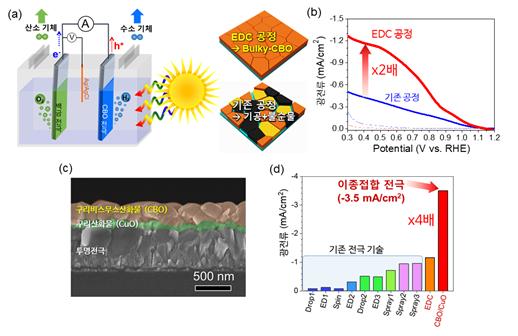
The research team developed a novel solution process that controls the evaporation rate of the solvent and the decomposition rate of the precursor (the coating solution containing the chemical sample) when the copper bismuth oxide precursor is coated, and used this to synthesize high-quality copper bismuth oxide thin films. This allowed the growth of large particles with a dense microstructure, and significantly reduced gaps or impurities that could occur during the thin-film formation process.
Large-Area Technology Needed for Commercialization
 Join Seon, Professor at Ajou University
The research team stated, "Compared to thin films made by conventional solution processes such as electrophoretic deposition, spray coating, and sol-gel methods, charge recombination was greatly reduced, resulting in more than four times higher photo-conversion efficiency."
Additionally, the team obtained a high photocurrent value of 3.5 mA/cm2 under standard solar illumination using a heterojunction structured photoelectrode with a copper oxide nanoparticle layer stacked beneath the copper bismuth oxide electrode. This is a higher value than any oxide hydrogen electrode reported to date.
A representative of the research team explained, "For commercialization of this material, further improvements in efficiency, stability, and large-area technology are necessary, and the team plans to continue related research."
© The Asia Business Daily(www.asiae.co.kr). All rights reserved.
![Clutching a Stolen Dior Bag, Saying "I Hate Being Poor but Real"... The Grotesque Con of a "Human Knockoff" [Slate]](https://cwcontent.asiae.co.kr/asiaresize/183/2026021902243444107_1771435474.jpg)

















