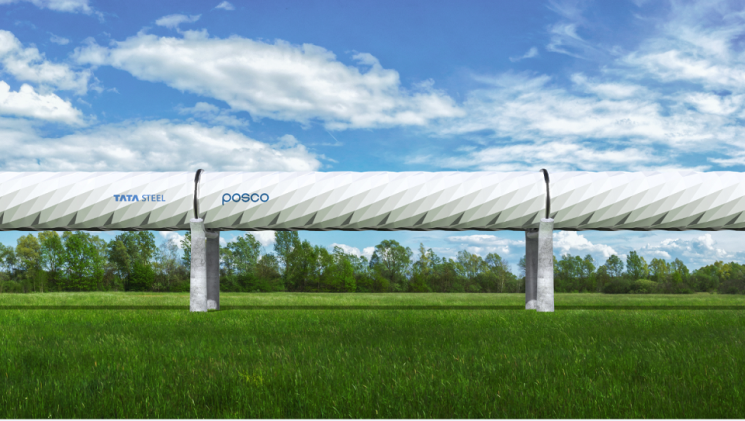
[Asia Economy Reporter Hwang Yoon-joo] POSCO has decided to actively collaborate with Tata Steel Europe (TSE) to develop materials for hyperloop. The plan is to develop structural solutions that not only focus on the development of steel materials dedicated to hyperloop but also derive optimal structural forms and manufacturing methods considering the safety and economic efficiency of hyperloop. They will also cooperate across the entire business field, including joint participation in global projects.
Since Tata Steel Europe has strengths in tube structure technology, synergy between the two companies is highly anticipated. In particular, this collaboration is also regarded as an exemplary case of open collaboration among global steel companies.
How much steel would be required if hyperloop tubes were made of steel? Experts estimate that approximately 2,500 tons of steel per kilometer would be needed to manufacture tubes with a diameter of 4 meters. Therefore, steel materials for hyperloop tubes are likely to become a major new market in the steel industry in the future. Since the shortcut to commercializing hyperloop depends on tube manufacturing technology, developing specialized steel materials for stable tubes and securing the market and standards is extremely important.
Many hyperloop companies such as VHO, HTT (Hyperloop Transportation Technologies), and Hardt Hyperloop are currently competing worldwide in a speed race to build hyperloop systems. VHO, which succeeded in the world’s first manned test in Nevada, USA, is working on two projects connecting Mumbai-Pune in India and Dubai-Abu Dhabi in the United Arab Emirates (UAE). Meanwhile, the US-based HTT is promoting the world’s first commercial section project connecting the 2020 Dubai World Expo Exhibition Center and Al Maktoum International Airport, postponed to October next year.
In South Korea, the Korea Railroad Research Institute succeeded eight years ago in accelerating a model transport vehicle weighing less than 1 kg to 700 km/h for the first time in the world. Since then, it has embarked on the development of the Korean-style hyper tube (HTX) and ultra-high-speed capsule trains. On the 11th, in a test where a 1/17 scale model of the actual size was produced, it recorded a top speed of 1,019 km/h, demonstrating world-class technological capabilities.
Europe’s Hardt Hyperloop announced plans in 2019 to establish a hyperloop test center in the Netherlands with a top speed of 700 km/h and a length of 3 km. At such speeds, the day when Seoul and Busan are connected by hyperloop may come sooner than expected.
© The Asia Business Daily(www.asiae.co.kr). All rights reserved.

















