International Commission on Radiological Protection (ICRP) Officially Distributes Model Developed by Professor Kim Chanhyung's Hanyang University Research Team
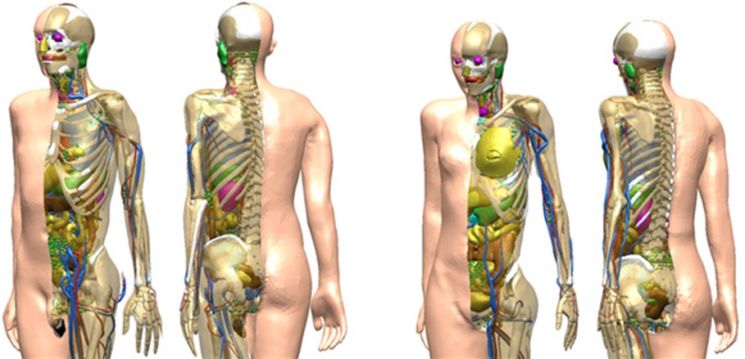 Next-generation international standard human model by the International Commission on Radiological Protection (ICRP) developed by the research team of Professor Kim Chan-hyung at Hanyang University. (Source: Nuclear Safety and Security Commission)
[Asia Economy Reporter Moon Chaeseok] A computational model for radiation dose assessment, perfectly tailored to the human body and developed in South Korea, has been adopted as an international standard.
The Nuclear Safety and Security Commission (NSSC) and Hanyang University announced on the 29th that the model developed by Professor Kim Chanhyung's research team has been selected as the next-generation international standard computational human model by the International Commission on Radiological Protection (ICRP).
Professor Kim's research team developed the model with support from the NSSC's Nuclear Safety Research and Development Project.
The ICRP is an international expert organization that develops standards and guidelines related to radiation safety and protection and recommends them to the international community. Countries worldwide establish and utilize radiation safety regulatory standards based on ICRP's recommendations.
The ICRP develops and provides international standard computational human models representing the global population, and this time, Professor Kim's research team's model was selected.
The previous ICRP international standard computational human model was a voxel-structured model developed by the Helmholtz Munich Research Center (HMGU) in Germany, selected in 2009. It was constructed in block form, showing significant differences from actual human body structures.
Specifically, it failed to accurately simulate ▲organ surfaces with unsmooth stepped shapes ▲discontinuous forms with holes in organs such as skin and digestive organs ▲thin cell layers highly sensitive to radiation, like the basal cell layer.
In 2013, at the ICRP annual meeting held in the United Arab Emirates (UAE), Professor Kim proposed the need to develop a new type of model based on tetrahedral mesh.
Recognizing this need, the ICRP formed a Task Group composed of top international experts from the United States, Germany, China, and others, centered around Professor Kim's research team, to develop the model.
The next-generation mesh-type ICRP international standard computational human model can simulate very small or complex organ tissues at the micrometer (=10^-6 m) scale. The accuracy of radiation dose assessment has been greatly improved.
Additionally, it allows easy modification of posture and body shape, enabling precise dose assessment considering the body shape and movements of the exposed individual.
Professor Kim explained, "The new model will be utilized not only for radiation protection but also in medical fields such as radiation diagnosis and treatment."
He added, "Furthermore, it is expected to be widely used in non-radiation fields such as electromagnetic wave-human interaction, automobile crash simulations, and virtual space surgery. It is significant in that it has demonstrated that Korea's radiation dose assessment technology is at the world's highest level."
The model adopted this time has been officially distributed since the 24th through ICRP Publication 145. The publication can be accessed on the ICRP website.
© The Asia Business Daily(www.asiae.co.kr). All rights reserved.

















