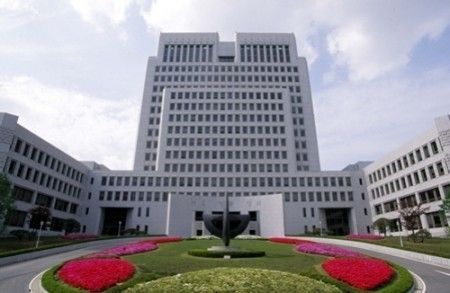
[Asia Economy Reporter Baek Kyunghwan] The Supreme Court has decided to overturn a lower court ruling that sentenced probation for 3 years and 6 months imprisonment, despite probation being allowed only for sentences of 3 years or less.
On the 29th, the Supreme Court's First Division (Presiding Justice Lee Gitaek) overturned the original ruling in the extraordinary appeal trial of Mr. A, who was indicted on charges including fraud, where he was sentenced to 3 years and 6 months imprisonment with 5 years probation.
Mr. A was tried on charges of conspiring with a voice phishing organization to swindle over 170 million won from 14 victims. Mr. A accepted the proposal from the voice phishing group and acted as a counselor calling victims from China. Domestically, he also collected borrowed-name check cards, withdrew money obtained from the crime, and transferred it.
The first trial court recognized most of Mr. A's charges and sentenced him to 3 years and 6 months imprisonment with 5 years probation. However, under criminal law, probation is only possible for imprisonment sentences of 3 years or less. The court effectively sentenced a term exceeding the legal limit while suspending the execution of the imprisonment. Despite the incorrect sentence, the prosecutor did not appeal. Thus, the first trial ruling was confirmed as is.
However, upon realizing the facts, the Supreme Prosecutors' Office filed an extraordinary appeal to the Supreme Court. An extraordinary appeal is a specific procedure requested by the Prosecutor General when a legal violation is found after a ruling has been finalized. The Supreme Court stated, "An imprisonment sentence of 3 years and 6 months cannot be suspended," and overturned the original ruling to correct the erroneous judgment.
However, since the prosecutor did not file an appeal or further appeal, the principle of 'prohibition of disadvantageous changes' was applied, meaning that a ruling more unfavorable to the defendant than the original cannot be made, so the original sentence for Mr. A was maintained.
© The Asia Business Daily(www.asiae.co.kr). All rights reserved.
![User Who Sold Erroneously Deposited Bitcoins to Repay Debt and Fund Entertainment... What Did the Supreme Court Decide in 2021? [Legal Issue Check]](https://cwcontent.asiae.co.kr/asiaresize/183/2026020910431234020_1770601391.png)
















