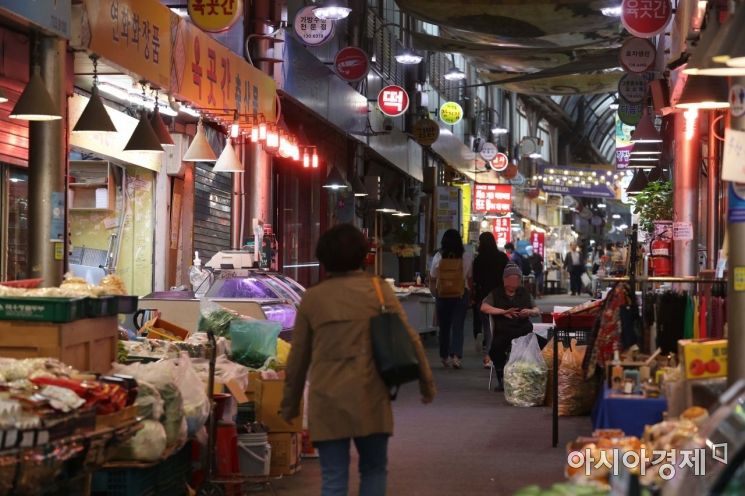
 Among the 10 households eligible for the government emergency disaster relief fund due to the COVID-19 pandemic, 9 households applied for and received the support. The Ministry of the Interior and Safety announced on the 22nd that the total amount of emergency disaster relief funds paid from the 4th to the 21st reached 12.1068 trillion won, with 19.21 million households receiving the funds. On the same day, citizens are shopping at Tongin Market in Jongno-gu, Seoul.
 Photo by Moon Honam munonam@
[Asia Economy Reporter Kim Bo-kyung] The government is pushing forward with a plan to provide the 3rd round of disaster relief funds to small business owners and self-employed individuals who have been affected by the third wave of the novel coronavirus infection (COVID-19).
According to the National Assembly and government on the 29th, there is a consensus between ruling and opposition parties on the provision of the 3rd disaster relief funds. Discussions remain to specify the target groups and methods.
The primary focus of the 3rd disaster relief funds is expected to be small business owners and the self-employed. Due to repeated business restrictions, vulnerable groups such as the self-employed are facing limits, and many believe that providing the 3rd disaster relief funds to support them is inevitable.
On the 25th, Lee Nak-yeon, leader of the Democratic Party of Korea, identified the COVID-19 affected groups in order as self-employed, small business owners, and workers during the Supreme Council meeting.
This is because under the social distancing level 2 measures currently in place in the metropolitan area and some local regions, small business owners and the self-employed are subject to business restrictions.
Under social distancing level 2, five types of businesses?hunting pubs, emotional bars, danran pubs, entertainment bars, and colatecs?are prohibited from operating. During the 4th supplementary budget, businesses that were banned from operating received up to 2 million won in business stabilization funds. Many expect that similar criteria will be applied for the upcoming disaster relief funds.
However, concerns about fiscal burden remain.
The government spent a total of 14.3 trillion won on the 1st disaster relief funds. This included 12.2 trillion won from the 2nd supplementary budget and 2.1 trillion won from local government funds.
Of the 12.2 trillion won in the supplementary budget, 8.8 trillion won was raised through expenditure restructuring, but the remaining 3.4 trillion won was procured by issuing government bonds.
For the 2nd disaster relief funds, 7.8 trillion won was spent, and the entire amount for the 4th supplementary budget was raised by issuing government bonds, thus increasing debt to secure the funds.
After the 4th supplementary budget, the national debt rose to 846.9 trillion won, and the debt-to-GDP ratio reached a record high of 43.9%.
Experts advise that when providing relief funds, targeted support to affected groups should be implemented to increase efficiency and reduce fiscal burden.
Professor Kim Woo-cheol of the University of Seoul said, "Considering that this situation may repeat next year and will not end at once, fiscal burden must be reduced. It is not possible to provide an amount equivalent to the 2nd relief funds multiple times a year. The 3rd relief funds should focus on a smaller scope than the 2nd."
The Korea Development Institute (KDI) also suggested in July that when supporting households facing financial difficulties due to COVID-19, selective support based on household characteristics is more efficient than providing cash uniformly to all households.
© The Asia Business Daily(www.asiae.co.kr). All rights reserved.
![User Who Sold Erroneously Deposited Bitcoins to Repay Debt and Fund Entertainment... What Did the Supreme Court Decide in 2021? [Legal Issue Check]](https://cwcontent.asiae.co.kr/asiaresize/183/2026020910431234020_1770601391.png)