[Asia Economy Reporter Suyeon Woo] Porsche's first pure electric sports car, the Taycan, has landed in Korea. With the launch of the Taycan featuring an 800V voltage system, Porsche is set to face off head-to-head against strong competitors in the high-performance electric vehicle market such as the Tesla Model S and Jaguar I-Pace.
On the 26th, Porsche Korea officially launched the brand's first pure electric sports car, the 'Porsche Taycan 4S,' in the domestic market. Two models will be released in Korea: the 'Performance Battery' model equipped with a 79.2kWh battery and the 'Performance Battery Plus' model equipped with a 93.4kWh battery. Vehicle deliveries will begin in mid-December, and Porsche Korea plans to sequentially introduce the 'Taycan TurboS' and 'Taycan Turbo' to the domestic market following the official launch of the Taycan 4S.
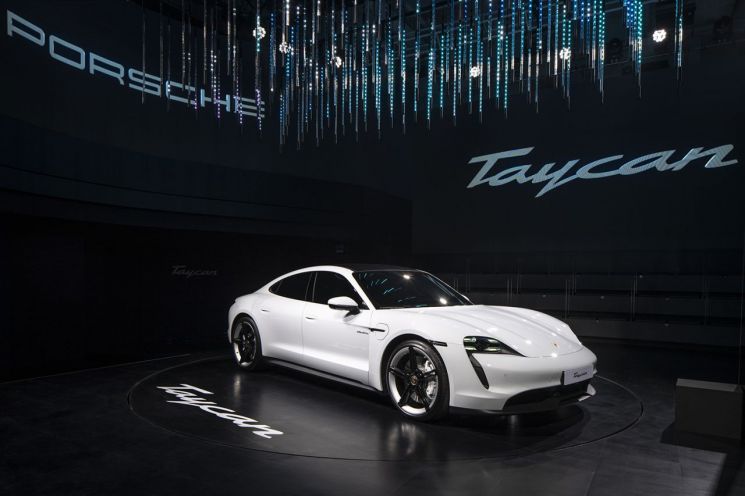
Taycan 4S Maximum Output 420kW... 0 to 100 km/h in Just 4 Seconds
The newly launched 'Taycan 4S' offers a choice between the Performance Battery with a maximum output of 390kW (530 horsepower) and the Performance Battery Plus with 420kW (571 horsepower). Both models accelerate from 0 to 100 km/h in just 4 seconds, with a top speed of 250 km/h. According to domestic certification standards, the driving range per charge is 289 km for the Performance Battery Plus, while certification for the Performance Battery model is currently underway.
The Porsche Taycan is the first to apply an 800V voltage system instead of the typical 400V used in existing electric vehicles. Utilizing DC energy from the rapid charging network on the road, it can travel up to 100 km with just a 5-minute charge. Under optimal conditions, the battery can be charged from 5% to 80% in 22 minutes and 30 seconds at a maximum output of 270kW.
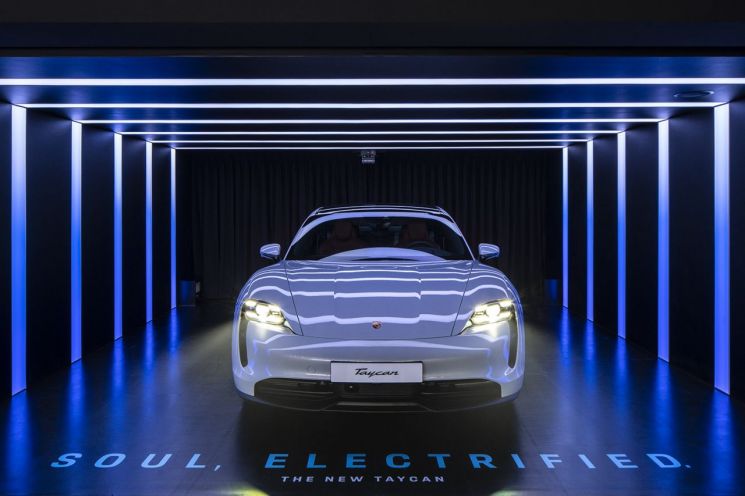
Central Network Control System Applied to Chassis
The Taycan chassis uses a centrally networked control system. The integrated Porsche 4D Chassis Control analyzes and synchronizes all chassis systems in real time.
Additionally, a unique all-wheel-drive control system equipped with two electric motors and an energy recovery system has been applied. Thanks to the energy recovery system capable of up to 265kW, about 90% of everyday braking can be achieved through regenerative braking without actual brake operation.
Each of the front and rear axles is equipped with an efficient electric motor, creating an all-wheel-drive system. The advantages in driving range and continuous output are derived from the high efficiency of PSM (permanently excited synchronous machines).
Aerodynamic Design... Clean and Pure Styling
The Porsche Taycan features a clean and pure design reflecting Porsche's unique design DNA. The front appears wider and flatter with clearly defined wings, and the silhouette is emphasized by a sporty roofline sloping towards the rear.
The sleek interior lines, shortened rear C-pillars, distinct shoulder lines, and sharply emphasized rear design reveal typical Porsche styling. Innovative elements such as the glass design of the light bar extending across the rear and Porsche lettering are also present. The aerodynamic design contributes to low energy consumption and long-distance driving.
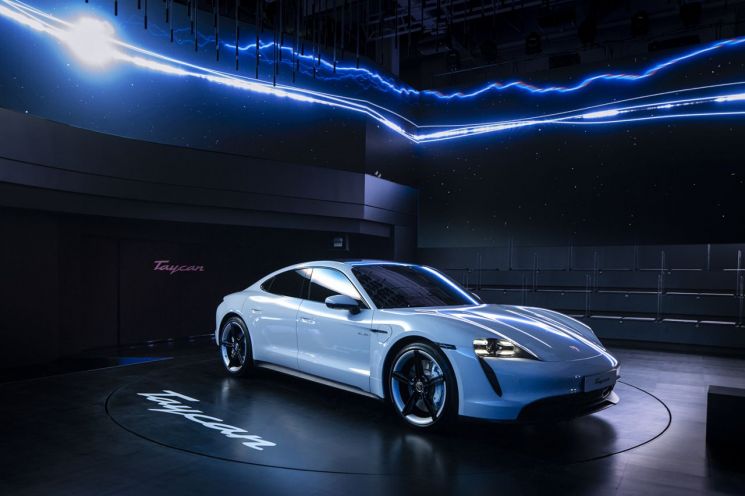
Porsche Taycan Faces Off Directly Against Tesla Model S
The main competitor to the Porsche Taycan is the representative high-performance premium electric vehicle, the Tesla Model S. While the Tesla Model S is a premium high-performance electric car made by an electric vehicle specialist, the Porsche Taycan represents a highly refined electric car that embodies the know-how of a supercar brand.
Comparing the specifications of the Model S and Taycan, the maximum output of the electric motor is higher in the Taycan 4S (420kW) than in the Model S (350kW). In high-performance driving involving explosive power over short distances, the Taycan appears to have the advantage.
On the other hand, the time to accelerate from 0 to 100 km/h is 2.5 seconds for the Model S and 4 seconds for the Taycan, and the driving range per charge is 487 km for the Model S and 289 km for the Taycan, with the Model S leading. In terms of battery charging, the Taycan can travel up to 100 km with just 5 minutes of DC charging, while the Model S can travel up to 171 km after 15 minutes of charging via a Supercharger.
The prices are set at 145.6 million KRW for the Porsche Taycan and 101.4 million KRW for the Tesla Model S, with both vehicles priced above 100 million KRW.
© The Asia Business Daily(www.asiae.co.kr). All rights reserved.



















