Decrease in Petroleum Production Also Reduces Byproduct 'Dry Ice'
Essential for Transporting Pfizer Vaccine at -70°C Ultra-Low Temperature
Dry Ice Must Be Replaced Every 5 Days During Storage
Supply Shortage Variations Expected by Region Due to 'Sublimation' Characteristics
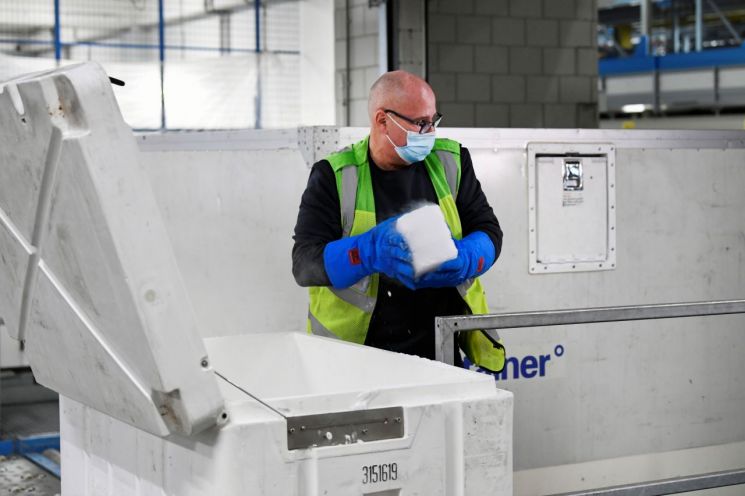
[Asia Economy Reporter Hyunwoo Lee] U.S. President Donald Trump announced that shipments of the novel coronavirus disease (COVID-19) vaccines will begin within the United States starting next week. However, concerns over a shortage of the essential item for shipping, 'dry ice,' are growing, raising the possibility of disruptions in distribution. Pfizer's vaccine, expected to begin administration next month, must be kept at an ultra-low temperature below minus 70 degrees Celsius during shipping, which is anticipated to require a massive amount of dry ice. Since April, the production volume of dry ice has been showing a declining trend.
According to the Associated Press (AP) and others on the 26th (local time), President Trump said during a video call with U.S. troops stationed overseas on Thanksgiving Day, "COVID-19 vaccine shipments will start next week or the week after," adding, "They will be sent first to workers and medical staff on the front lines fighting COVID-19, as well as the elderly." Earlier, the U.S. Centers for Disease Control and Prevention (CDC) stated that vaccinations would begin immediately after the Pfizer vaccine, which has applied for approval from the U.S. Food and Drug Administration (FDA), is approved on December 10.
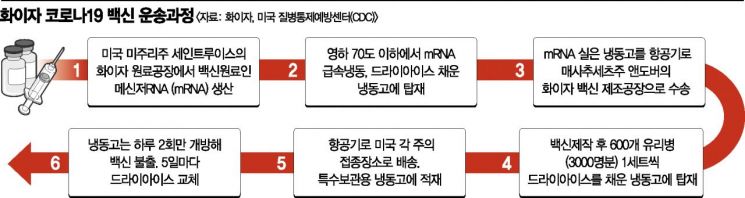
Dry ice is essential to safely transport the Pfizer vaccine. Since this vaccine is based on messenger RNA (mRNA), it must be kept at an ultra-low temperature below minus 70 degrees Celsius to maintain its efficacy. Additionally, dry ice is necessary to maintain the ultra-low temperature after delivery. Dry ice must be replaced every five days in the vaccine storage freezers installed at each vaccination site.
The problem is that concerns about a shortage of dry ice for vaccine transportation in the U.S. are serious. While demand has surged, production is actually decreasing. The decline in production is closely related to reduced petroleum demand. Dry ice is made as a byproduct of petroleum refining, and due to the impact of the COVID-19 pandemic, the production of industrial carbon dioxide, the main raw material for dry ice, has decreased across the U.S. since April.
Sam Lushing, CEO of Advanced Cryogenics, a U.S. management consulting firm, told CNN in an interview, "Regional dry ice shortages have already begun in the U.S.," pointing out, "Due to the COVID-19 impact this year, demand for vehicle and aviation fuel has plummeted, causing ethanol production in the U.S. and Europe to drop significantly."
Concerns about dry ice shortages were already raised earlier by the U.S. Compressed Gas Association (CGA) in early April. At that time, CGA sent a joint letter addressed to Vice President Mike Pence, co-signed by U.S. meat producers and brewers' associations, stating, "Many manufacturers have halted production of industrial carbon dioxide, a refrigerant raw material including dry ice, due to decreased demand for refrigerated foods and beverages following COVID-19 lockdown measures," warning, "Without a stable supply of carbon dioxide, transportation of pharmaceuticals and food and beverages will become difficult, exacerbating product shortages." According to CGA, U.S. industrial ethanol producers have reduced production by about 20% compared to the previous year, and more than 60% of bioethanol producers, which ferment grains, have closed their doors.
In response to dry ice supply concerns, UPS, the logistics company responsible for shipping the Pfizer vaccine, decided to build dry ice production facilities directly in the U.S. and Canada. According to The New York Times (NYT), UPS announced on the 24th that it plans to establish dry ice production facilities in the U.S. and Canada to store and transport the vaccine, with a production capacity of 1,200 pounds (approximately 544 kg) of dry ice per hour.
However, to meet the nationwide surge in dry ice demand after vaccine distribution, it appears necessary to expand production facilities across the U.S. Rich Gottwald, CGA CEO, told CNN in an interview, "The dry ice production volume in the U.S. and Canada this year is about 30,000 to 35,000 tons, which alone could meet the amount needed for vaccine transportation," but he pointed out, "Dry ice sublimates quickly, making it difficult to transport to regions far from production facilities." He explained, "We will cooperate with authorities to increase production and relocate production facilities to resolve regional supply shortages."
© The Asia Business Daily(www.asiae.co.kr). All rights reserved.
![Clutching a Stolen Dior Bag, Saying "I Hate Being Poor but Real"... The Grotesque Con of a "Human Knockoff" [Slate]](https://cwcontent.asiae.co.kr/asiaresize/183/2026021902243444107_1771435474.jpg)












