"Cannot Put Tax Money into Both Companies"
"Will Contribute to Enhancing Competitiveness in the Aviation Industry"
[Asia Economy Reporter Kim Hyo-jin] Financial authorities are showing continuous support for KDB Industrial Bank regarding the merger of Korean Air and Asiana Airlines. They state that the merger is inevitable and positive for strengthening competitiveness in the aviation industry.
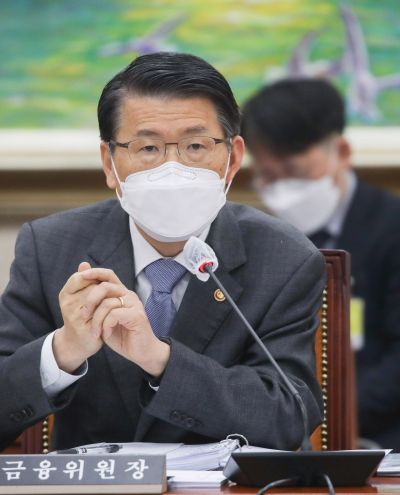
On the 27th, at the National Assembly's Legislation and Judiciary Committee plenary session, Financial Services Commission Chairman Eun Sung-soo responded to Democratic Party lawmaker Kim Byung-wook's question about whether there were alternatives other than the merger by saying, "The creditors judged that there is no alternative other than the merger to reduce taxpayers' money and maintain employment, and both the Ministry of Land, Infrastructure and Transport and our Financial Services Commission agreed."
Chairman Eun also explained, "(If Asiana Airlines) had been sold to HDC Hyundai Development Company, the two-company system (Korean Air and Asiana) would have continued, but HDC Hyundai Development withdrew its purchase intention, and when we approached other potential buyers, they all declined."
He added, "The remaining alternative is independent survival, but no one knows when the aviation industry crisis will end, and we could not pour taxpayers' money into both companies."
Regarding the choice of purchasing common shares of Hanjin KAL instead of providing loans, Chairman Eun said, "Loans are debts, so there is interest burden and the debt ratio increases," adding, "Stocks are the best for financial soundness."
He expressed his view, "There needed to be a means to guarantee whether the management could fulfill their promises well, and since participation as a shareholder is necessary to provide such guarantees, it seems they participated through stocks."
Regarding injecting funds through Hanjin KAL rather than Korean Air, he said, "If support is given directly to Korean Air, the parent company Hanjin KAL's stake in Korean Air would fall below 20% due to dilution."
Chairman Eun also added, "If funds are injected into Asiana, the debt ratio rises. As Asiana's credit rating falls, existing bondholders may trigger recovery actions," and "It was necessary to prevent the credit rating from falling while injecting funds into Asiana."
Do Gyu-sang, Vice Chairman of the Financial Services Commission, stated at the Financial Risk Response Team meeting the day before, "It is expected that the merger of the two companies will contribute to enhancing competitiveness in the aviation industry."
Vice Chairman Do explained, "As concerns about the prolonged normalization of the aviation industry arise, the merger of the two airlines is being promoted for the survival of the aviation industry," and predicted that if the restructuring proceeds swiftly and efficiently, approximately 37,000 employees of both airlines and affiliated companies, as well as about 60,000 workers in aviation partner companies, could retain their jobs.
Regarding some concerns about the investment structure, he said, "I understand this is an inevitable choice to prevent nationalization and to achieve early normalization of the domestic aviation industry through efficient management," emphasizing, "In the future merger process, transparent and sound management should be led, and jobs and consumer benefits must be protected."
© The Asia Business Daily(www.asiae.co.kr). All rights reserved.

















