Leading the 'Green New Deal' Era: ZEB (Zero Energy Building)
AI and IoT Technology Applied to Analyze Heating and Cooling Usage Patterns
Active Use of Solar and Wind Power... Reducing Waste and Increasing Efficiency
Mandatory for New Public Buildings Over 1000㎡ from This Year
[Asia Economy Reporter Jo In-kyung] #The Edge in Amsterdam, Netherlands, used by the global accounting firm Deloitte's European headquarters, is considered the most eco-friendly building in the world. Nearly 30,000 sensors installed throughout the building collect real-time data on employees' movements, indoor temperature, heating and cooling status, and lighting brightness to control energy usage. Lights automatically turn off in unoccupied offices, and heating and lighting are adjusted to optimal levels to prevent energy waste. Electricity is self-supplied through solar panels installed on the building's roof and exterior walls, as well as on the nearby University of Amsterdam's roof, and rainwater is collected for use in toilets and gardens. The building, with glass walls covering all 15 floors, uses only 30% of the electricity compared to other buildings of similar size, and through solar and geothermal power generation, it produces 102% of the energy it needs.
#In 2017, the Garden Grove School District in California, USA, renovated school buildings constructed in the 1950s and 60s by applying zero-energy systems. Windows were replaced with highly insulating products, daylight control devices were installed to maximize natural lighting, and solar power was installed in parking lots. Additionally, technologies optimized for natural ventilation were applied, and heating, cooling, and ventilation systems were disabled when windows were open to prevent energy waste. At Santiago High School, one of the schools in the district, an electronic display showing real-time energy usage prompted students, teachers, and staff to actively participate in energy-saving campaigns. Ralston Middle School's kitchen, which prepares 5,500 meals daily, reduced electricity consumption by half by replacing fluorescent lights with LEDs and improved ventilation fans and exhaust hoods to lower kitchen temperatures.
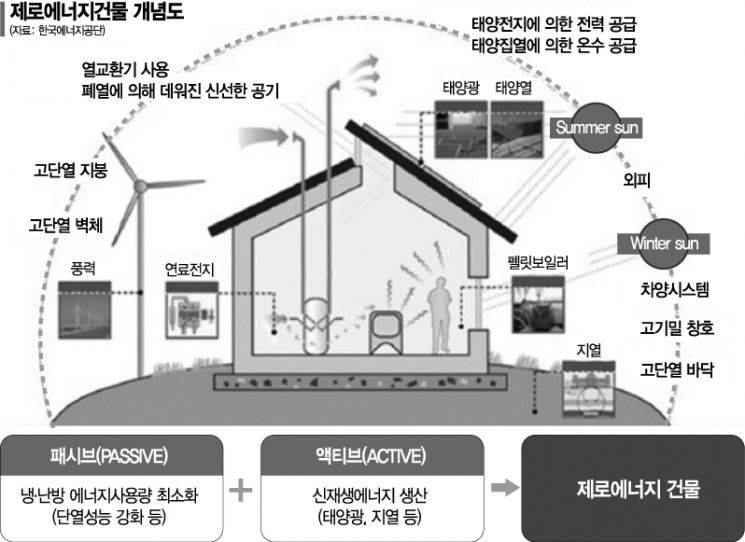
The world is focusing on 'Zero Energy Buildings (ZEB),' which enhance energy efficiency in buildings. A zero-energy building minimizes external energy loss through high-performance insulation materials, double glazing, and shading, and produces energy independently using renewable sources such as solar and wind power. It is a building capable of energy 'self-sufficiency.'
Recently, energy management systems combined with artificial intelligence (AI) have been added. Based on information and communication technology, these systems find optimized energy control methods tailored to building characteristics to improve energy efficiency. Using big data analysis based on the Internet of Things (IoT) and cloud technology, they identify energy usage patterns, detect abnormal signs different from usual, and automatically prevent wasted energy.
Zero-energy buildings have become essential because energy consumption in large buildings worldwide is rapidly increasing. According to the International Energy Agency (IEA), 36% of global energy consumption occurs in residential and commercial buildings, and these buildings are responsible for 39% of direct and indirect greenhouse gas emissions.
Accordingly, countries are expanding zero-energy buildings as a key measure to reduce energy consumption and greenhouse gas emissions. The United States plans to replace all public buildings and 50% of existing buildings with zero-energy buildings by 2030, starting with new homes this year. The United Kingdom has recommended zero carbon emissions for newly built homes since 2016, and Germany requires zero-energy buildings to reduce energy use by 85-90% compared to conventional buildings. Japan aims to realize zero-energy buildings as the average for new homes by 2030 and has introduced various support measures.
South Korea has gradually strengthened mandatory energy reduction rates for buildings since 2009. In 2017, it introduced a zero-energy building certification system, and from this year, public buildings with a total floor area of 1,000㎡ or more must be constructed or expanded as zero-energy buildings. Public buildings with 500㎡ or more must comply from 2023, private buildings with 1,000㎡ or more from 2025, and from 2030, all new buildings with 500㎡ or more must be designed as zero-energy buildings.
In line with the government's recently announced 'Green New Deal' policy, zero-energy models will be applied not only to new constructions but also to remodeling projects.
The energy zeroing of individual buildings is expected to enable zero-energy realization at the level of interconnected buildings, districts, and even entire cities.
Yu Gi-hyung, head of the Green Building Research Center at the Korea Institute of Civil Engineering and Building Technology, said, "Zero energy is more of a policy issue than a technological one. When the government initiates policies with various supports or incentives, related industries accelerate accordingly. In the future, beyond buildings or apartment complexes, efforts will be made to integrate various energy sources used within a city, such as cars and power plants, to achieve self-sufficiency and reduce carbon emissions."
© The Asia Business Daily(www.asiae.co.kr). All rights reserved.

















