3Q Total Debt to GDP Ratio Rises 24.7%P from Last Year-End to 270.1%
Emphasis on Management to Prevent Systemic Financial Crisis
[Asia Economy Beijing=Special Correspondent Jo Young-shin] The People's Bank of China, the central bank of China, stated that non-performing loans in the financial sector have increased due to the COVID-19 pandemic and that it will strengthen management to prevent the situation from escalating into a financial crisis.
According to Chinese media such as Caixin on the 27th, the People's Bank of China pointed out in its third-quarter monetary policy implementation report released the previous night that "the intensity of economic adjustment policies to cope with COVID-19 in the first half of the year was somewhat strong, causing the total debt ratio to gradually rise, and the financial risks caused by the COVID-19 shock may appear with a delay."
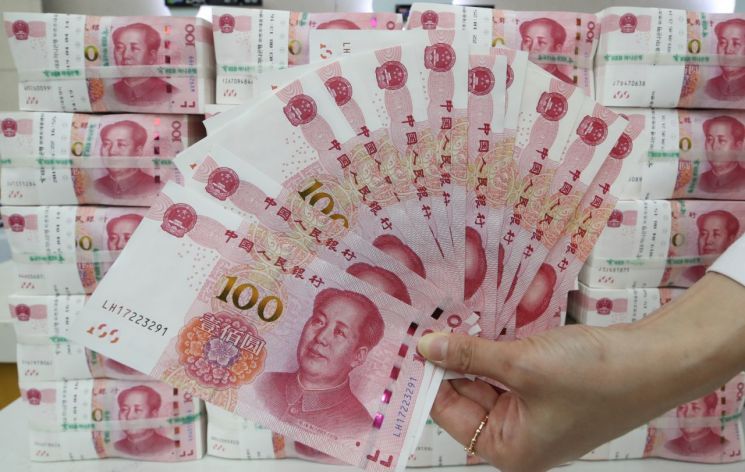
According to the National Institute of Financial Development (NIFD), a think tank under the Chinese Academy of Social Sciences, as of the end of the third quarter, China's total debt ratio relative to gross domestic product (GDP) was 270.1%, up 24.7 percentage points from 245.4% at the end of last year.
The People's Bank of China emphasized, "We will firmly maintain the bottom line to prevent systemic financial crises by establishing a system for prevention, early warning, response, and accountability."
Since the beginning of the year, Chinese authorities, including the People's Bank of China, have significantly expanded liquidity supply through measures such as lowering reserve requirement ratios and policy interest rates to mitigate the impact of COVID-19, while implementing various corporate support policies such as low-interest policy fund supply and loan maturity extensions.
Through these measures, many companies and individual business owners in difficulty have overcome the immediate crisis, but concerns have been raised that many marginal companies may fail to repay their debts properly if authorities normalize monetary policy amid the overall recovery of the Chinese economy.
In fact, concerns rapidly grew that the crisis of companies delayed due to stimulus measures introduced to alleviate the COVID-19 shock might surface in earnest, as Brilliance China Automotive, a large state-owned enterprise and BMW's joint venture partner in China, entered bankruptcy proceedings recently.
The People's Bank of China explained, "Monetary policy must be well managed," adding, "We will neither let the market suffer from a shortage of money nor flood the market with money through 'Daesu Manguan' (an irrigation method that fills farmland with water)."
© The Asia Business Daily(www.asiae.co.kr). All rights reserved.
!["The Woman Who Threw Herself into the Water Clutching a Stolen Dior Bag"...A Grotesque Success Story That Shakes the Korean Psyche [Slate]](https://cwcontent.asiae.co.kr/asiaresize/183/2026021902243444107_1771435474.jpg)
















