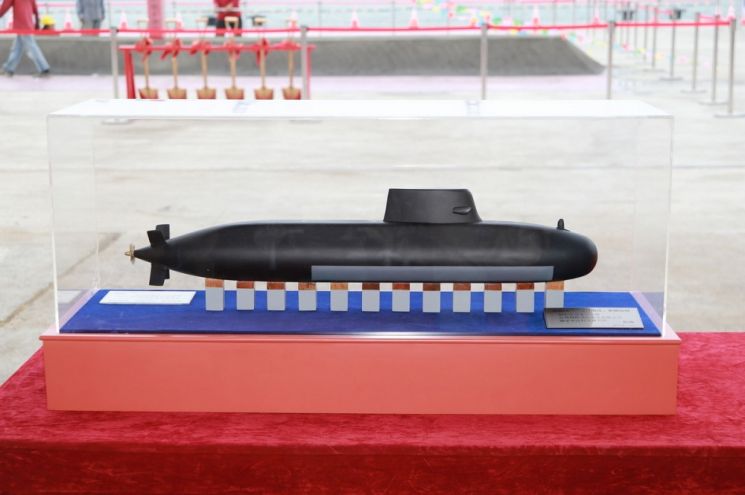
[Kim Daeyoung, Military Commentator] On the 24th, at the Taiwan International Shipbuilding located in Kaohsiung, Taiwan, a ceremony was held to commemorate the construction of Taiwan's domestically produced submarine, the IDS (Indigenous Defense Submarine). The ceremony was attended by Taiwan's President Tsai Ing-wen (蔡英文), military and government officials, as well as William Brent Christensen, Director of the American Institute in Taiwan (AIT), which serves as the de facto U.S. embassy in Taiwan.
Since President Tsai Ing-wen took office, the Taiwanese government has been fervently pursuing the development of domestically produced submarines under the name "Qianjian Guozao" (潛艦國造). In fact, Taiwan introduced submarines earlier than South Korea. In 1969, Taiwan attempted to acquire 10 to 12 conventional diesel submarines from the United States, but the U.S. government at the time refused, citing submarines as offensive weapons. However, after the Taiwanese Navy imported the Cosmos-class midget submarines made in Italy and localized them, the policy changed, and under the pretext of anti-submarine training, two Tench-class submarines were delivered in 1973.
Additionally, in the mid-1980s, Taiwan spent a large budget to acquire two Zwaardvis-class submarines from the Netherlands. However, due to pressure from the Chinese government, Taiwan's efforts to secure submarine capabilities faced repeated difficulties. The Tench-class submarines operated by the Taiwanese Navy were built near the end of World War II and are known as the oldest submarines still in active service worldwide. Moreover, the two Zwaardvis-class submarines have also been in operation for over 30 years. Because of this, the Guanghua 8 (光華八號) plan was initiated in the early 2000s.
The Guanghua 8 plan involved acquiring diesel submarines made by the United States, with extensive consulting fees paid and various negotiations conducted. However, progress stalled due to U.S.-China relations. The situation reversed with the arrival of the Donald Trump administration. From the U.S. perspective, it was advantageous for Taiwan to develop submarines independently to counter China's aircraft carriers. Furthermore, as relations between the U.S. and Taiwan rapidly advanced, Taiwan's independent submarine development accelerated. The U.S. State Department granted various marketing approvals necessary for Taiwan's submarine development and construction, paving the way.
Since then, engineers from various countries around the world have been brought in to develop the IDS. According to Taiwanese media reports, South Korean engineers are also included. Recently, with the U.S. State Department's export approval for the combat system, considered the "brain" of the submarine, and the sonar system, regarded as its "eyes and ears," the IDS has entered full-scale construction. The first IDS, expected to appear in 2024, will be a 2,500-ton class submarine, with eight units planned for construction. Armaments will include the U.S.-made Mk 48 heavyweight torpedoes and UGM-84 Harpoon anti-ship missiles. A military expert in Taipei, Taiwan, stated that as China's aircraft carrier fleet increases, the number of Taiwan's domestically produced IDS submarines may also increase in response.
© The Asia Business Daily(www.asiae.co.kr). All rights reserved.
![From Hostess to Organ Seller to High Society... The Grotesque Scam of a "Human Counterfeit" Shaking the Korean Psyche [Slate]](https://cwcontent.asiae.co.kr/asiaresize/183/2026021902243444107_1771435474.jpg)
















