26th 'Korea Energy Policy National Report Publication Event' Held
"Nuclear Power Is Not the Only Alternative... Countries Choose Renewable Energy, Green Hydrogen, etc."
Asked About Feasibility of Renewable Energy 3020... "Offshore Wind Power and Growth Rate Are Positive"
LNG Usage Expected Until 2030... "Inevitable to Reduce Coal"
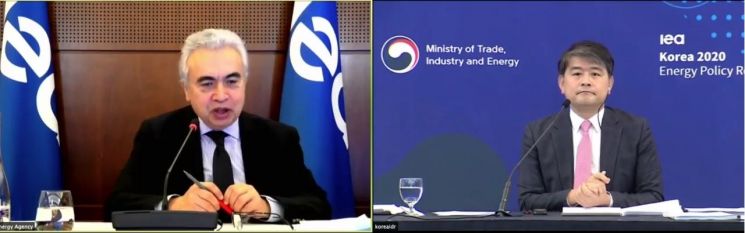 At the 'Korea Energy Policy National Report Publication Event' held by the International Energy Agency (IEA) on the 26th, Fatih Birol, IEA Executive Director (left), and Ju Young-jun, Director General of the Energy Resources Department at the Ministry of Trade, Industry and Energy, are seen exchanging questions and answers. (Image source: Screenshot from IEA event YouTube live stream)
[Asia Economy Reporter Moon Chaeseok] "Globally, nuclear power holds a significant share in the energy mix and has advantages in implementing carbon-neutral technologies by utilizing nuclear energy. However, nuclear power is not the only 'carbon-neutral technology.' Renewable energy, green hydrogen, and others are equally necessary."
On the 26th, Fatih Birol, Executive Director of the International Energy Agency (IEA), stated this at the launch event of the 'Korea Energy Policy Country Report.' Executive Director Birol exchanged conversations via video with Joo Young-joon, Director General of the Energy Resources Office at the Ministry of Trade, Industry and Energy.
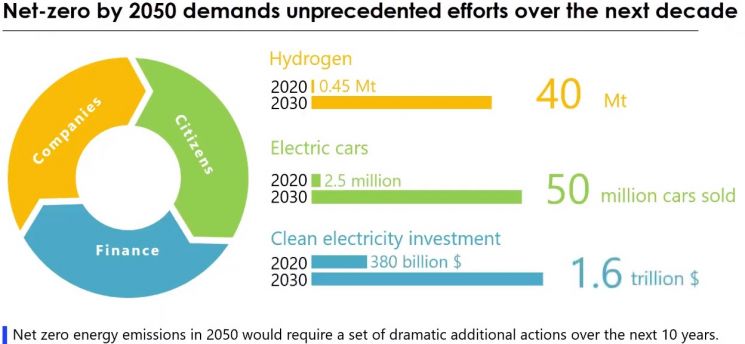 The International Energy Agency (IEA) estimated that to achieve carbon neutrality by 2050, over the next decade, ▲companies need to increase hydrogen usage from 0.45 Mt to 40 Mt, ▲citizens need to expand electric vehicle purchases from 2.5 million to 50 million units, and ▲investment in clean energy must grow from $380 billion to $1.6 trillion. (Source: International Energy Agency)
Executive Director Birol responded this way to the question, "The Korean government has maintained a nuclear phase-out policy while simultaneously declaring 'carbon neutrality by 2050.' Isn't the nuclear phase-out policy an obstacle to securing Korea's energy security and achieving carbon neutrality?"
He explained, "All countries, including Korea, must make their own choices for carbon neutrality and energy security, and there is no single recipe. However, it is true that nuclear power holds a high share in the global energy mix and has advantages in realizing carbon neutrality."
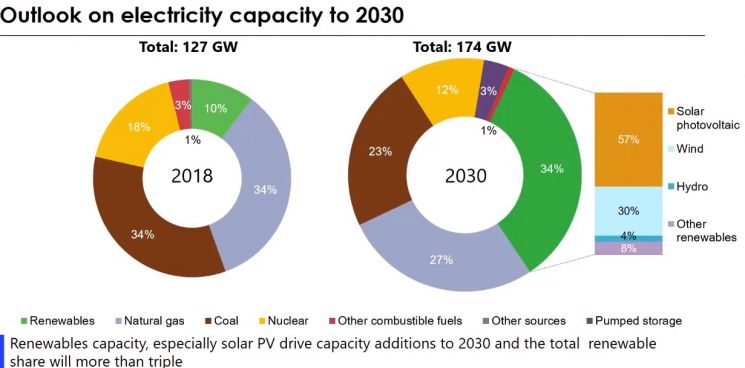 Data from the International Energy Agency (IEA) forecasting South Korea's energy supply and demand and the implementation plan for Renewable Energy 3020. Coal, which accounts for 34% this year, is expected to decrease to 23%, nuclear power from 18% to 12%, and renewable energy is projected to increase from 10% to 34%. Among renewable energy sources, 57% is expected to be solar power, 30% wind power, and 4% hydrogen. (Data=International Energy Agency)
Regarding the effectiveness of the 'Renewable Energy 3020' policy, which aims to expand the share of renewable energy generation to 20% of the total national energy by 2030, he answered, "Currently, Korea's renewable energy ratio is 4%, which is lower than the average of IEA member countries and the world, but two positive signals are visible."
He cited the growth rate of offshore wind power and renewable energy permit projects as the 'two positive signals.'
Executive Director Birol said, "The costs related to offshore wind power will significantly decrease, but this will not happen automatically, so we will support the Korean government's promotion of renewable energy." He added, "The Korean government is communicating well with local communities and supporting research and development (R&D) related to renewable energy projects, which is the path to reach from 4% to 20% by 2030."
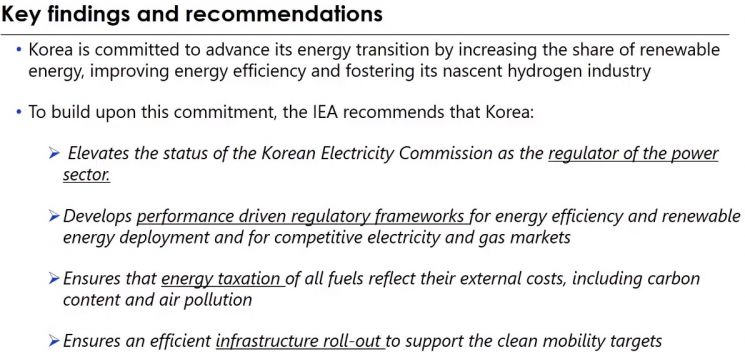 Four recommendations conveyed by the International Energy Agency (IEA) to the Korean government on the 26th. These include elevating the Electricity Commission to a regulatory authority and reflecting external costs such as carbon content in energy taxation for all fuels. (Source: International Energy Agency)
Director General Joo said, "'Renewable Energy 3020' is an achievable goal," and explained, "It is true that Korea's renewable energy share is low, but energy capacity has increased over the past three years, and the scale was larger than expected."
He continued, "The Korean government will continue to reflect IEA's recommendations because they are very similar to the government's policies, including promoting R&D for wind and solar (photovoltaic) energy," and added, "Various policies are being used to increase local acceptance in carrying out larger-scale offshore wind projects."
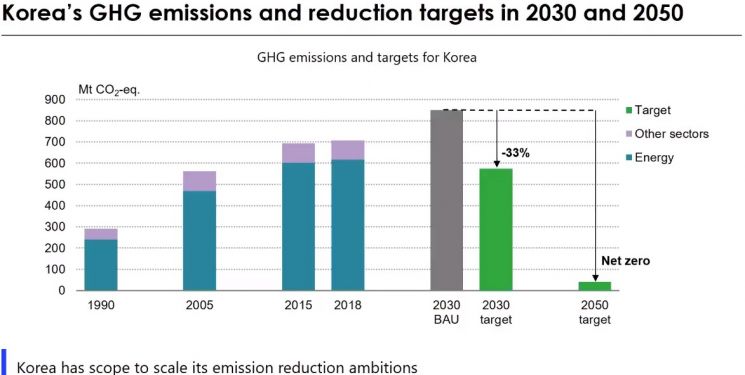 A graph showing South Korea's 2030 Nationally Determined Contribution (NDC) for greenhouse gas reduction and the required reduction amount up to the 2050 Long-term Low Carbon Development Strategy (LEDS). Even if annual greenhouse gas emissions are reduced to 536 million tons by 2030, it is clear at a glance that there is still a long way to go to reach 'zero' by 2050. (Source: International Energy Agency)
The IEA recommended to the government ▲ upgrading the Electricity Commission to a regulatory authority to strengthen tariff setting and market oversight ▲ developing a performance-driven regulatory system for electricity and gas markets, as well as promoting energy efficiency and renewable energy dissemination ▲ reflecting carbon content and external costs such as air pollution in energy taxation for all fuels ▲ building infrastructure for clean mobility.
In response to a foreign journalist's question, "As the third-largest LNG user, how does Korea plan to utilize LNG by 2030 or beyond to realize the 'Renewable Energy 3020' policy?" Executive Director Birol forecasted, "Coal is currently the most polluting fuel. At least in the short and medium term, LNG will have to be used partially as a substitute for coal."
© The Asia Business Daily(www.asiae.co.kr). All rights reserved.



















