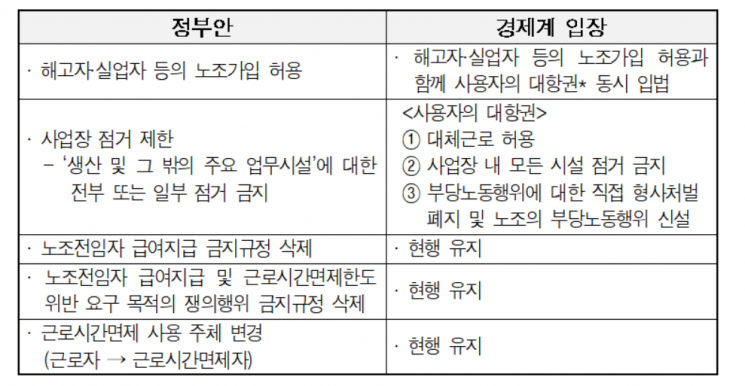
[Asia Economy Reporter Kiho Sung] On the 26th, a total of 32 economic organizations (hereinafter referred to as economic organizations), including the Korea Employers Federation (KEF) and six other comprehensive economic organizations, as well as industry-specific associations and groups, jointly submitted their position on the "Partial Amendment to the Labor Union and Labor Relations Adjustment Act" to the National Assembly.
In their statement on the same day, they emphasized, "The business community agrees with the purpose of ratifying the International Labour Organization (ILO) core conventions; however, if the government’s legislative bill, which aims to guarantee the right of association for dismissed workers and the unemployed under the pretext of ratifying the ILO core conventions, passes the National Assembly as is, it will intensify the power imbalance toward labor unions, increase the burden of labor-management relations on companies, and inevitably worsen the domestic business environment significantly."
They continued, "The government’s legislative bill was prepared with a bias toward labor unions without considering the realities of Korea’s conflictual and confrontational labor movement and the unique labor-management relations tilted toward unions, so it must be thoroughly reconsidered. Furthermore, unlike Europe, which has ratified all ILO core conventions, Korea has a ‘company-based union system,’ and if the bill allows dismissed workers and the unemployed to join company-based unions, the power imbalance toward unions will deepen, raising concerns about greater negative impacts on labor-management relations in workplaces and corporate competitiveness."
Regarding the allowance of dismissed workers and the unemployed to join company-based unions, the economic organizations stated, "This will lead to an increase in union demands beyond improving the working conditions of employees who are the original subjects of collective bargaining, such as reinstatement of dismissed workers and measures for the unemployed, making labor-management relations even more difficult for companies to handle. Additionally, the possibility of increased complaints and accusations related to unfair labor practices by unions, which are already problematic, habitual strikes, and damages caused by workplace occupations will rise. This will also lead to the expansion of militant union members by strong unions, resulting in more confrontational labor-management relations."
They added, "Therefore, if guaranteeing the right of association for dismissed workers and the unemployed is necessary for ratifying the ILO core conventions, legislative improvements that strengthen the employer’s countermeasures?such as allowing replacement workers in line with global standards, prohibiting workplace occupations during strikes, deleting direct criminal penalties for unfair labor practices, and establishing unfair labor practices by unions?must be legislated simultaneously to secure a balance of power between labor and management."
Regarding the issue of deleting the prohibition on paying salaries to full-time union officials, they argued, "This matter is unrelated to the ILO conventions, and rather, the government’s legislative bill will result in a violation of Article 2 of ILO Core Convention No. 98 concerning union autonomy. Globally, full-time union officials’ salaries are borne by the unions themselves, and major competing and advanced countries only grant the minimum necessary working hour exemptions. However, the scale of paid full-time union officials (working hour exemptions) in Korea is excessively large to an unprecedented degree worldwide."
The economic organizations stated, "The government explains the urgency of ratifying the ILO core conventions citing the Korea-EU FTA provisions, but the ILO core convention ratification-related matters in the Korea-EU FTA are efforts clauses with a recommendatory nature, not punitive. While the business community acknowledges the need to comply with the Korea-EU FTA and efforts to ratify the ILO core conventions, these are national-level significant matters requiring national consent and should be decided and pursued sovereignly from the perspective of Korea’s labor reform and advancement of labor-management relations."
© The Asia Business Daily(www.asiae.co.kr). All rights reserved.

















