'Difficulties in "Amend Radio Waves Act First, Reassign Frequencies Later"
Frequency Reassignment in 2021 Expected to Be Difficult
Likely to Proceed Without Amending Radio Waves Act
Must Ensure Operator Predictability and Formula Consistency'
[Asia Economy Reporter Koo Chae-eun] As the announcement date for frequency reassignment approaches, it seems difficult to implement 'first amend the Radio Waves Act, then apply the 2021 reassignment fees.'
Initially, the industry criticized the frequency reassignment criteria as 'opaque' and 'stretchable,' demanding a revision of the Radio Waves Act to establish clear standards. However, the government is pushing forward with the 2021 frequency reassignment, postponing the law amendment by citing scheduling reasons.
"Applying the Radio Waves Act to the 2021 Frequency Reassignment is Difficult"
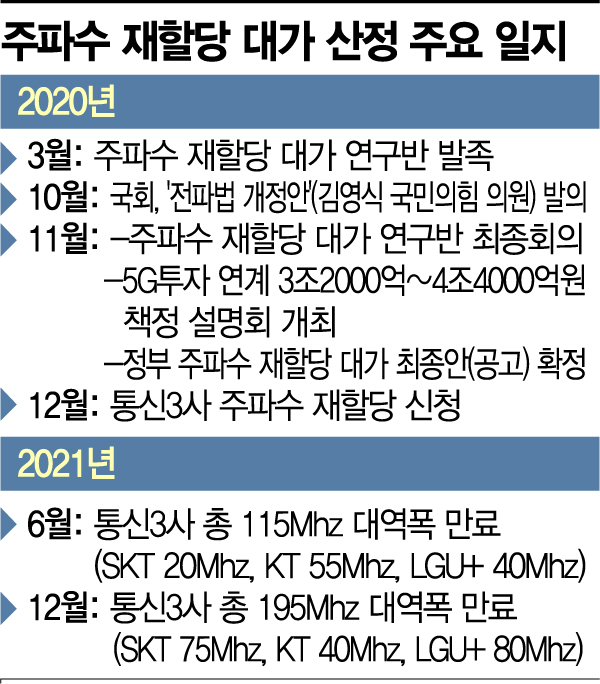
According to the telecommunications industry on the 26th, the Ministry of Science and ICT internally judged that it is appropriate to proceed with the 2021 frequency reassignment separately from the Radio Waves Act amendment bill. The government agrees with the rationale and purpose of the amendment but considers the timeline tight and anticipates fairness issues among operators. Therefore, it has conveyed to the National Assembly and the industry that the Radio Waves Act amendment should be implemented after the 2021 frequency reassignment fees. The Radio Waves Act amendment bill currently pending in the National Assembly (proposed by Kim Young-sik of the People Power Party) aims to legislate the reassignment fee standards stipulated in the frequency enforcement ordinance and to specify the method for calculating the reassignment fees.
The government insists on fees ranging from 3.2 trillion to 4.4 trillion KRW, which is significantly higher than the industry's proposed fees of 1.6 trillion KRW. An industry official explained, "In June, the main LTE bands of KT and LG Uplus expire, and in December, SK Telecom's LTE band ends, so the schedule is tight." In fact, the total 115 MHz bandwidth expiring in June next year (excluding SK Telecom's 2G 10 MHz) includes KT's 55 MHz, LG Uplus's 40 MHz, and SK Telecom's 20 MHz. The frequencies expiring in December are allocated as SK Telecom 75 MHz, KT 40 MHz, and LG Uplus 80 MHz bandwidths.
There is also considerable criticism that the government is conducting overly convenience-driven administration. While agreeing with the purpose and rationale of the Radio Waves Act amendment, it is said to be carrying out a slapdash administration with an attitude of "let's let it slide this time." A National Assembly official pointed out, "If there is an issue of operator discrimination, flexibility can be exercised by delaying the announcement date by a month to align with the passage of the Radio Waves Act," adding, "In a situation where it is urgent to amend the law to establish clear standards and frameworks for frequency reassignment, it seems the government is not responding promptly."
Industry: "Passing the Radio Waves Act Comes First"
The Radio Waves Act amendment bill is an issue on which the government, National Assembly, and industry all agree. Currently, the formula for calculating frequency reassignment fees lacks specific delegation provisions and only vaguely states that "past auction fees may be considered," leading to criticism that the government's discretionary power is excessively high. Because fees have been calculated through research teams each time, there have been continuous complaints about "stretchable frequency values." Minister Choi Ki-young of the Ministry of Science and ICT also responded at the October National Assembly audit, saying, "We will flexibly include regulations related to frequency reassignment fees in the law and find a predictable method."
Experts also agree that amending the Radio Waves Act and transparently setting frequency reassignment fees is desirable. Ahn Jeong-sang, senior expert at the Democratic Party, prefacing his opinion, said, "The current reassignment fee calculation method lacks specific regulations on reflecting past auction fees or the reflection ratio, causing great confusion and legal risks," adding, "If this continues, operators will find it difficult to predict reassignment fee levels and plan investments, and if administrative lawsuits arise, social conflicts will intensify." Professor Kim Yong-hee of Soongsil University stated, "If the Radio Waves Act amendment passes and standards for the formula are established, operators can escape uncertainty and controversies can be resolved."
© The Asia Business Daily(www.asiae.co.kr). All rights reserved.
![Clutching a Stolen Dior Bag, Saying "I Hate Being Poor but Real"... The Grotesque Con of a "Human Knockoff" [Slate]](https://cwcontent.asiae.co.kr/asiaresize/183/2026021902243444107_1771435474.jpg)
















