Government to Provide Up to 4 Million KRW per Company... Final Applications from 101,146 Companies
 As the demand for remote work among small and medium-sized enterprises has surged, it has been revealed that 100,000 companies applied for the 'Non-face-to-face Service Voucher Project.' Graphic = Asia Economy DB
[Asia Economy Reporter Kim Heeyoon] It has been confirmed that the demand for remote and telecommuting work among small and venture businesses has increased due to the prolonged COVID-19 pandemic.
The Ministry of SMEs and Startups announced on the 26th the progress of the 'Non-face-to-face Service Voucher' project and measures to prevent fraudulent and inappropriate services.
The 'Non-face-to-face Service Voucher Support Project' is a program that supports small and venture companies with vouchers worth up to 4 million KRW per company (including a 10% self-payment) to easily use non-face-to-face services such as video conferencing and telecommuting that they need.
Considering that the number of companies that can be supported with this year's project budget (288 billion KRW) is 80,000, the Ministry of SMEs and Startups announced that the application and registration were closed early by the 23rd, resulting in a final total of 101,146 companies applying.
Compared to the daily average of 1,161 applications in the first week of October, the daily average applications as of the closing date on the 23rd increased about fivefold to 5,265. This is interpreted as a rapid surge in demand for non-face-to-face services among small businesses due to the prolonged COVID-19 pandemic.
Among the applying companies, startups with less than 7 years of business accounted for 55,498 (54.9%), which was relatively higher than the 45,585 companies (45.1%) with more than 7 years, indicating that startups have a higher demand for new services or systems.
By industry, the proportion of manufacturing companies among applicants was 30.7%, which is relatively high compared to the average manufacturing proportion of small businesses at 8.6%, showing a relatively high demand for non-face-to-face services in manufacturing. This was followed by wholesale and retail trade (36.0%), accommodation and food services (7.6%), and education services (7.0%).
By region, companies located in the metropolitan area accounted for 61,240 (60.5%), exceeding the small business average of 51.0%.
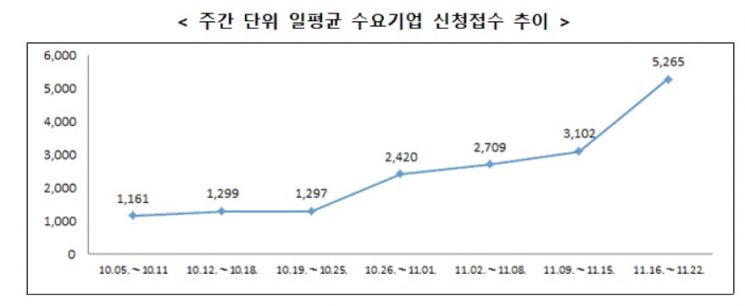 Weekly average daily demand for non-face-to-face service vouchers by applying companies. Table = Provided by the Ministry of SMEs and Startups
The sales concentration of mid-sized companies is 20.8%, indicating no significant concentration... Telecommuting accounts for the largest share at 80.3%
The top 10 suppliers by voucher sales accounted for 60.1% of total sales, and small businesses accounted for 79.2%. Suppliers with at least one sales record numbered 270 companies (12 mid-sized companies, 258 small businesses), representing 73.4% of the total 368 suppliers.
The sales proportion of mid-sized companies was 20.8%. Excluding the mid-sized company with the highest sales, the sales proportion of the remaining mid-sized companies was only about 1.7% of total sales, confirming that the initially feared concentration toward mid-sized companies is not significant.
By sector, telecommuting accounted for the largest share at 80.3%, indicating the highest demand among small businesses, followed by edutech at 8.7%, video conferencing at 5.7%, and network and security solutions at 5.0%.
The most frequently purchased service products by demand companies from 1st to 10th place were all in the telecommuting field, such as electronic approval, messenger, accounting and HR management, and schedule management, reflecting a sharp increase in interest in telecommuting due to the prolonged COVID-19 pandemic.
Some suspected cases of fraudulent activities such as collusion between demand companies and suppliers, and unfair business practices due to overheated competition among suppliers have been reported. As of the 23rd, a total of 48 suspected cases of fraudulent activities have been reported and received through the platform's fraud report center, email, phone, and the People's Petition system.
Suspected fraudulent cases are classified as ▲ proxy applications by intermediaries or sellers ▲ payment of sales commissions or paybacks ▲ 'bundling' by providing expensive goods when purchasing services ▲ selling at prices higher than market prices or inducing high-priced payments.
On the 5th, the Ministry of SMEs and Startups sent a notice to suppliers prohibiting unfair business practices such as paying part of the sales amount as sales commissions (rebates) or returning gift certificates or cash to demand companies on the condition of purchasing service products (paybacks). In addition, the project management guidelines specify sanctions such as cancellation of supplier selection (agreement), suspension of sales, full or partial refund for unfair business practices by suppliers.
Furthermore, products unsuitable as support targets for the Non-face-to-face Service Voucher project are being deregistered and sanctions against the corresponding suppliers are being pursued.
The Ministry of SMEs and Startups and the Korea Institute of Startup & Entrepreneurship Development classified 80 products suspected to be inappropriate services through a full survey and passed the criteria for judging inappropriate services through the project operation committee, and are currently reviewing the appropriateness of those services.
The Ministry of SMEs and Startups has been operating a joint public-private task force to prevent fraudulent activities in the Non-face-to-face Service Voucher project since the 23rd. They plan to have suppliers voluntarily correct inappropriate services identified through appropriate price analysis by market research agencies and a national monitoring group, and if corrections are not made or recurrences occur, measures such as banning service re-registration will be taken. Additionally, measures to prevent monopolization of service supply by a few companies will be prepared within the year, and through platform advancement, real-time analysis of demand companies' service utilization and surveys on utilization status will also be promoted.
Park Yongsun, Director of Venture Innovation Policy at the Ministry of SMEs and Startups, said, "The Non-face-to-face Service Voucher project is a program to support small businesses in building non-face-to-face work environments and to foster suppliers in response to the spread and continuation of COVID-19." He added, "To prevent the project's purpose from being undermined by fraudulent activities of some companies, we will strengthen the project management system and conduct thorough on-site inspections. Fraudulent activities will be strictly dealt with by canceling selected companies, recovering subsidies, and criminal prosecution upon detection."
© The Asia Business Daily(www.asiae.co.kr). All rights reserved.


















