Deliberated and Confirmed at the National Affairs Review and Coordination Meeting on the 26th
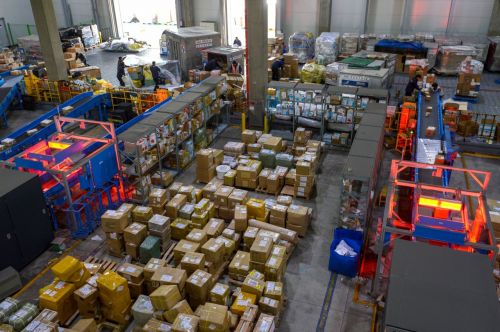 Overseas direct purchase items bought by domestic consumers during the Black Friday period are piled up at the Incheon Customs Express Logistics Center in Jung-gu, Incheon. / Yeongjongdo - Photo by Jinhyung Kang aymsdream@
[Asia Economy Reporter Moon Chaeseok] The government has decided to establish a legal basis to block overseas direct purchase (ODP) product sales sites. It will revamp the food information provision system and strengthen customs inspections to prevent the inflow of hazardous products.
On the 26th, the government held a National Policy Issue Inspection and Coordination Meeting chaired by Prime Minister Chung Sye-kyun at the Sejong Government Complex and announced that it had reviewed and finalized the "Improvement Plan for Overseas Direct Purchase Product Distribution and Safety Management System."
The improvement plan was prepared under the supervision of the Office for Government Policy Coordination, with related ministries including the Ministry of Food and Drug Safety, Korea Customs Service, Fair Trade Commission, and Ministry of Trade, Industry and Energy.
According to the Ministry of Food and Drug Safety, as of last year, 9.6% (125 out of 1,300) of products related to sexual function enhancement, muscle strengthening, and diet posted on overseas direct purchase sites were found to contain pharmaceutical ingredients that are not allowed in food.
Accordingly, the government has prepared measures across four stages: ▲ information collection and purchase ▲ customs declaration and inspection ▲ post-customs distribution management ▲ consumer damage relief.
First, at the information collection and purchase stage, the food information provision system will be revamped. A mobile application integrating hazardous and recall information will be developed. The system will be redesigned so that food information can be checked on purchase sites.
For food and industrial products, a legal basis will be established to block hazardous product sales sites. The Import Food Safety Control Act and the Framework Act on Product Safety will be amended to provide grounds for blocking.
Overseas businesses selling food on Korean platforms will be required to pre-report business information such as name, contact details, and location. The Import Food Safety Control Act will be revised to prohibit businesses that sell hazardous food from registering on platforms for a certain period.
At the customs declaration and inspection stage, measures include ▲ mandatory submission of internet addresses for express shipments ▲ mandatory prior electronic information provision for direct purchase items among postal parcels ▲ preparation of import declaration forms dedicated to e-commerce.
To prevent abuse of the customs duty exemption system, the government is considering setting cumulative exemption limits per individual. This is to stop cases where hundreds of purchases per year have been made through tax evasion.
At the post-customs distribution management stage, measures include ▲ expanding purchase inspections of overseas direct purchase products (more than double the 2019 level next year) ▲ joint monitoring of hazardous product distribution.
In particular, to prevent the sale of overseas recalled hazardous products, the government will block the redistribution of such products through the "Overseas Hazardous Products Council," which involves related agencies.
The council includes the Fair Trade Commission, Korea Consumer Agency, Ministry of Trade, Industry and Energy, Ministry of Environment, Ministry of Food and Drug Safety, and Korea Customs Service.
Additionally, a dedicated e-commerce customs clearance department (Korea Customs Service) and an Overseas Direct Purchase Food Safety Management Center (under the Ministry of Food and Drug Safety) will be established to prevent overseas direct purchase damages and strengthen safety management.
At the consumer damage relief stage, compliance requirements for food purchasing agencies will be strengthened to eradicate the purchase agency of hazardous food labeled with prohibited ingredients.
The Import Food Safety Control Act and its enforcement rules will be amended to impose administrative sanctions such as business suspension on violating companies.
The Korea Consumer Agency will expand Memorandums of Understanding (MOUs) with foreign countries to respond to consumer damages and international disputes. Currently, MOUs have been signed with 12 countries.
An official from the Office for Government Policy Coordination said, "We will actively encourage the implementation of the improvement plan finalized today within next year," and added, "We plan to review the detailed progress of each ministry's implementation of the improvement plan semiannually."
© The Asia Business Daily(www.asiae.co.kr). All rights reserved.
















