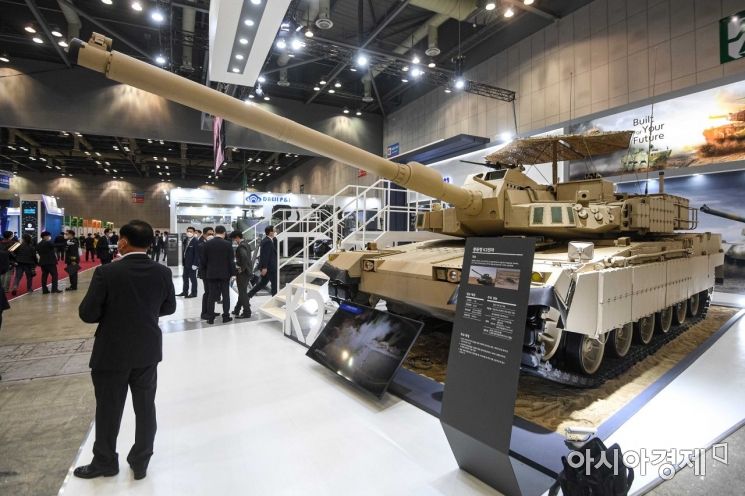
 The Middle Eastern version of the K-2 tank is on display at the "Korea Defense Industry Exhibition" held on the 18th at Kintex in Goyang, Gyeonggi Province. Photo by Jinhyung Kang, Goyang aymsdream@
[Asia Economy Yang Nak-gyu, Military Specialist Reporter] The military has decided to continue using the German-made transmission for the K2 'Black Panther' tank instead of installing a domestically produced transmission, which has been a subject of ongoing controversy. The 'powerpack,' the heart of the K2 tank, consists of an engine and a transmission; the engine has been domestically produced while the transmission has been imported from Germany. Although efforts to localize the transmission were made, performance issues persisted, leading to the decision to equip the existing 'mixed powerpack.'
On the 25th, the Defense Acquisition Program Administration Committee (DAPAC), chaired by Defense Minister Seo Wook, reviewed the third phase of K2 tank mass production plans and resolved to procure about 50 additional K2 tanks from this year through 2023, confirming this decision.
The military had planned to fully localize the K2 tank and invested 96.4 billion won (48.8 billion won for the engine and 47.6 billion won for the transmission) starting in 2005 to develop a purely domestic powerpack. If successful, it was expected that Korea would become the third country in the world, after Germany and the United States, to develop 1,500-horsepower powerpack technology. The domestically developed powerpack was also scheduled to be applied from the second phase of K2 tank mass production.
However, during the initial inspection of the domestically produced powerpack, while the engine met defense standards, problems arose with the transmission. Consequently, the second phase of mass production used a mixed powerpack (domestic engine + foreign transmission) instead of the fully domestic powerpack. During the second phase, performance issues with the domestic transmission caused a delay of about 3 years and 5 months in mass production. The original completion deadline for the domestic powerpack set by military authorities was 2012. However, durability problems with the domestic transmission, such as parts breaking during operation, continued to surface. Related defense contractors protested that the military applied excessively strict standards and even filed a lawsuit against the Defense Acquisition Program Administration in court.
As a result, the domestic defense industry is expected to face repercussions. The Defense Acquisition Program Administration plans to claim approximately 110 billion won in delay compensation from Hyundai Rotem, which assembles and delivers the K2 tanks. Hyundai Rotem is reportedly pursuing a subrogation lawsuit against S&T Dynamics, the supplier of the transmission. It is also reported that S&T Dynamics did not participate in transmission testing for the third phase of the project.
A defense industry official said, "Due to issues with the domestic transmission, the mass production of the K2 tank was delayed by about six years, and the manufacturer has suffered significant economic losses beyond the delay penalties."
The K2 tank is a world-class tank developed independently by the Agency for Defense Development using domestic technology. It possesses performance equal to or exceeding that of advanced main battle tanks such as the U.S. M1A2 SEP, France's Leclerc, and Germany's Leopard A6EX.
The K2 tank features driving capabilities of 50 km/h across rough terrain, the ability to cross rivers up to 4.1 meters deep while submerged, suspension systems that ensure safety and control of the vehicle during movement, and more. Notably, it is equipped with advanced systems such as an automatic loading device that quickly reloads shells during movement, automatic target detection and tracking systems, an electric turret drive system, and tactical information processing devices, which have enhanced the performance of domestic tanks.
© The Asia Business Daily(www.asiae.co.kr). All rights reserved.

















