Revision of the Provincial Road Act Fails to Pass Subcommittee the Day Before
Public Reconstruction Bill Not Even Discussed in the National Assembly
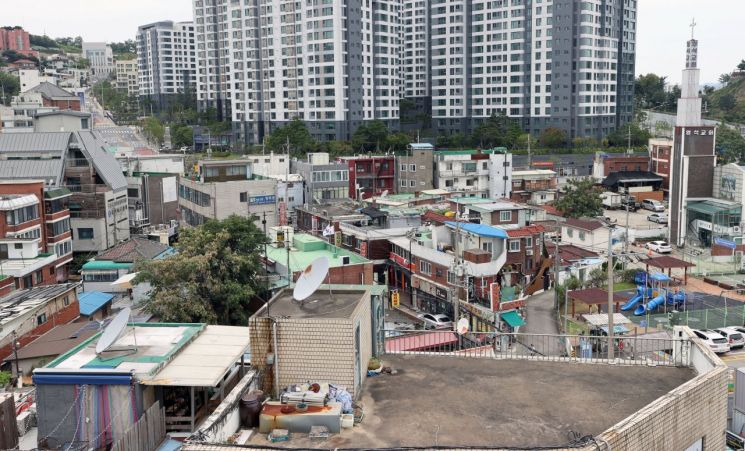
[Asia Economy Reporter Moon Jiwon] The government's 'public redevelopment' project, launched to increase housing supply in the Seoul metropolitan area, is struggling to gain momentum due to delays in the passage of related legislation in the National Assembly.
According to the National Assembly and the Ministry of Land, Infrastructure and Transport on the 25th, the amendment to the 'Urban and Residential Environment Improvement Act,' proposed by Representative Chun Junho of the Democratic Party of Korea, was not processed at the National Assembly Land, Infrastructure and Transport Committee's bill review subcommittee yesterday and was moved to the continued review agenda.
Considering the National Assembly schedule, it is unlikely that this bill will pass within this year. The government and Seoul City have already held a public redevelopment pilot project contest, receiving applications from 60 sites and are currently reviewing them, but the bill has not passed the National Assembly, making rapid project implementation difficult.
The bill is effectively a joint legislative effort between the ruling party and the government, containing the framework for the public redevelopment project presented in the government's 5th and 6th housing supply measures. Therefore, the Ministry of Land, Infrastructure and Transport, the main ministry in charge, is somewhat taken aback.
Public redevelopment is a redevelopment project method that receives a floor area ratio 20% higher than the legal standard, simplified permits and approvals, exemption from the sale price ceiling system, loans for project costs, and various other supports, in exchange for donating 20-50% of the increased floor area ratio.
During the National Assembly bill review process, significant disagreements were reportedly raised. For example, in the case of public redevelopment projects, more than 50% of the housing, excluding the units allocated to association members, must be supplied as public rental or equity-type housing. However, a National Assembly expert committee member expressed the opinion that "equity-type housing is a system designed to prevent homeowners with insufficient funds from being forced out, so it should be supplied to association members."
Additionally, there was criticism that since redevelopment projects originally have mandatory regulations to build a certain percentage of rental housing, and public redevelopment projects add an additional public rental construction ratio separately, this could cause unnecessary confusion on site. There were also opinions that the provision to set higher sale prices for association members who join after the public redevelopment project has started constitutes excessive infringement on property rights.
Furthermore, another amendment to the Urban and Residential Environment Improvement Act, proposed by Representative Chun to introduce public reconstruction, was not even discussed in the National Assembly. The amendment proposed by Representative Cho Eungcheon of the same party also failed to pass the subcommittee yesterday and was deferred to the continued review agenda. Cho's bill is one of the key points of the 6.17 measures, requiring reconstruction association members to reside for more than two years to be eligible to purchase housing.
© The Asia Business Daily(www.asiae.co.kr). All rights reserved.

















