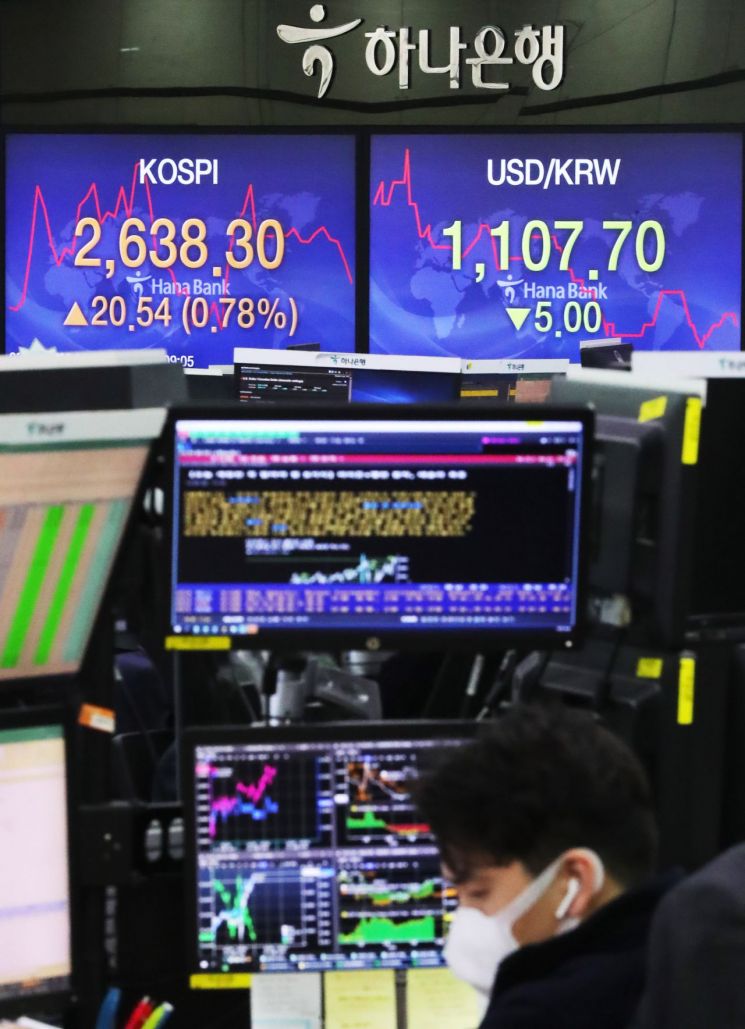
[Asia Economy Reporter Eunmo Koo] The KOSPI continued its record-breaking streak, rising for the sixth consecutive trading day, driven by simultaneous net buying from individual and foreign investors in the early session. The KOSDAQ index also showed a slight upward trend.
On the 25th, the KOSPI opened at 2,637.34, up 19.58 points (0.75%) from the previous trading day. The KOSPI, which started higher, maintained its positive momentum in the early session due to net buying by individual and foreign investors. As of 9:25 a.m., it was trading at 2,631.46, up 13.70 points (0.52%) from the previous day.
Overnight, major indices on the New York Stock Exchange rose sharply amid reduced uncertainty over the U.S. presidential transition and optimism about COVID-19 vaccines. The Dow Jones Industrial Average surpassed the 30,000 mark for the first time in history. On the 24th (local time) at the NYSE, the Dow closed at 30,046.24, up 454.97 points (1.54%) from the previous day.
The Standard & Poor's (S&P) 500 index closed at 3,635.41, up 57.82 points (1.62%), and the tech-heavy Nasdaq index ended at 12,036.79, up 156.15 points (1.31%). During the session, the Dow reached as high as 30,116.51, opening the 30,000 era. This marked a dramatic rebound from the low of around 18,200 at the end of March. The S&P 500 also set a new all-time closing high that day.
Seosangyoung, a researcher at Kiwoom Securities, said, “The Korean stock market has been hitting record highs daily, led by foreign investors since early this month. It is estimated that large-scale net buying focused on semiconductor and secondary battery sectors by active fund money has driven this trend.” He added, “Foreign investors who had withdrawn large amounts of capital from emerging markets during the first and second quarters amid the COVID-19 spread are now returning to emerging markets due to a weaker dollar, expectations of strengthened free trade following Biden’s election, and eased COVID-19 concerns thanks to vaccine development. This is expected to positively impact foreign investor demand in the Korean stock market.”
He continued, “The foreign capital inflow this time has mainly targeted the Korean and Indian stock markets, likely focusing on semiconductor and secondary battery sectors. Therefore, the behavior of foreign investors has become even more important, and whether their active net buying continues will influence changes in the Korean stock market today.”
Looking at the current trading trends by participant, individual and foreign investors are net buyers of 100.8 billion KRW and 74.6 billion KRW respectively, driving the index higher. In contrast, institutional investors are net sellers of 180.1 billion KRW.
By sector, most industries including securities, banking, chemicals, pharmaceuticals, and construction are rising.
Among the top market capitalization stocks, Celltrion, LG Chem, Hyundai Mobis, SK Hynix, and LG Household & Health Care are rising, while Samsung SDI and Kakao are declining.
The KOSDAQ index reversed its previous day’s decline and turned upward again. It opened at 877.35, up 5.25 points (0.60%) from the previous day, and is slightly rising in the early session due to net buying by individual investors. As of 9:25 a.m., it was at 875.11, up 3.01 points (0.35%) from the previous day.
Regarding current supply and demand, individual investors are net buyers of 115.2 billion KRW, while institutional and foreign investors are net sellers of 64.6 billion KRW and 36.9 billion KRW respectively.
By sector, telecommunications services, finance, and distribution are rising, while transportation and digital content sectors are falling.
Among the top market capitalization stocks, Celltrion Pharm, Celltrion Healthcare, SK Materials, Alteogen, and EcoPro BM are rising, whereas Hugel and Seegene are declining.
© The Asia Business Daily(www.asiae.co.kr). All rights reserved.

















