Hankyung Research Institute, Business Survey Index (BSI) Investigation
[Asia Economy Reporter Dongwoo Lee] Concerns over the third wave of the novel coronavirus infection (COVID-19) have caused the recovery of corporate sentiment to stall. In particular, the average annual economic outlook for this year recorded the lowest level in 22 years since the International Monetary Fund (IMF) foreign exchange crisis.
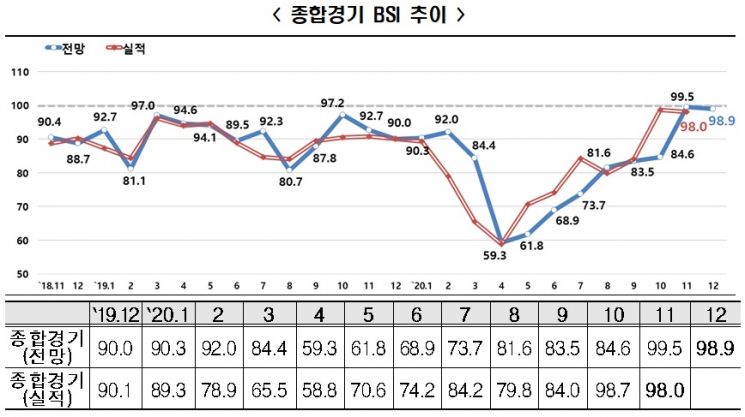
The Korea Economic Research Institute announced on the 25th that the Business Survey Index (BSI) for 600 major companies based on sales recorded a December outlook of 98.9. This is a 0.6-point drop compared to last month (99.5), reflecting concerns over the third wave of COVID-19, showing a stagnant trend. The November actual figure (98.0) also decreased by 0.7 points compared to the previous month, indicating a prevailing negative outlook.
The BSI represents the business sentiment felt by companies, with 100 as the baseline. A figure below 100 means that more companies expect the economy to worsen than improve, while a figure above 100 means more companies expect economic improvement.
By sector for the December outlook, all areas recorded below the baseline: domestic demand (98.9), exports (96.1), investment (94.7), funds (99.2), inventory (100.6), employment (93.3), and profitability (95.5). In the inventory sector, a figure above 100 indicates negative responses due to excess inventory.
By industry, non-manufacturing (103.2) showed a positive outlook centered on electricity and gas and construction industries, as heating demand increased seasonally and year-end business orders rose. However, manufacturing business sentiment (95.5) slightly decreased by 3.6 points from the previous month, continuing a negative outlook.
Companies pointed to the main causes of the negative outlook as concerns over the third wave of COVID-19 resurgence, the decline in exchange rates, and worsening profitability due to rising raw material prices. In fact, the won-dollar exchange rate has been steadily declining since May, and prices of key raw materials such as copper and nickel have shown a sharp rise, surpassing pre-COVID-19 levels.
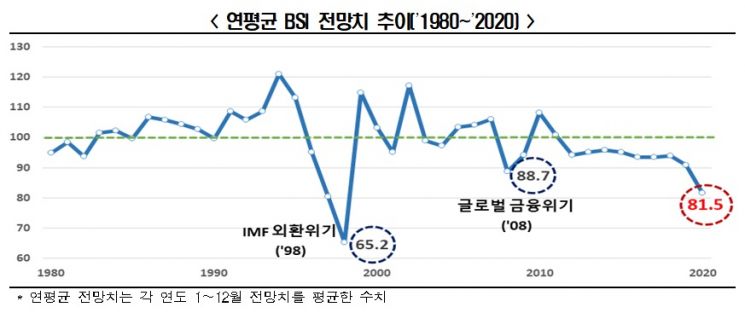
The average annual outlook for this year (81.5) also decreased by nearly 10 points (-9.3 points) compared to the previous year due to the impact of the COVID-19 economic crisis, marking the lowest level in 22 years since 1998 (65.2) during the IMF foreign exchange crisis. The average annual outlook has shown a declining trend for nine years since falling below the 100 mark in 2012, reflecting deepening negative economic perceptions.
The November actual figure was 98.0, slightly down from the previous month, remaining below the baseline for 67 consecutive months. By sector, all areas recorded below the baseline: domestic demand (98.3), exports (93.6), investment (93.0), funds (98.3), inventory (100.3), employment (90.5), and profitability (96.6).
Choo Kwang-ho, Director of Economic Policy at the Korea Economic Research Institute, stated, "Due to domestic and international uncertainties including COVID-19 continuing this year and next, negative corporate sentiment is expected to persist," adding, "Bold regulatory reforms and policy preparations that can reverse corporate sentiment are necessary to escape the chronic economic recession."
© The Asia Business Daily(www.asiae.co.kr). All rights reserved.
![Clutching a Stolen Dior Bag, Saying "I Hate Being Poor but Real"... The Grotesque Con of a "Human Knockoff" [Slate]](https://cwcontent.asiae.co.kr/asiaresize/183/2026021902243444107_1771435474.jpg)

















