Diverse Housing for Single-Person Households: Detached Houses, Apartments, Multi-Family Homes
Economic and Psychological Stability Declines in 40s
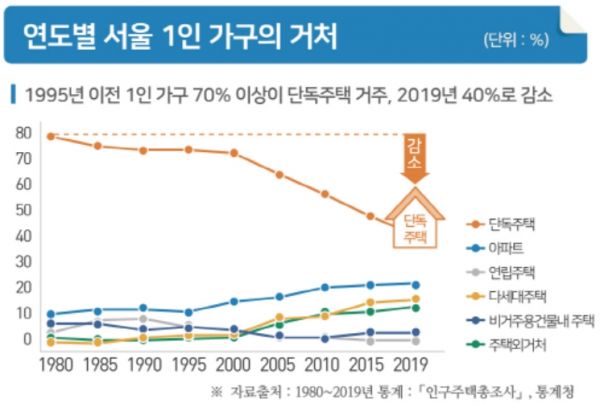
[Asia Economy Reporter Jo In-kyung] With the increase in elderly living alone due to aging and the rise of single-person households among middle-aged and older adults due to late marriage and remaining unmarried, it has been found that single-person households account for 34% of approximately 3.8 million households residing in Seoul. These single-person households identified 'housing stability support' as the most necessary policy across all age groups.
On the 25th, based on data from the Population and Housing Census by Statistics Korea, Seoul City analyzed that last year, the number of single-person households in Seoul was about 1.3 million, which is approximately 16 times higher than the 82,000 households 40 years ago in 1980. This accounts for 33.9% of the total households in Seoul.
The residences of single-person households varied, with detached houses (40.4%) followed by apartments (22.1%) and multi-family houses (17.2%). Additionally, the proportion of residences other than housing, such as officetels, lodging rooms, and goshiwon, reached 15.4%.
According to the Seoul Survey, compared to traditional multi-person household heads, single-person households felt less happy starting from their 40s. Satisfaction with personal financial status, happiness in social life, and satisfaction with one’s health status decreased from the 40s, while job satisfaction significantly declined from the 50s among single-person households.
The social relationships of single-person households decreased sharply compared to multi-person household heads from their 30s onward. The presence of 'someone to care for them when sick' was lower throughout life, and 'someone who can provide financial help' and 'someone to talk to when discouraged or depressed' were lower from the late 20s. Experiences of cultural activities, which indicate fewer relationships with others, were lower from the late 30s, and 'regular exercise' was lower from the 50s.
However, even within single-person households, individual happiness and social relationships showed differences by age, being higher in the 20s and 30s and relatively lower in the 50s and 60s.
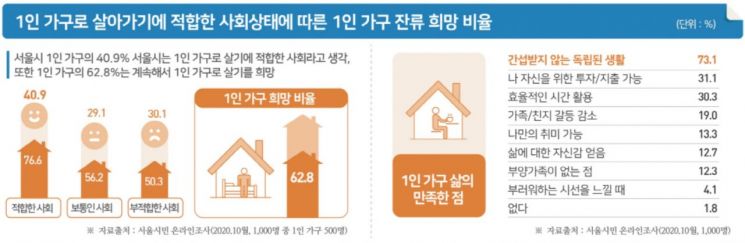
According to an online survey conducted by Seoul City from the 16th to the 21st of last month targeting 500 single-person households aged 18 to 65 residing in Seoul, 40.9% of respondents thought that 'Seoul is a society suitable for single-person households to live in.' The most satisfying aspects of being a single-person household were 'independent life without interference (73.1%)', 'ability to invest and spend on oneself (31.1%)', and 'efficient use of time (30.3%)'. Notably, 62.8% of them wished to continue living as single-person households.
On the other hand, 30.1% of single-person households responded that Seoul is 'a society unsuitable for single-person households to live in.' Additionally, 35.9% of single-person households believed there is a social prejudice that 'single-person households are deficient people who cannot adapt to society due to various problems (loners, non-marriage advocates, economically incompetent, individualists/selfish people, easy targets, etc.).'
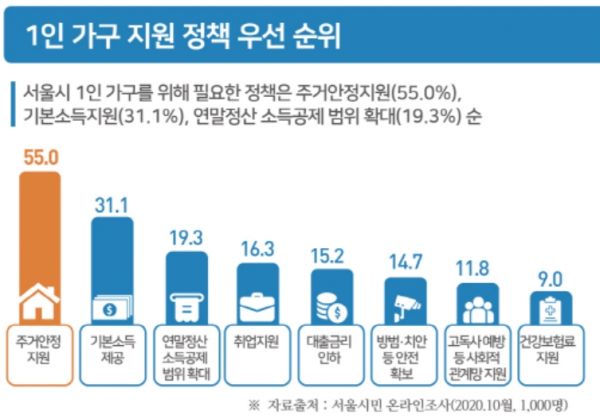
Regarding the 'Comprehensive Support Plan for Single-Person Households' first announced by Seoul City last year, half (53.4%) of single-person households were aware of it. They identified the priorities for support as housing stability support (55.0%), basic income support (31.1%), and expansion of income deduction scope for year-end tax settlement (19.3%). In particular, women and those in their 20s and 60s showed interest in 'securing safety such as crime prevention and public security,' while those aged 40 and above showed interest in 'support for social networks such as prevention of solitary death' and 'health insurance premium support.'
Lee Won-mok, Director of Smart City Policy at Seoul City, said, "Policies for single-person households are becoming more diverse according to household characteristics such as gender, age, and occupation, and we believe they align with welfare policy development across life cycles." He added, "We will continuously identify the diversifying policy demands through systematic monitoring of single-person households."
© The Asia Business Daily(www.asiae.co.kr). All rights reserved.



















