At the Local Autonomy Forum held on the 20th-21st, Eunpyeong Green MoaMoa Project Presented...Recognized as a New Model for Recycling Policy at the 2nd Local Autonomy Forum
[Asia Economy Reporter Jongil Park] To establish a resource-circulating society by improving the recycling collection system, Eunpyeong-gu's initiative ‘Eunpyeong Green Moa Moa’ attracted attention from participating local governments as a new model of recycling policy at the ‘2020 2nd Local Autonomy Decentralization Forum’.
Eunpyeong-gu (Mayor Kim Mi-kyung) participated in the ‘2020 2nd Local Autonomy Decentralization Forum’ held on the 20th and 21st, showcasing Eunpyeong Green Moa Moa, an Eunpyeong-type Green New Deal project, as an excellent policy case in the resource circulation field.
Kim Mi-kyung, Mayor of Eunpyeong-gu, personally presented at the local autonomy decentralization conference sharing excellent policy cases of local governments, introducing the background of the ‘Eunpyeong Green Moa Moa’ initiative, its project characteristics, and Eunpyeong’s vision for resource circulation.
Mayor Kim pointed out the need to transition to a green economy to respond to environmental pollution and the climate crisis threatening our lives.
She especially emphasized that ‘promoting resource circulation’ is an important area of the ‘Green New Deal’ that enables sustainable development centered on the economy, environment, and people toward carbon neutrality.
Eunpyeong-gu focused on existing recycling processing issues as part of efforts to reduce carbon emissions. In the existing method, various recyclable items were mixed together when disposed of, making sorting difficult, and contamination from food waste and other residues lowered the commercial value of recyclables, causing problems such as illegal dumping in residential areas.
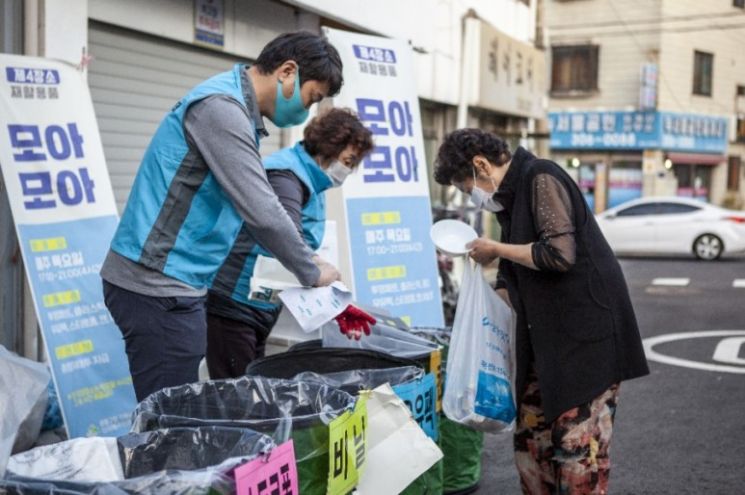
The project aiming to solve these problems at the Green New Deal level is ‘Eunpyeong Green Moa Moa.’ In Moa Moa, with residents’ consent, 10 to 20 designated collection points per village are set, where residents directly separate and dispose of eight types of recyclables, including transparent PET bottles, on predetermined days and times.
‘Bihangbunseok’ (Empty, Rinse, Separate, and Not Mixed) ensures clean disposal without mixing, increasing product value. The collected recyclables are sold immediately without separate sorting, reducing processing costs. It is also highly effective for the ‘transparent PET bottle’ separate collection policy scheduled to be implemented by the Ministry of Environment from December.
By using portable recycling bins that are easy to install and dismantle, spatial constraints for installation are overcome, and after operation, the bins are removed to prevent environmental pollution caused by illegal dumping.
The role of ‘resource managers’ is crucial for Moa Moa to function as a Green New Deal project. Two to three resource managers operate at each Moa Moa site, promoting ‘Bihangbunseok’ to residents and managing the site. This public job closely connected to daily life contributes to environmental conservation and improves residents’ quality of life.
The Eunpyeong-type Green New Deal project ‘Eunpyeong Green Moa Moa’ is expected to function as a stable public waste processing system together with the upcoming ‘Eunpyeong Metropolitan Resource Circulation Center,’ serving as a good model for realizing a resource-circulating society. This is also why it has attracted media attention and why more local governments are benchmarking it.
Kim Mi-kyung, Mayor of Eunpyeong-gu, stated, “Eunpyeong Green Moa Moa will open a new path toward a resource-circulating society through recycling,” and added, “We hope the Moa Moa project, which started in Eunpyeong, will expand nationwide to Jeju, the environmental island.”
© The Asia Business Daily(www.asiae.co.kr). All rights reserved.
![User Who Sold Erroneously Deposited Bitcoins to Repay Debt and Fund Entertainment... What Did the Supreme Court Decide in 2021? [Legal Issue Check]](https://cwcontent.asiae.co.kr/asiaresize/183/2026020910431234020_1770601391.png)















