At 5 PM on the 28th at Sejong Chamber Hall
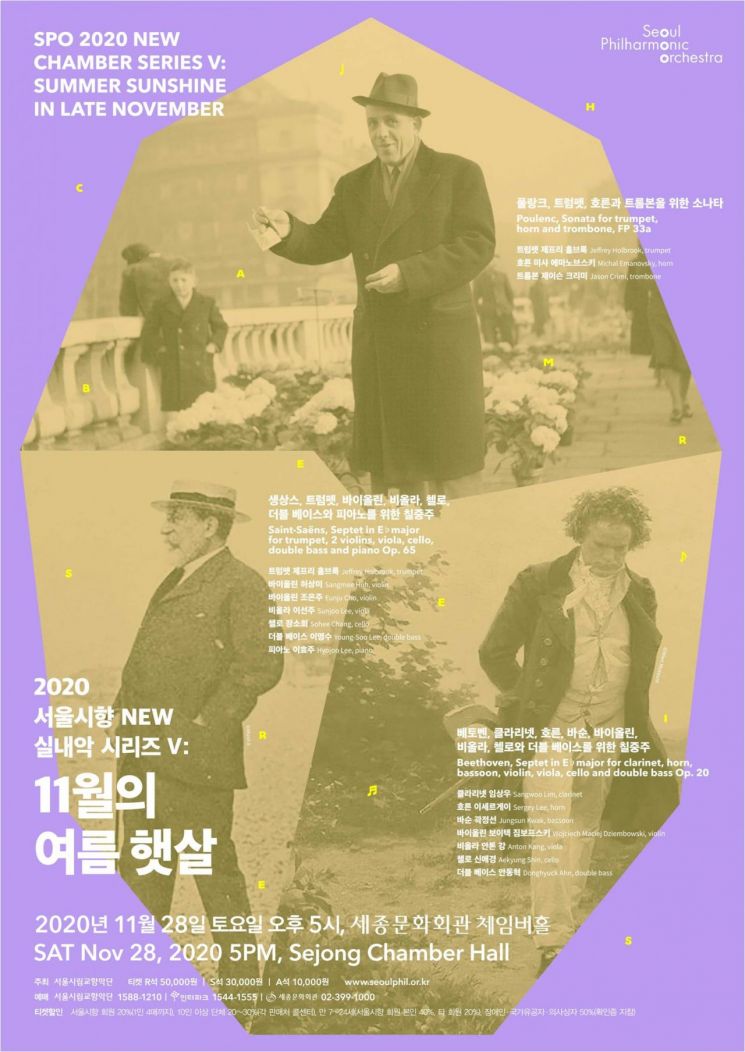
[Asia Economy Reporter Byunghee Park] The Seoul Philharmonic Orchestra (Seoul Philharmonic) will hold its final chamber music subscription concert of the year titled "New Chamber Music Series V: November Summer Sunshine" at 5 p.m. on the 28th at Sejong Chamber Hall.
The program consists of three bright and witty pieces from classical, romantic, and 20th-century chamber music, promising a performance as warm as summer sunshine.
The pieces to be performed are Poulenc's "Sonata for Trumpet, Horn, and Trombone," Saint-Sa?ns' "Septet for Trumpet, Violin, Viola, Cello, Double Bass, and Piano," and Beethoven's "Septet for Clarinet, Horn, Bassoon, Violin, Viola, Cello, and Double Bass." Pianist Hyoju Lee will join as a guest performer alongside members of the Seoul Philharmonic. For the safety of performers and audience members, social distancing between seats will be implemented during this concert.
Poulenc was a member of the "Les Six," a group active in the early 20th century in France. Les Six shared Jean Cocteau's motto that music should be concise, sharply realistic, and melody-focused. Poulenc was the most proactive in practicing this motto, enjoying rhythmic playfulness with a diverse palette of tones, combining enchanting dissonances with elegant wit. His "Sonata for Horn, Trumpet, and Trombone," composed in 1922, fully reflects these characteristics. The first movement consists of a lively rhythm and a witty first theme followed by a second theme imbued with Poulenc's unique lyricism; the second movement is a sweet variation of the first movement's second theme; and the third movement begins with a provocative melody that shifts between major and minor keys. Darius Milhaud, a fellow member of Les Six, praised this piece as "a true masterpiece, classically structured and astonishingly well balanced."
Saint-Sa?ns' "Septet" was completed in December 1880. It was commissioned by ?mile Remoant, an amateur trumpet player, for the Trumpet Association and is scored for a relatively high-pitched E♭ trumpet, string quartet, double bass, and piano. This piece combines a suite of dances in the style of Rameau with serious German classical influences from Bach, Schubert, and Schumann. Although the E♭ trumpet, string quartet, double bass, and piano ensemble could suggest a small trumpet concerto, the trumpet plays only an obbligato role. Saint-Sa?ns composed it this way so it could be performed even without an outstanding trumpet player. The first movement features a dramatic development starting with the clear trumpet fanfare introduction; the second movement is an elegant minuet; the third movement presents a cello theme filled with sorrow, reminiscent of Schubert's songs; and the fourth movement concludes with trumpet fanfares and powerful harmonies.
Beethoven's Septet is light and bright in the galant style. It consists of six somewhat lengthy movements and is an example of chamber music including wind instruments, a format that appears in Beethoven's early works. The piece premiered on April 2, 1800, at the "Academy" concert at the Burgtheater in Vienna. After the piece gained popularity, Beethoven arranged it in 1803 as a "Trio for Clarinet (or Violin), Cello, and Piano." Additionally, Schubert modeled his 1824 "Octet" after this septet.
The first movement begins solemnly and continues with a lively theme; the second movement features a texture where one instrument plays the melody while the other seven accompany; the third movement is an elegant minuet in an old style; the fourth movement appears to be a variation of a folk song from the Niederrhein region in western Germany, Beethoven's hometown Bonn; the fifth movement showcases musical playfulness; and the final sixth movement has the violin playing the theme busily without rest, including a violin cadenza despite the piece not being a concerto.
© The Asia Business Daily(www.asiae.co.kr). All rights reserved.

















