"Strong ROK-US Alliance Expected to Further Develop Under Next Administration"
Solution to Korean Peninsula Issues "Not Prejudged by Blinken's Past Remarks"
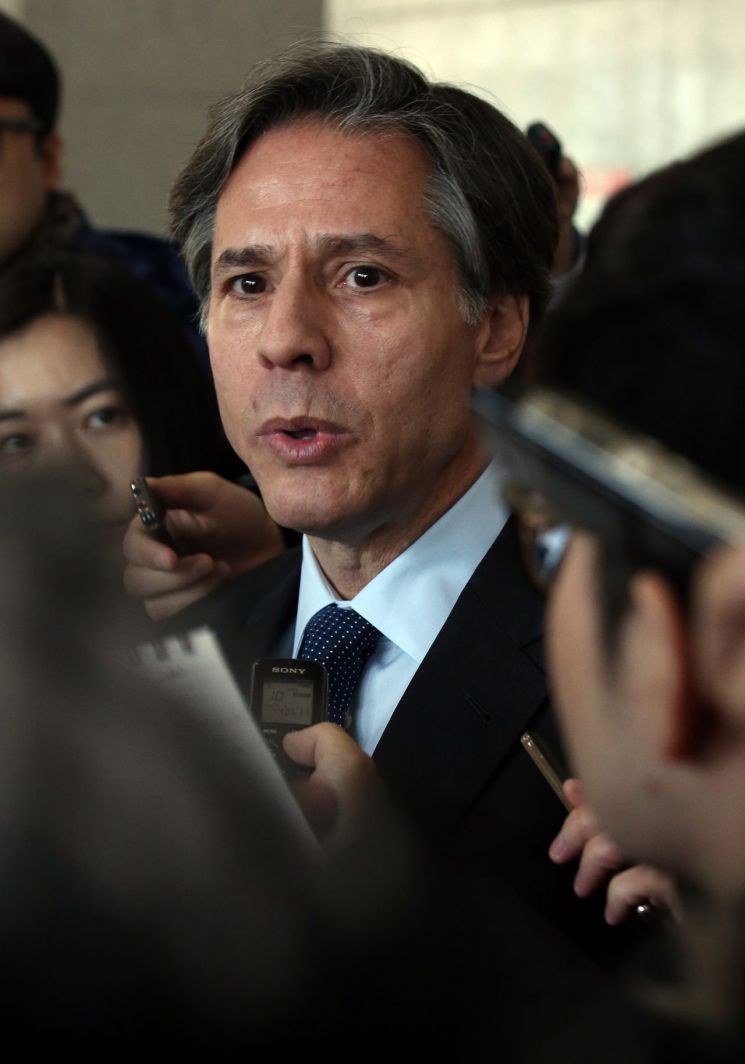
[Asia Economy Reporter Lim Cheol-young] The Ministry of Foreign Affairs stated that Tony Blinken, the former Deputy Secretary of State nominated as the first Secretary of State under the Joe Biden administration, is a person with extensive diplomatic experience and a deep understanding of the Korea Peninsula issue, and that they will cooperate to advance the Korea-US relationship.
On the 24th, Foreign Ministry spokesperson Choi Young-sam said at a regular briefing, "The nominee Blinken has rich experience and expertise in diplomacy and a deep understanding of Korea-US relations and the Korean Peninsula issue," adding, "Our government expects the strong Korea-US alliance to further develop under the next US administration and plans to cooperate accordingly."
However, some voices express concerns that the Biden administration will continue to pursue a multilateral, step-by-step approach to resolving the Korean Peninsula issue, as in the past. In response, a Foreign Ministry official explained, "We do not make premature judgments or excessive concerns based on specific remarks or frames, nor do we treat them as established facts," and added, "We are conducting extensive research on how to cooperate with him across various departments, including the North American Affairs Bureau, emphasizing expertise, including on the Korean Peninsula issue."
Earlier, President-elect Joe Biden nominated Tony Blinken, former Deputy Secretary of State and a key figure in foreign and security affairs, as the inaugural Secretary of State, and appointed Jake Sullivan, former National Security Advisor to the Vice President, as the White House National Security Advisor. With a foreign and security team favoring a practical, step-by-step approach, it is analyzed that North Korea's stance?demanding sanctions relief as a precondition for negotiating denuclearization, similar to Iran?will likely determine the future direction of denuclearization on the Korean Peninsula.
The Iran nuclear deal, signed in July 2015 during the Barack Obama administration, involved easing economic sanctions in exchange for Iran's restraint on nuclear weapons development and international inspections. The agreement was signed by Iran, the US, the UK, France, Germany, Russia, China, and the European Union (EU). The participation of various countries ensured the binding nature of the agreement's implementation and is also regarded as a positive factor in overcoming mutual distrust between North Korea and the US.
During the Donald Trump administration, North Korea-US negotiations failed to find common ground due to conflicting denuclearization processes advocated by both sides. Following former White House National Security Advisor John Bolton's approach of "denuclearization first, rewards later," North Korea opposed with the opposite stance. However, there is growing analysis that the Biden administration's early foreign and security policy will likely emphasize a "step-by-step denuclearization" and "international cooperation" approach.
In a September interview on CBS, nominee Blinken referenced the Iran nuclear deal achieved during the Obama administration and said, "I think there is an opportunity to move in the same direction with North Korea." Earlier, on June 11, 2018, a day before the first North Korea-US summit, he wrote in a New York Times op-ed that "the best model for nuclear negotiations with North Korea is Iran." Nominee Sullivan also stated in a May 2016 policy speech at the Asia Society in New York, while serving as the foreign policy chief for Hillary Clinton's presidential campaign, that "we plan to employ a strategy toward North Korea similar to that used with Iran."
Accordingly, there is analysis that the role of the South Korean government will become more important than ever. This is based on the judgment that the Biden administration is likely to steer foreign relations toward strengthening alliances based on the Democratic Party's value-centered diplomacy. Professor Jung Dae-jin of Ajou University explained, "Blinken is likely to pursue alliance-centered diplomacy within the Democratic Party that does not engage in denuclearization against US national interests," adding, "Regarding North Korea-US dialogue, since the Singapore summit is considered to have failed, it is likely that the US will ask for the South Korean government's position and approach the matter practically based on that, making the South Korean government's stance more important than ever."
© The Asia Business Daily(www.asiae.co.kr). All rights reserved.

















