Kang Seon-woo Proposes Bill to Punish Secret Recording of Sexual Intercourse
Up to 3 Years Imprisonment for Recording Sexual Intercourse Without Consent
Experts Say "Hasty Bill... Victims May Suffer More"

[Asia Economy Reporter Heo Midam] "I can't believe that recording during sexual intercourse was still legal.", "It's the minimum means of self-defense. What if someone is falsely accused?"
As a bill prohibiting recording during sexual intercourse without the other party's consent has been proposed, controversy surrounding the amendment is intensifying. The main point of this amendment is to classify and punish audio recordings of sexual intercourse as sexual violence crimes, just like filming sexual scenes.
Supporters of the bill expressed concerns that "recorded files could lead to other sexual crimes such as revenge porn," urging swift passage of the bill, while opponents argue that recordings during sexual intercourse are the only evidence to prevent 'false Me Too' claims. Experts criticized the bill as being hastily pushed forward.
On the 18th, 13 lawmakers including Kang Sun-woo of the Democratic Party of Korea jointly proposed an amendment to the Sexual Violence Crime Punishment Act to punish sexual crimes if sexual intercourse is recorded without the other party's consent.
According to the amendment, anyone who records or distributes a person's voice that may induce sexual desire or shame against the person's will using a recording device can be punished by imprisonment for up to three years or a fine of up to 30 million won.
Under current law, there are no punishment provisions for simple recordings. While filming sexual intercourse without consent is punishable by up to seven years imprisonment or a fine of up to 50 million won, there are no punishment provisions for simple recordings, so ultimately only defamation charges with relatively lighter sentences have been applied when recordings are distributed.
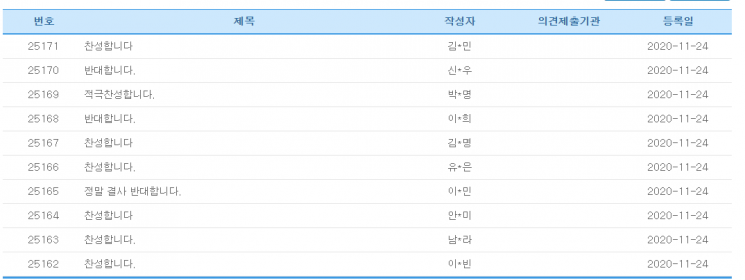 Support and opposition opinions on the amendment to the "Act on the Punishment of Sexual Violence" posted on the National Assembly legislative notice board on the 24th. Photo by National Assembly legislative notice board capture.
As news of the bill's proposal spread, public opinion has been divided, especially on online communities. In particular, as of 11 a.m. on the 24th, over 25,000 comments for and against the bill have been posted on the National Assembly's legislative notice system bulletin board, indicating growing controversy.
One netizen who posted on the legislative notice board pointed out, "Why would anyone have a reason to record audio during sexual intercourse?" and added, "Even illegal filming, despite clear evidence of the perpetrator's act and intent, is often punished lightly or not properly enforced. Therefore, 'audio recording during sexual intercourse,' which is not legislated, is highly likely to be abused by exploiting legal blind spots."
Other netizens also raised their voices, saying, "Why record without the other party's consent?" and "I don't understand why it was legal until now and why there is opposition now; this law must be passed."
University student Kim (25) also said, "I didn't know that recording without consent during sexual intercourse was legal until now," adding, "Illegal recordings cause the same mental shock to victims as illegal filming. What if the recording files are distributed? Once leaked, the files cannot be recovered, and it would be a huge shock to the victim."
In fact, a man in his 40s who was prosecuted for recording sounds of guests' sexual intercourse in motels over three years last year received a light sentence of 10 months imprisonment and one year suspension of qualifications, drawing public criticism.
It was reported that from December 2015 to October last year, he recorded sounds of sexual intercourse of guests in motel rooms in Eunpyeong-gu, Seoul, and Yangju-si, Gyeonggi-do, where he worked, by placing a mobile phone with recording function turned on on the ceiling light 21 times in total over about three years.

On the other hand, some express concerns about the amendment. One netizen stated on the legislative notice board, "In a situation where one can be detained based only on the victim's consistent testimony without clear evidence, I think recording is the last means of self-defense," opposing the bill.
Office worker Lee (27) also said, "There are cases where men are accused of sexual assault after consensual sex. The only evidence used in these cases is the recording file," expressing concern that "this law must never be enacted. It could be abused to turn innocent men into sexual offenders."
Experts criticized the bill as a 'hasty bill' and pointed out that it could actually harm victims.
Lawyer Lee Eun said, "If this bill passes, victims could actually suffer more," adding, "Victims have almost no evidence other than CCTV footage or recording files in sexual assault cases. What will they do if audio recordings are prohibited?"
She continued, "If this bill passes, most victims will ultimately be unable to use recording files they rely on as evidence. I wonder if such situations have been fully considered. Also, it is necessary to consider detailed matters such as whether the bill is limited to sexual intercourse or how it applies to similar sexual acts," adding, "I think it would be more appropriate to punish the distribution of recordings that cause sexual shame."
© The Asia Business Daily(www.asiae.co.kr). All rights reserved.



















