2020 Global Cost of Living Analysis Report
4th Place After Zurich, Paris, and Hong Kong
Main Cause: Foreign Worker Exodus
[Asia Economy Singapore Correspondent Su-mi Seo] As the COVID-19 pandemic prolongs, Singapore has lost its title as the 'world's most expensive city' for the first time in seven years. The global ranking of the most expensive cities has changed due to the large-scale economic stimulus and lockdown measures implemented by various countries.
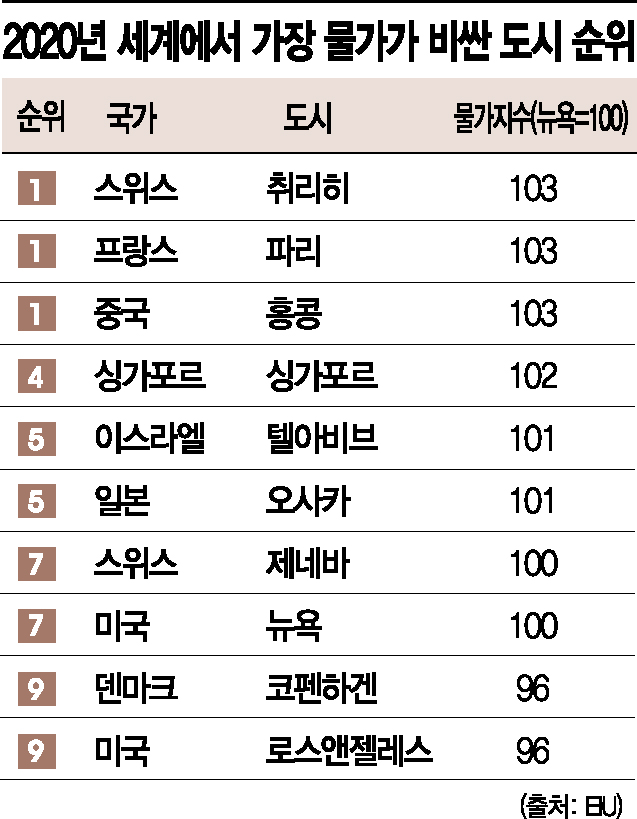
According to the 2020 Worldwide Cost of Living report recently released by the Economist Intelligence Unit (EIU) on the 23rd (local time), Singapore's prices were ranked the fourth most expensive in the world.
Singapore had maintained the number one spot as the most expensive city for seven consecutive years. In the survey conducted last March, Singapore was even tied for first place with Hong Kong. However, after the Singapore government implemented strict lockdown policies, the rankings shifted.
The EIU report pointed out that the biggest factor behind this result was the departure of foreign workers from Singapore. Due to the surge in layoffs of foreign workers amid the COVID-19 crisis, the total population decreased for the first time since 2003, leading to economic contraction and a drop in prices.
Singapore's unemployment rate is at its highest since the 2008 US financial crisis. According to local media such as The Straits Times, the unemployment rate in the third quarter was 3.6%, with 200,000 layoffs occurring since the beginning of the year. The service sectors hit hardest by COVID-19, including tourism, leisure, aviation, and accommodation, were most affected. Foreign workers employed in these industries lost their jobs and left Singapore. As of June, the total number of foreigners in Singapore decreased by 2.1% compared to the same month last year, and the total population also declined by 0.3%.
The EIU's cost of living report uses the price level of New York, USA as the baseline (100) to comparatively evaluate the prices of cities worldwide. It compares the prices of a basket of 138 items across more than 133 cities globally, conducting the survey twice a year. The report covers ten categories of consumer goods, including food, clothing, household items, rent, transportation, utilities such as electricity and water, as well as education and entertainment expenses, to compile the overall cost of living for each city.
The report also analyzed that the COVID-19 pandemic has influenced global consumption habits. While prices of essential goods remained relatively stable, clothing items, which saw a relative decrease in demand, experienced significant price drops, and demand for home appliances increased as more people worked from home.
The weakening of the US dollar due to the pandemic and the relative strength of Western European and North Asian currencies also had an impact. It is analyzed that prices in Paris, France, and Zurich, Switzerland, rose relatively due to the appreciation of local currencies.
Additionally, Tel Aviv, Israel's economic center, and Osaka, Japan, tied for fifth place, while US cities New York and Los Angeles, Swiss Geneva, and Danish Copenhagen also appeared in the rankings.
© The Asia Business Daily(www.asiae.co.kr). All rights reserved.

















