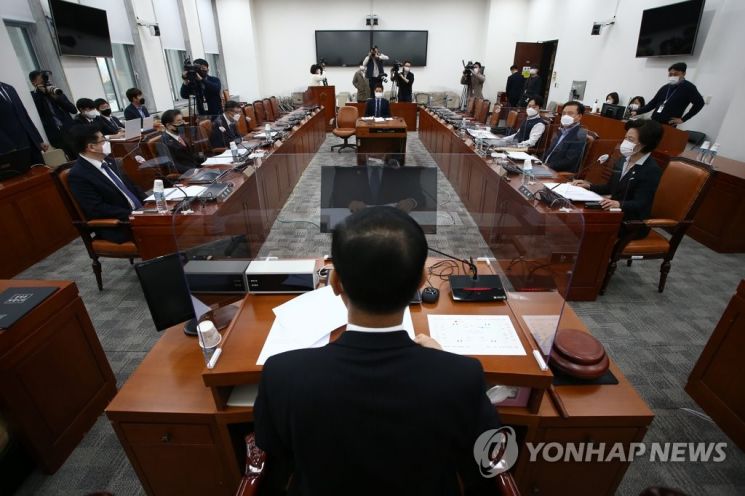
 Committee for the Recommendation of the Chief of the Corruption Investigation Office for High-Ranking Officials.
[Asia Economy Reporter Choi Seok-jin] The High-ranking Officials’ Crime Investigation Unit (PCC) Chief Candidate Recommendation Committee, which had effectively declared the end of its activities after the third meeting on the 18th, will hold its fourth meeting on the 25th through a bipartisan agreement.
However, due to significant differences in positions among the recommendation committee members, there are skeptical views about the possibility of successfully recommending two final candidates.
Considering this situation, the ruling Democratic Party intends to push forward with the revision of the PCC Act to nullify the opposition party’s veto power as originally planned, alongside the resumption of the PCC Chief Candidate Recommendation Committee meetings, which is expected to lead to clashes with the opposition party.
On the 24th, the PCC Chief Candidate Recommendation Committee’s National Assembly support team announced that, based on Article 6, Paragraph 5 of the PCC Act and the Speaker of the National Assembly’s request to convene the meeting, the fourth meeting will be held at 2 p.m. on the 25th in Room 220 of the National Assembly Main Building.
Previously, at the third meeting, the seven recommendation committee members failed to decide on two final candidates despite three rounds of voting and effectively declared the end of the committee’s activities. Although two opposition party recommendation members requested the resumption of the meeting, the request was rejected as it did not meet the meeting convening requirement under the PCC Act (at least one-third of the members’ request).
Currently, the two opposition party recommendation members and the remaining five members show significant differences in views regarding the reasons for the failure to recommend final candidates and the opposition party’s veto power.
First, the ruling party recommendation members, along with Justice Minister Choo Mi-ae who shares the ruling party’s stance, neutral figures such as Lee Chan-hee, President of the Korean Bar Association, and Cho Jae-yeon, Director of the Court Administration Office, hold the position that “the opposition party recommendation members are effectively opposing all candidates, and further meetings are meaningless.”
In fact, the Korean Bar Association president said in a radio interview the day after the third meeting, “It was wrong in itself that recommendation members representing each party appear in the PCC Chief Candidate Recommendation Committee, which should be politically neutral,” and added, “Holding further meetings is meaningless.”
The association president also posted on his Facebook right after the decision to resume the PCC Chief Candidate Recommendation Committee by agreement of the ruling and opposition floor leaders, saying, “Is the Korean Bar Association, which values political neutrality as its lifeblood, an organization that just goes when the National Assembly agrees?” This suggested that he might not attend the fourth meeting even if it is held.
On the other hand, the opposition party recommendation members argue that “the veto right against inappropriate candidates is a right recognized by the law enacted through bipartisan agreement.” Furthermore, they claim that since none of the ten candidates received the approval of six recommendation members as required by law, additional candidate recommendations are necessary.
They also express dissatisfaction that “the association president and Director Cho, who should be neutral, sided with the ruling party and tried to quickly recommend two PCC chief candidates unconditionally.”
At the fourth meeting, since it was already decided at the second meeting not to accept additional candidate recommendations, the recommendation members except for the opposition party members are expected to propose a re-vote on the existing ten candidates or the four candidates who received four to five votes each in the third meeting.
However, the candidates with many votes at that time?Attorney Jeon Hyun-jung recommended by Minister Choo (5 votes), Kim Jin-wook, Senior Researcher at the Constitutional Court recommended by the Korean Bar Association president (5 votes), Lee Geon-ri, Chair of the Anti-Corruption Division at the Anti-Corruption and Civil Rights Commission (4 votes), and Han Myung-kwan, Attorney at Barun Law Firm (4 votes)?are all candidates whom the opposition party finds difficult to support. Therefore, if the opposition party recommendation members oppose such a vote itself or participate and cast the same opposing votes as before, it is highly likely that the final candidate decision will fail again at the fourth meeting.
Meanwhile, the ruling party is determined to launch the PCC within this year by pushing for amendments to the PCC Act to lower the quorum for the committee’s resolution from six to five members or to set a deadline for the final candidate recommendation. If the law is amended and changes occur in the existing recommendation members under the current law, the PCC chief candidates may be recommended again.
On the other hand, the opposition party defines the ruling party’s moves as “legislative dictatorship” and is prepared to engage in an all-out confrontation. They are also urging the Constitutional Court to promptly deliver a ruling on the constitutional complaint regarding the PCC Act.
Attention is focused on what choice the opposition party will make in a situation where the PCC chief could be appointed without the opposition party if the veto is exercised again at the fourth meeting.
© The Asia Business Daily(www.asiae.co.kr). All rights reserved.