Marine Science and Technology Promotion Institute, Certification of New Marine and Fisheries Technologies
Helping Small and Medium Enterprises with Technology but No Sales and Difficult Verification to Open Sales Channels
Achieved 7.2 Billion KRW in Sales Related to Certified Technology Until Last Year
Sales Expected to Increase Further This Year
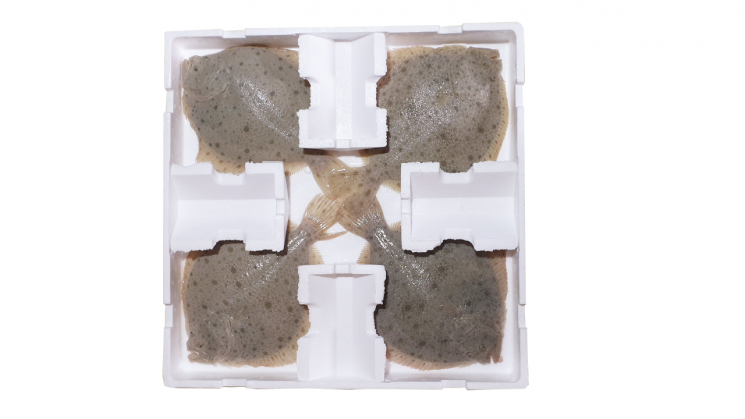 Turbot (Cheolgwangeo) packed in a box without water using The Fish's 'Turbot Artificial Dormancy Technology'.
[Sejong=Asia Economy Reporter Joo Sang-don] The Fish, a live fish distribution company, has been exporting live turbot to the United States since last year by applying artificial dormancy technology. In the past, transporting sashimi required carrying tanks filled with water, but now they use their self-developed 'Turbot Artificial Dormancy Technology.' This method induces artificial dormancy in fish by gradually adjusting the water temperature according to the species. After stabilization, adaptation, dormancy preparation, and dormancy induction stages, the fish can survive for more than 36 hours in an environment without water. Since no water or tanks are needed during delivery, transportation costs can be reduced by more than 40%.
This achievement was made possible by the 'Marine and Fisheries New Technology Certification' operated by the Korea Institute of Marine Science and Technology Promotion (KIMST). The Fish possessed the artificial dormancy technology but had no sales performance and thus could not commercialize it. However, through the marine and fisheries technology certification in 2018, they gained credibility for their technology, which opened the export path to the U.S. The Fish recorded sales of 342 million KRW last year through the turbot artificial dormancy technology.
KIMST's marine and fisheries new technology certification system is leading to commercialization and market expansion for small and medium enterprises with technological capabilities in the marine and fisheries sector. According to KIMST, among companies that obtained marine and fisheries certification, nine companies commercialized and sold new technologies (or applied products) last year, recording sales of 5.018 billion KRW. Even in the early years of the certification system in 2017 and 2018, sales of 118 million KRW and 2.026 billion KRW were recorded respectively, totaling 7.2 billion KRW in sales so far. Considering the increase in certified technologies and the commercialization efforts of previously certified companies, KIMST expects related sales to increase further this year.
Aquatopia International's 'Non-toxic Pufferfish Production Technology' is also one of the representative cases of market expansion through marine and fisheries new technology certification. Aquatopia developed a detoxification breeding process technology to overcome the vulnerability of residual tetrodotoxin, a type of neurotoxin, in the bodies of highly toxic pufferfish species such as tiger puffer, yellow puffer, and pufferfish in cage aquaculture. However, it was difficult to verify whether the fish were truly non-toxic, making actual sales challenging. But based on the new technology certification, they achieved sales of 292 million KRW worth of non-toxic pufferfish production and sales last year.
The Korea Marine Environment Ecology Institute's 'Seaweed Farm Formation Technology through Control of Grazing Animals,' certified in 2017, has no sales performance yet but is expected to be a technology that can effectively prevent marine degradation. This technology uses underwater waves to move the lines on which seaweed is transplanted and hung, preventing grazing animals such as sea urchins and starfish that climb the lines to eat seaweed from approaching. It has tension and length adjustment devices on the spore lines, allowing customized installation according to the marine environment. This prevents loss of transplanted seaweed, induces seaweed spore release, helps prevent the decline of fishery resources caused by coastal desertification and marine ecosystem destruction, and aids in fishery recovery through seaweed farm formation.
Additionally, Airas received certification for its 'Air-driven Circulating Filtration System Design Technology for Fish Farming,' which enables cost reduction compared to existing aquaculture systems and requires no separate oxygen supplementation device, recording sales of 300 million KRW last year. Cubem obtained certification for its 'Marine Deep-sea Water Mineral Regulation Technology Combining RO/NF-ED-IX Processes,' generating sales of 973 million KRW last year. This technology supplies deep-sea water minerals that meet drinking water quality standards for related industries such as health functional foods and cosmetics. K-Fusion Tech received certification for its underwater plasma generation technology using micro-nanobubbles that sterilize aquaculture water by circulating water under high pressure.
A KIMST official said, "The marine and fisheries new technology certification is a system that helps small and medium enterprises with no sales performance to open sales channels and increase sales by providing government-guaranteed new technology certification." He added, "We will continue to expand certification and strive for the growth of small and medium enterprises."
© The Asia Business Daily(www.asiae.co.kr). All rights reserved.
![Clutching a Stolen Dior Bag, Saying "I Hate Being Poor but Real"... The Grotesque Con of a "Human Knockoff" [Slate]](https://cwcontent.asiae.co.kr/asiaresize/183/2026021902243444107_1771435474.jpg)











