KCCI Holds Labor-Management Relations Development Advisory Committee Meeting... Discusses Issues and Improvement Plans for Government's Trade Union Act Amendment
"If Allowing Dismissed and Unemployed Workers to Join Unions Is Inevitable for Ratifying ILO Core Conventions, Employer Countermeasures Must Also Be Improved to International Standards"
Demands Allowing Substitute Labor During Strikes, Prohibiting Workplace Occupation During Union Disputes, and Deleting Criminal Penalties for Employer Unfair Labor Practices
[Asia Economy Reporter Kim Hyewon] The business community has strongly opposed the proposed amendments to the Labor Union Act being pushed by the government and ruling party, arguing that they will further deepen the power imbalance between labor and management. They have made a desperate appeal that if allowing dismissed and unemployed workers to join unions is inevitable for ratifying the International Labour Organization (ILO) core conventions, then the employers' countermeasures should also be improved simultaneously to meet international standards in proportion to the strengthening of union solidarity rights.
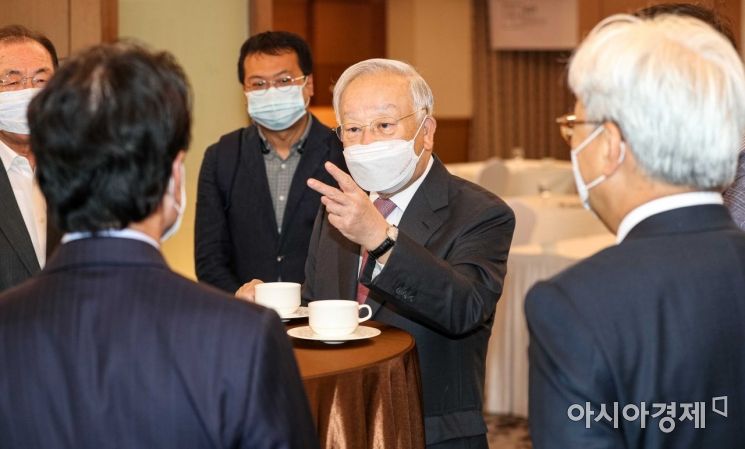
On the 24th, the Korea Employers Federation (KEF) held the 'Labor-Management Relations Development Advisory Committee' meeting to discuss the problems and improvement measures of the government's proposed amendments to the Labor Union Act for ratifying the ILO core conventions.
KEF Chairman Sohn Kyung-shik stated, "To overcome the economic and employment crises caused by the COVID-19 pandemic, KEF signed a tripartite agreement in July and has continuously proposed measures such as reducing corporate tax burdens, deregulation, and supplementing flexible work systems. However, legal and institutional improvements have hardly been made, and rather, many bills that restrict corporate management and investment activities have been submitted to the National Assembly, which is a significant burden."
At the meeting, the business community pointed to the government's and ruling party's proposed amendments to the Labor Union Act related to the ratification of the ILO core conventions as one of the most concerning bills. Chairman Sohn criticized, "If the government's proposed amendments, which include allowing dismissed and unemployed workers to join unions and deleting the prohibition on paying salaries to union full-time officers, are legislated without fully considering the reality of labor-management relations in our country, the power imbalance between labor and management will deepen further, posing a great burden on industry and corporate competitiveness."
The consistent position of the business community is that if allowing dismissed and unemployed workers to join unions is unavoidable for ratifying the ILO core conventions, then employers' countermeasures must be improved to alleviate the power imbalance. Chairman Sohn emphasized, "Employers should be allowed to use replacement labor as a countermeasure against strikes, and acts such as occupying workplaces during union disputes should also be prohibited." He also argued that instead of maintaining direct criminal penalties for unfair labor practices imposed only on employers, regulations to control unfair labor practices by unions should be newly established.
Park Ji-soon, director of the Labor Graduate School at Korea University, who gave a presentation on the topic of 'Issues in Ratifying the ILO Core Conventions and Amendments to the Labor Union Act,' expressed the opinion that regarding the prohibition of replacement labor, "It is necessary to consider reviewing and improving the current complete ban on replacement labor within a reasonable scope so that companies can cope with market risks caused by long-term disputes that damage management." Regarding improvements to the unfair labor practices system, she suggested, "As the scope of freedom for union activities expands, it is necessary to ease the unilateral criminal penalties on employers in response, and especially, consideration should be given to reducing or abolishing criminal penalties related to the unfair labor practices system."
The business community unanimously agreed that the payment of salaries to union full-time officers should be maintained as is, since it is a global standard for unions to bear these costs themselves and aligns with the principle of 'autonomy.' Chairman Sohn particularly explained, "The government's position to pursue legal amendments according to ILO recommendations contradicts Article 2 of ILO Convention No. 98, which regards financial support from employers to workers' organizations as interference. Therefore, the government should reconsider this."
Nam Sung-il, professor of economics at Sogang University and an advisory committee member, stated, "Over the past 20 years, the labor environment in our country has increasingly tilted power in favor of unions, which have become political power groups beyond mere representatives of workers, dominating the labor market and labor-management relations." He evaluated, "The government's proposed amendments to the Labor Union Act will further tilt the already 'uneven playing field,' shrink corporate activities, reduce jobs, and generally cause the national economy to decline." Therefore, if legal amendments are necessary for ratifying the ILO conventions, he proposed that if the right of dismissed workers to join unions is recognized, it should be for non-company unions (or cross-company unions) rather than specific company unions, and that measures such as allowing employers to use replacement labor and prohibiting unfair labor practices by unions should be considered to restore equality in labor-management relations.
Another advisory committee member, Professor Ryu Jae-woo of the Business Administration Department at Kookmin University, expressed concern, saying, "Although our country fundamentally has enterprise-based unions, it is unreasonable to adopt the laws and systems of Europe and the United States, where industrial unions predominate, as they are. The proposed amendments that strengthen union powers without corresponding measures such as banning strikes within workplaces and allowing replacement workers will make corporate management more difficult and deepen the employment cliff."
Professor Kim Tae-gi of the Economics Department at Dankook University also evaluated, "The government's proposed amendments to the Labor Union Act are not about strengthening basic labor rights but rather about enhancing union privileges. The constitutional guarantee of basic labor rights aims to improve working conditions for general workers, and the ILO conventions share this purpose, but the amendments are far removed from this." He added, "Union privileges deepen labor market dualism, including instability in labor-management relations and the divide between regular and non-regular workers. The government's proposed amendments will worsen the labor market dualism problem more than now."
© The Asia Business Daily(www.asiae.co.kr). All rights reserved.

















