Secret Recording of Sexual Intercourse to Be Punished Under 'Law Amendment' Proposal
Intensified Gender Dispute Over the Amendment
Women: "Voice as a Tool for Threats" Men: "Fake MeToo Evidence"
Heated Debate on the National Assembly Legislative Notice Website

[Asia Economy Reporter Han Seung-gon] The conflict between men and women over the proposed amendment to the Act on Special Cases Concerning the Punishment of Sexual Violence Crimes, which punishes those who record sexual intercourse audio without the consent of the other party, is intensifying. The amendment was prepared based on the judgment that sexual intercourse audio could be abused for purposes of threatening or retaliation, similar to illegal videos.
Many women support the amendment, arguing that men often use such recordings to threaten others. On the other hand, men oppose the amendment, claiming that recordings of sexual intercourse audio are the only evidence to refute 'fake Me Too' accusations. The National Assembly legislative notice website, where the amendment was posted, has seen tens of thousands of comments, sparking heated debates between supporters and opponents.
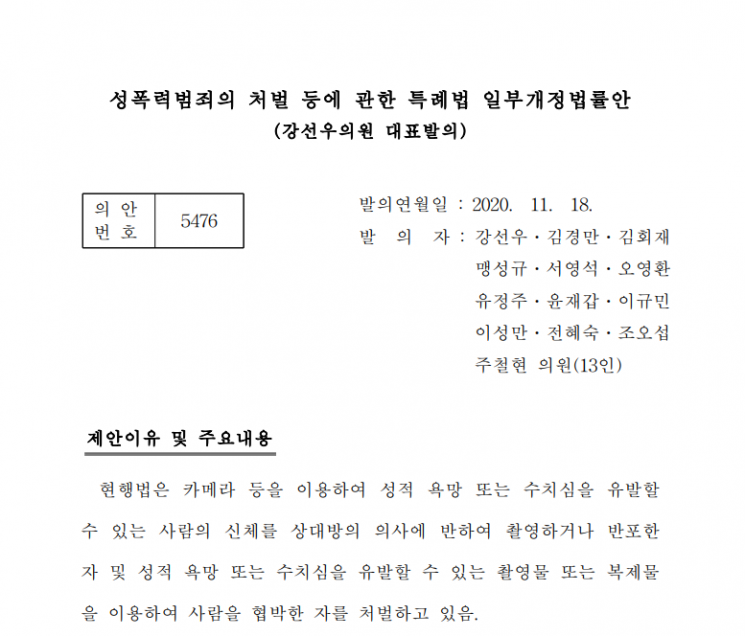 Partial Amendment to the Act on Special Cases Concerning the Punishment of Sexual Violence Crimes. Photo by National Assembly Legislative Notice Website Capture
According to the amendment, which was jointly proposed by Kang Seon-woo, a member of the Democratic Party of Korea, on the 18th, anyone who records or distributes a person's voice that may induce sexual desire or shame without the other party's consent using a mobile phone, recorder, or other devices shall be punished by imprisonment for up to three years or a fine of up to 30 million won.
Additionally, if the audio is distributed via information and communication networks for commercial purposes, the offender may face imprisonment for up to five years. Those who threaten others using such audio recordings shall be sentenced to imprisonment for at least one year.
The current Sexual Violence Crime Punishment Act only includes punishment regulations related to recordings or reproductions made using cameras. In cases of damage caused by illegal recordings, charges of defamation have been applied.
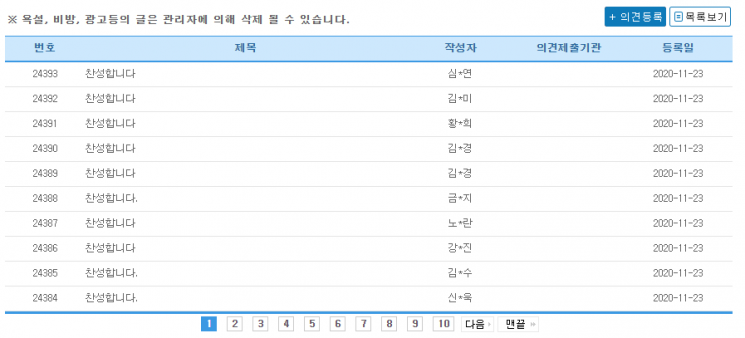
Following the posting of the amendment on the National Assembly legislative notice website on the 19th, as of 11 p.m. on the 23rd, 24,386 opinions had been submitted. While posts titled "I support" constitute the majority, there are also opposing opinions. The amendment has been viewed 213,806 times.
One netizen who expressed support for the amendment stated, "This law amendment is long overdue," and added, "We must promptly amend the law to prevent further harm."
Conversely, a netizen opposing the amendment argued, "If the only evidence that sexual intercourse was consensual is no longer allowed due to the amended law, innocent men could become victims."
Civilian opinions are also sharply divided. A female office worker in her 30s, Lee, emphasized, "Not only videos but also audio can obviously be used as tools for threats," and expressed support for the amendment. She continued, "We should not view the 'some' that men claim as the 'whole,' but rather see this law as a measure to prevent even those few cases. We just need to prevent any unjust situations from arising."
On the other hand, among men, concerns are emerging that the last method to prevent 'fake Me Too' accusations might disappear.
A male office worker in his 30s, Kim, said, "Legislation and law amendments must be very cautious," and emphasized, "Although only some, among men, 'audio recordings' are a kind of evidence that best explains the circumstances of consensual sexual intercourse." He added, "Without even these recordings, there would be no evidence to counter claims that the sexual intercourse was not consensual."
Meanwhile, Kang, the lawmaker who proposed the amendment, explained the reason, saying, "Recently, cases of recording or distributing sexual intercourse audio without the other party's consent using mobile phones or small recorders have frequently occurred," and emphasized, "Such recorded audio files, like illegal videos, can be abused to threaten the other party or used as revenge porn, so there are calls to punish this as a sexual violence crime."
© The Asia Business Daily(www.asiae.co.kr). All rights reserved.



















