COVID-19 Resurgence, Self-Employed Face 'Tears'
Impact of COVID-19... Over Half of Bottom 20% Households in Deficit
Experts: "Public Safety Takes Priority Over Economic Activity"
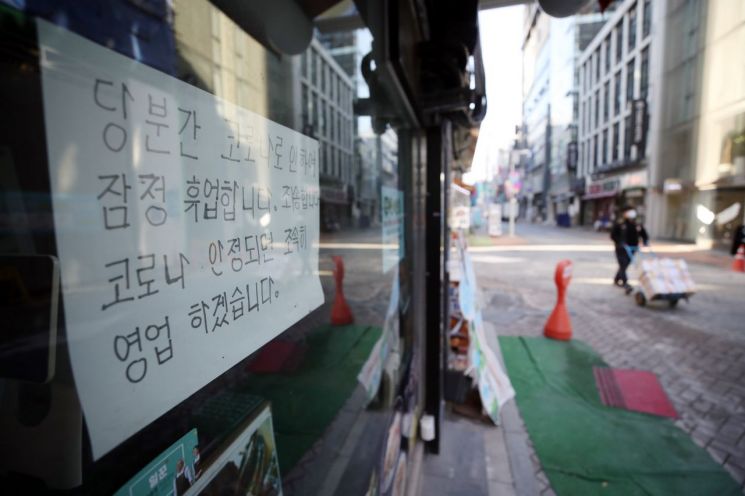 On the 23rd, a temporary closure notice is posted at a store in Myeongdong, Seoul. Photo by Yonhap News
[Asia Economy Reporter Kim Ga-yeon] "Do we have to close again?", "I feel hopeless."
As the number of new confirmed cases of the novel coronavirus infection (COVID-19) continues to fluctuate above 200, the sighs of self-employed business owners worried about economic damage are growing deeper. This is because the government decided to raise the social distancing level in the metropolitan area to Level 2, applying measures such as gathering bans and dining restrictions to some facilities. Experts emphasized the need to prepare measures focused on economic recovery.
On the 22nd, the government decided to raise the 'social distancing' level in the metropolitan area to Level 2 starting at midnight on the 24th. This is just five days after raising it to Level 1.5 on the 19th. The measure was taken due to the 'third wave' progressing faster than expected, with new confirmed cases recently reaching the 300s.
Accordingly, among the nine types of high-risk facilities, gathering bans will be imposed on five types of entertainment facilities: clubs, room salons, karaoke bars, emotional pubs, colatecs, and hunting pubs. Cafes will only be allowed takeout and delivery, and restaurants can operate normally but only takeout and delivery are allowed after 9 p.m.
Park Neung-hoo, the first head of the Central Disaster and Safety Countermeasure Headquarters (CDSCHQ), said at a regular briefing that day, "Considering the rapid spread of COVID-19 infections, the metropolitan area will be raised to Level 2 and the Honam region to Level 1.5 starting from the 24th."
Park explained, "This is to reverse the increasing trend of confirmed cases before the College Scholastic Ability Test (CSAT) scheduled for December 3 and to proactively block a large-scale winter outbreak."
As a result, voices of concern about the raising of social distancing levels and business restrictions are growing among self-employed business owners. These measures inevitably lead to a decrease in sales. While they understand the necessity of quarantine, they collectively expressed that their livelihoods are threatened as the damage has continued for several months.
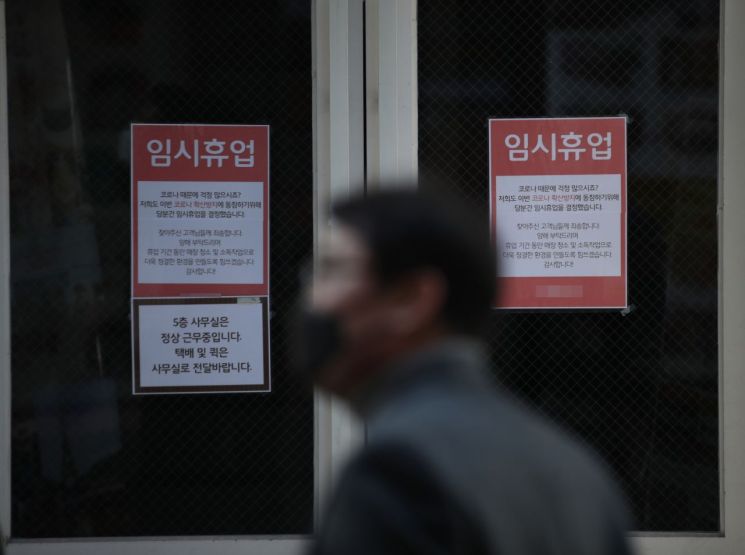 On the 23rd, a temporary closure notice is posted at a cafe in Myeongdong, Seoul. Photo by Yonhap News
A in their 30s, who runs a restaurant in Seoul, said, "At the beginning of the COVID-19 spread, I thought 'Let's endure for a few months until it ends,' but now there is no such hope," adding, "The number of confirmed cases keeps rising and falling; how can I feel at ease?"
A said, "If social distancing is strengthened, customers will naturally decrease, and if only takeout and delivery are allowed after 9 p.m., alcohol sales will practically disappear," adding, "Fixed expenses like rent are several million won, and if income doesn't come in at all, I can't handle it. Now, I'm at my limit and am considering whether to temporarily close or permanently shut down."
A survey showed that the economic impact of COVID-19 spread is concentrated on low-income groups, including small self-employed business owners.
According to the National Statistical Portal of Statistics Korea on the 22nd, the deficit household rate for the lowest 20% income group (first quintile) in the third quarter was 50.9%. This is the first time since 2013 that the deficit household rate for the first quintile exceeded 50% for the third quarter.
In the third quarter, the average monthly income of first quintile households was 1,637,000 won, a 1.1% decrease compared to last year. Earned income decreased by 10.7% to 553,000 won, and business income decreased by 8.1% to 276,000 won.
Experts suggested that after curbing the spread of COVID-19, measures to revitalize the economy should be sought.
Professor Kim Tae-gi of Dankook University's Department of Economics said, "Since safety takes priority over economic activity, strengthening (quarantine measures) is necessary," emphasizing, "Resolving the COVID-19 situation should come before policies that increase people's activity."
Professor Kim added, "The government introduced measures such as the eight major consumption coupons, but they had little effect," and said, "Rather than consumption stimulation measures, plans that can boost the vitality of the entire industry, such as tax reductions, should be prepared. Measures addressing the intermediate consumption stage and the overall distribution system should be introduced to protect self-employed business owners."
© The Asia Business Daily(www.asiae.co.kr). All rights reserved.


















