Government to Announce '2021 Economic Policy Directions' in Mid-Next Month
Seeking Economic Recovery through Korean New Deal... Possibility of Restructuring Marginal Companies in the First Half
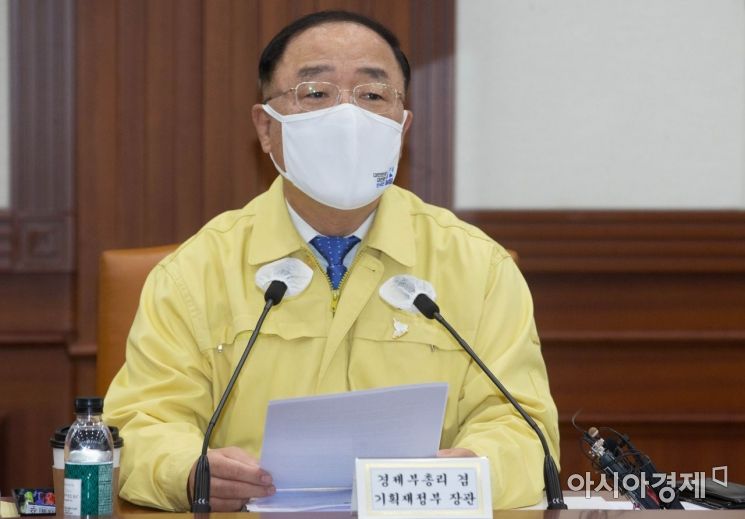 Hong Nam-ki, Deputy Prime Minister and Minister of Economy and Finance, is delivering opening remarks at the '5th Korean New Deal Ministerial Meeting' held at the Government Seoul Office in Jongno-gu, Seoul on the 19th. Photo by Kang Jin-hyung aymsdream@
[Asia Economy Reporter Jang Sehee] The Ministry of Economy and Finance is expected to include an exit strategy for various temporary measures introduced to respond to the COVID-19 crisis in the '2021 Economic Policy Direction' scheduled to be announced in mid-next month. The exit strategy refers to gradually normalizing policies that were expansively operated during the crisis.
On the 23rd, a senior government official stated, "Due to the prolonged COVID-19 pandemic, government and private funds are being injected into the Industrial Stability Fund and Employment Retention Subsidies," adding, "We will comprehensively analyze whether to maintain these measures or, if not extended, the extent of the impact on companies." In this regard, a government official said, "Typically, exit strategies are included in the economic policy direction immediately after an economic crisis," and added, "It can be seen as preparing recovery measures through investment and entering the normalization process."
Since the economic policy direction for next year is a plan for the entire year, it is being formulated considering the future reduction of uncertainties. In particular, the government is reviewing a cautious approach to initiating the exit strategy after the first half of next year, when loan principal and interest maturity extensions and deferment measures end. In this case, the restructuring of marginal companies, which increased significantly during the COVID-19 situation, is expected to emerge as an issue.
In fact, the Ministry of Economy and Finance prepared exit strategies after both the 1999 International Monetary Fund (IMF) foreign exchange crisis and the 2009 global financial crisis to respond to rapidly changing economic conditions. The main content of the 1999 Economic Policy Direction was corporate restructuring, strengthening corporate health, and economic revitalization. At that time, to establish a sound financial structure, the debt ratio was lowered to international levels, and the expiration of debt guarantees by the top 30 affiliated companies was pursued by the deadline (March 2000). Amendments to insolvency-related laws such as the Corporate Restructuring Act and Bankruptcy Act were also promoted to enable the swift exit of insolvent companies and early normalization of viable companies.
In 2010, additional restructuring targets were selected through credit risk assessments.
The government is also expected to include in next year's economic policy direction a shift from direct support policies implemented this year to indirect support methods. In 1999, the government emphasized indirect support methods aimed at improving the foundational environment such as human resource development, research and development, and information infrastructure, avoiding direct support methods. The 2009 Economic Policy Direction included the phrase, "Considering moral hazard, temporary measures will be normalized, but some measures that may cause market shocks will be phased out."
Experts also advise reducing direct support methods and efficiently distributing within allocated budgets. Professor Kim Sangbong of Hansung University’s Department of Economics said, "Uncertainty continues due to COVID-19," and added, "It is important to efficiently redistribute within the fixed budget rather than additional supplementary budgets or direct support methods." Professor Lee Inho of Seoul National University’s Department of Economics said, "At the point when the economy recovers and companies can operate properly, the support methods should change," and added, "Until now, support has been to enable companies to continue activities during COVID-19, but now it is important to create an environment where regulations are lifted and companies can actively invest."
Meanwhile, the government is expected to accelerate the concretization of the Korean New Deal project to promote job creation and investment for economic recovery next year. Earlier, Deputy Prime Minister and Minister of Economy and Finance Hong Namki stated regarding the Korean New Deal, "Starting in 2021, we will create visible results through full-scale fiscal investment." The government plans to raise 100 trillion won from policy finance and 70 trillion won from private finance over the next five years to invest in the Korean New Deal project and companies.
© The Asia Business Daily(www.asiae.co.kr). All rights reserved.

















