Consignment-operated Mapo Facilities Management Corporation refuses contract renewal if lease exceeds 10 years and rent increase is rejected; 128 out of 142 stores (90%) face 'Nest Displacement' risk due to rent hikes from bids within 3-4 years
[Asia Economy Reporter Park Jong-il] The Mapo Agricultural and Marine Products Market, owned by the Seoul Metropolitan Government, has been operated under consignment by Mapo District and the Mapo Facilities Management Corporation. However, due to insufficient improvements to the aging facilities and ongoing conflicts with merchants regarding lease contracts, voices demanding direct management by the Seoul Metropolitan Government are growing.
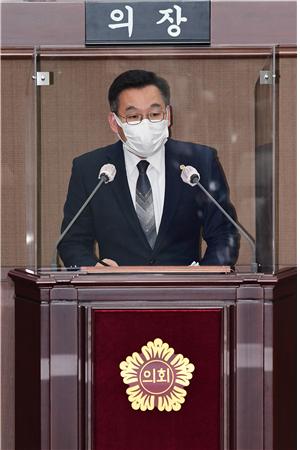
Jeong Jin-cheol, a member of the Seoul Metropolitan Council (Democratic Party, Songpa 6), pointed out during the 298th regular session of the Seoul Metropolitan Council held on the 18th, “The Mapo Agricultural and Marine Products Market, owned by the Seoul Metropolitan Government, has been permitted for use by Mapo District as compensation since 1998. In November 2016, Seoul planned to reclaim it, but the plan was ultimately abandoned due to various reasons.” He added, “Afterwards, Mapo District submitted a ‘Mapo Agricultural and Marine Products Market Facility Improvement and Revitalization Plan’ and promised to implement it, but it was not carried out.”
Councilor Jeong stated, “Although the market’s 2019 revenue settlement was 6.6 billion KRW and expenditure settlement was 4.21 billion KRW, resulting in a balance of 2.39 billion KRW, Mapo District’s expenditure on facility improvements since 2010 was only 814 million KRW. In contrast, Seoul Metropolitan Government provided a total of 2.8 billion KRW in support.” He criticized Acting Mayor Seo Jeong-hyeop, saying, “According to the bid results for one store conducted by the corporation in August this year, the market’s total annual monthly rental income is about 8 billion KRW, which is no different from a private company pursuing profit.”
Continuing, Councilor Jeong said, “The corporation unilaterally amended the market operation management regulations to require the deposit to be paid in cash equivalent to 20 months’ rent. After strong opposition, they revised it to allow payment by performance guarantee insurance bonds. They shortened the lease renewal period from the existing two years to one year and pushed through a 5% annual rent increase policy despite merchants’ protests.” He added, “During this process, they also tried to impose a surcharge of 1.3 times the existing rent without legal grounds due to contract expiration but later withdrew it.”
Furthermore, Councilor Jeong stated, “The corporation amended the management regulations to allow unilateral refusal of lease renewal contracts if the total lease period, including the initial lease, exceeds 10 years or if the tenant does not accept the rent increase set by the corporation. Currently, 128 out of 142 stores, or 90%, fall under the 10-year limit within 3 to 4 years and are scheduled for public competitive bidding. Unable to bear the rent increase resulting from the bidding, all are at risk of losing their livelihoods. For example, one store recently put up for public bidding saw its rent skyrocket from about 70 million KRW to 420 million KRW, a 615% increase, demonstrating that a public institution is openly causing ‘gentrification and displacement.’”
Councilor Jeong continued, “On June 9th, the late former Mayor Park Won-soon visited the market and promised merchants direct management and modernization by the Seoul Metropolitan Government.” He added, “According to the ‘Feasibility Study for Facility Modernization of Mapo Agricultural and Marine Products Market’ conducted by Seoul in 2018, the market received a ‘C grade’ in structural safety diagnosis, indicating severe aging. It requires expertise for efficient management and operation. Considering the market is a public facility of Seoul, it is necessary to explore roles and functions related to public interest in operation and management.”
Finally, Councilor Jeong urged, “The Seoul Metropolitan Government must immediately reclaim the property under Article 1, Paragraph 3 of the Conditional Paid Use Permit for Public Property and Article 10, Item 1, considering public interest in the use and benefit of the property. It must guarantee the business rights of merchants who have long strived to keep the market alive.” He emphasized, “Seoul should follow the precedent of protecting merchants’ business rights in developments such as Seun Shopping Center, and the promise made by the former mayor must be upheld.”
The Mapo Agricultural and Marine Products Market was opened on April 30, 1998, after renovating the Nanji Landfill, a waste disposal site owned by Seoul built in 1978. Currently, it has a dedicated area of 10,804 square meters and houses 142 businesses of various sizes, including agricultural and marine product stores and restaurants. It operates as a traditional market combining wholesale and retail with annual sales exceeding 100 billion KRW.
© The Asia Business Daily(www.asiae.co.kr). All rights reserved.
![Clutching a Stolen Dior Bag, Saying "I Hate Being Poor but Real"... The Grotesque Con of a "Human Knockoff" [Slate]](https://cwcontent.asiae.co.kr/asiaresize/183/2026021902243444107_1771435474.jpg)
















