[Asia Economy Reporter Choi Eun-young] Amid the achievements of introducing a new international standard nautical chart book that labels the 'East Sea' with identification numbers instead of place names through domestic public and private efforts, Google has sparked user outrage by listing 'Sea of Japan' first in some of its domestic services.
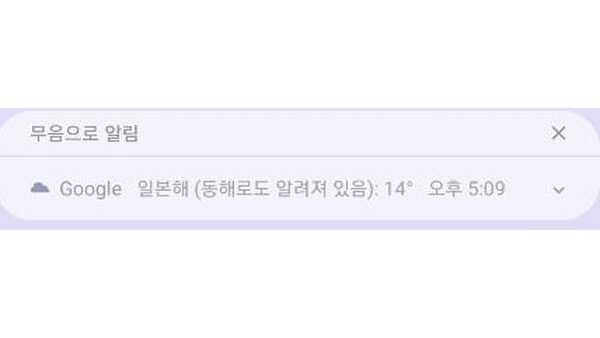
According to the IT industry on the 22nd, Google's app recently began labeling the East Sea as 'Sea of Japan (also known as East Sea)' in its weather service.
According to Google's existing practice, disputed place names should be displayed according to the naming conventions of the country from which the user accesses the service. For example, when using the Google Maps app in Korea, it is labeled as 'East Sea,' while in Japan it is labeled as 'Sea of Japan.' When accessed from a third country, it is displayed as 'Sea of Japan (East Sea)' in dual notation.
However, in this case, 'Sea of Japan' was displayed before 'East Sea' even to Korean users, causing controversy to spread. Google Korea stated, "We are currently verifying the facts internally," but no further statements have been made so far.
This is not the first time Google has caused controversy over place name labeling. In August, there was controversy when searching for 'Dokdo' on Google Maps yielded no results, and in October, during a comprehensive audit by the National Assembly's Science, Technology, Information and Broadcasting Committee, it was pointed out that "the English version of Google Earth (Google's satellite map service) labels the East Sea as the Sea of Japan."
At that time, Lim Jae-hyun, Executive Director of Google Korea who attended as a witness at the audit, said, "If true, it seems to be a huge mistake. We will correct it immediately," but also added, "As a global company, we need to listen to the positions of both the Korean and Japanese governments."
Meanwhile, on the 17th, the Ministry of Foreign Affairs announced that it had agreed to introduce a new international standard nautical chart book 'S-130' at the recent IHO General Assembly discussions regarding the labeling of 'East Sea' and 'Sea of Japan.' S-130 is a revised edition of the existing nautical chart book 'S-23,' and its core is to label seas with unique identification numbers instead of names such as 'East Sea' or 'Sea of Japan.'
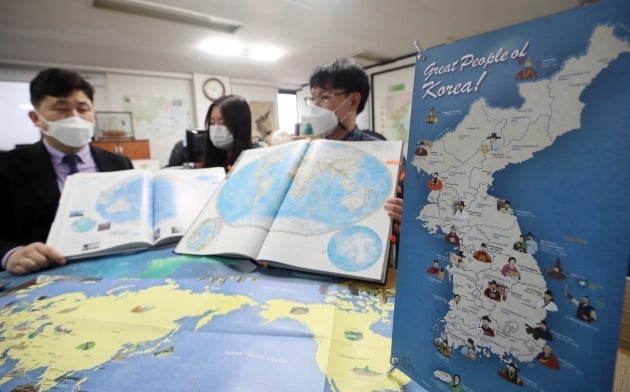 Officials at the office of the cyber diplomatic mission 'VANK' are introducing their own promotional materials labeled as East Sea and foreign publications that list both East Sea and Sea of Japan. [Image source = Yonhap News]
Contrary to the Ministry of Foreign Affairs viewing this as a 'diplomatic achievement' of public and private sectors, Google continues to boldly display 'Sea of Japan' even within Korea, and the labeling controversy is expected to continue.
It is also reported that in Japan, there is a reaction of "We have effectively won." On the 17th, Japanese Chief Cabinet Secretary Kato Katsunobu said at a press conference, "Korea requested the IHO to use dual notation of Sea of Japan and 'East Sea,' but the IHO tentatively approved the Secretariat's proposal to maintain the sole use of Sea of Japan as before," adding, "We have effectively won."
The Ministry of Foreign Affairs immediately rebutted the claims of the Japanese government and media, stating, "This is not true." It also plans to work with private experts to ensure that the East Sea is included in existing maps and internet services where only the Sea of Japan is labeled. In fact, thanks to the efforts of the government and private organizations, the rate of dual notation of the East Sea, which was only 2.8% in the early 2000s, is reported to have recently risen to 41%.
However, as Google's app made an absurd mistake that belies these efforts by the Ministry of Foreign Affairs, online reactions have been critical, with comments such as "This is really crazy," and "Google's audacity to send alerts saying 'Sea of Japan' on Korean phones..."
© The Asia Business Daily(www.asiae.co.kr). All rights reserved.



















