[Asia Economy Reporter Changhwan Lee] After the inauguration of the Biden administration, 7 out of 10 companies surveyed believe that the business environment, including exports, will not change significantly compared to the Trump administration.
The Korea Chamber of Commerce and Industry (KCCI) recently conducted a survey of 300 domestic manufacturers on "The Impact of the Biden Administration's Inauguration on the Industry and Response Tasks." When asked about the overall business environment changes such as exports under the Biden administration, 65.3% of the responding companies answered that "there will be no significant change," the KCCI announced on the 22nd. Companies expecting improvement accounted for 32.0%, while those expecting deterioration were only 2.7%.
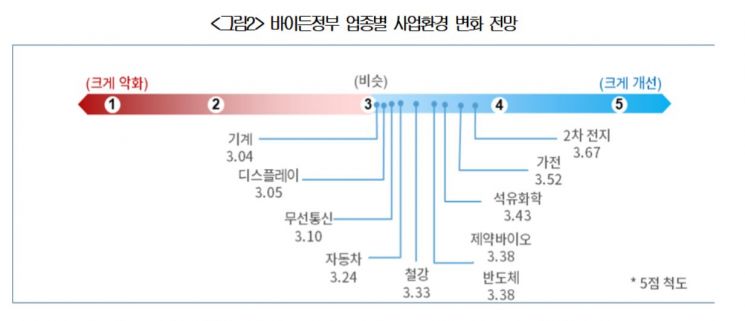
By industry, sectors expected to benefit from the U.S.'s green investment and economic stimulus included secondary batteries, home appliances, and petrochemicals, showing high expectations for improvement. Conversely, industries such as machinery, displays, and wireless communications, which face strengthened U.S. domestic usage requirements and fierce competition with China, showed relatively low expectations.
The most cited reason for expecting an improved business environment was "activation of global trade norms" (42.7%), followed by "emergence of new business opportunities such as green energy" (27.1%), "enhanced policy predictability" (20.8%), and "implementation of large-scale economic stimulus" (9.4%).
More than half of the companies (61.0%) expected that trade friction between the U.S. and China would "ease compared to the Trump era."
When companies evaluated Biden's campaign promises on a 5-point scale, "restoration of the multilateral trade system" (4.4 points), "expansion of fiscal spending" (3.7 points), and "2 trillion dollar green investment" (3.4 points) were seen as opportunity factors.
In contrast, "continued pressure on China" (2.3 points), "minimum wage increase" (2.4 points), and "strengthened environmental regulations" (2.5 points) were perceived as risk factors. "Tax increases" (2.6 points) and "mandatory use of U.S.-made products" (2.8 points) were also expected to have negative impacts.
Song Yoo-cheol, an advisory committee member of KCCI and professor of International Business at Dongduk Women's University, said, "While the Biden administration's multilateral system, expanded fiscal spending, and green policies are generally seen as opportunities, detailed aspects such as continued pressure on China, strengthened environmental regulations, and U.S.-made product requirements present considerable barriers. Since the ripple effects vary by industry and company, thorough analysis and proactive responses are required."
37% of Companies Reflect Biden Variables in Business Plans... 49% Strengthen Policy Monitoring, 31% Raise Export Targets
The level of response by Korean companies to Biden's election was at the planning stage. Regarding whether Biden-related variables are being reflected in next year's business plans, 37.3% answered that they are either "reflecting" or "planning to reflect" them.
As for response measures, "strengthening policy change monitoring" (49.1%) was the most common, but a considerable number of companies were actively pursuing "raising export targets" (31.3%), "discovering and expanding new businesses" (19.6%), and "adjusting investment schedules" (16.1%).
Regarding the Biden administration's focus on green policies, 4 out of 10 responding companies (40.0%) answered that they "lack the capacity to respond."
Companies particularly anticipated that Biden's green policies would be a factor driving up international oil prices. In this survey, only 30.7% responded that "the spread of clean energy use will lower oil prices," whereas more than twice as many, 69.3%, responded that "restrictions on shale development and reduced crude oil supply will raise oil prices."
Regarding the impact of rising oil prices on business management, 56.7% responded that "the cost increase effect is greater," far surpassing the 15.0% who said "the effect of increased sales and export promotion is greater."
A KCCI official related to the survey results stated, "The inauguration of the Biden administration suggests that while a great opportunity is unfolding in the green sector, Korean companies need to enhance their response capabilities and prepare for ripple effects such as rising oil prices."
Companies expressed intentions to pursue strategies to expand exports to the U.S. under the Biden administration, including "investment in productivity improvement" (33.0%), "innovation investment such as technology development and promising industries" (26.7%), "expansion of strategic alliances with U.S. companies" (24.0%), and "expansion of local presence" (16.3%).
The most cited key variable influencing future exports to the U.S. was "exchange rate fluctuations" (42.3%). This was followed by "U.S. domestic economy" (27.0%), "U.S.-China relations" (11.7%), and "changes in industrial landscape" (9.7%).
Kang Seok-gu, head of the Industrial Policy Team at KCCI, said, "The inauguration of the Biden administration brings both expectations and concerns, but it should be turned into an important momentum for our economy and exports to make a new leap forward in the post-COVID era. It is important to actively utilize growth opportunities such as the reorganization of the global trade order and green trends, while establishing diverse cooperation channels and detailed strategies to overcome risk factors such as exchange rate fluctuations and carbon reduction."
© The Asia Business Daily(www.asiae.co.kr). All rights reserved.

![Clutching a Stolen Dior Bag, Saying "I Hate Being Poor but Real"... The Grotesque Con of a "Human Knockoff" [Slate]](https://cwcontent.asiae.co.kr/asiaresize/183/2026021902243444107_1771435474.jpg)















