Frontline Response to COVID-19 at National and Public Medical Institutions and Regional Medical Centers
Active Discussions Across Sectors on Expanding Public Healthcare
"Invest 200 Billion KRW Nationwide by Medical Districts for 300-500 Bed Public Hospitals"
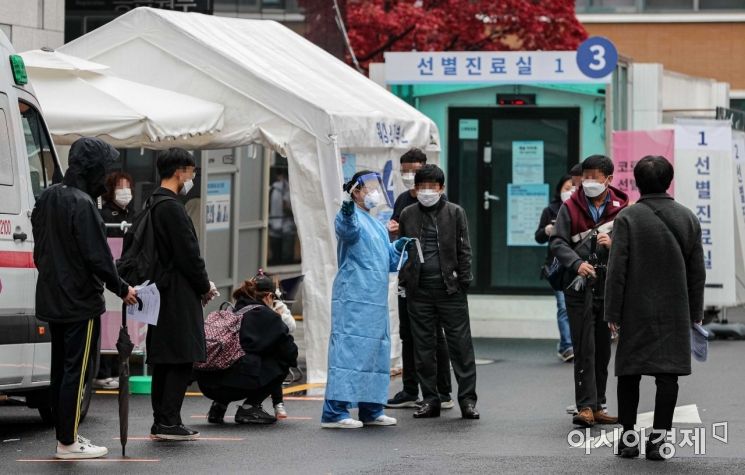 On the 18th, citizens waiting to receive COVID-19 diagnostic tests gathered at the National Medical Center in Jung-gu, Seoul. The National Medical Center serves as the central infectious disease hospital and operates a joint situation room for COVID-19 patient treatment, standing at the forefront of the response. Photo by Jinhyung Kang aymsdream@
[Asia Economy Reporter Choi Dae-yeol] More than two out of three people view medical services as public resources. This is the result (67.2%) from a survey conducted by the National Medical Center in June, targeting over 1,000 people nationwide. This increase is due to the novel coronavirus disease (COVID-19) outbreak this year; previously, only 22.2% held this view, so it has more than tripled. This indicates a significant change in public perception regarding how a country's healthcare system should be structured and operated.
During the more than ten months of dealing with COVID-19, national and public medical institutions and local medical centers across the country have taken the lead in response, and not only the public but also the government, political circles, and civil society agree that public healthcare should be elevated beyond its current level. The key issue is how to achieve this. While the proportion of public funding symbolized by health insurance has increased to around 60%, the share of public hospital beds remains only about 10%. Additionally, the expansion of public healthcare since the 2000s has been function-oriented rather than institution-oriented, and there is a need to reform the medical delivery system. These factors must be comprehensively considered.
At a forum held on the 20th, experts and stakeholders from various fields gathered to share their opinions on this matter. Professor Kim Yoon of Seoul National University College of Medicine (Healthcare Management) pointed out that the government's public healthcare policies so far have focused only on facility and equipment support, lacking strategies to strengthen the public healthcare system. He emphasized the need to revise the 'system' to efficiently respond to infectious disease crises like COVID-19 and to reduce regional medical disparities.
To this end, Professor Kim suggested establishing a National Central Medical Center by integrating the National Medical Center with the Cancer Center, Rehabilitation Center, and Psychiatric Hospital. He also advocated for the establishment of a National Medical School to cultivate public healthcare personnel in essential medical fields. Furthermore, he proposed building a medical cooperation system centered on national university hospitals and regional units, as well as expanding or constructing new regional base hospitals. He stressed the necessity of sufficient incentives, including budget support and exemption from preliminary feasibility studies.
Lee Chan-jin, Executive Director of the People's Solidarity for Participatory Democracy, who also attended the same forum, evaluated the government's failure to allocate any budget for new public hospital construction next year, only including partial expansions of some local medical centers, as "a leisurely level." Lee questioned whether the current government truly has a philosophy regarding public healthcare centered on national and public hospitals. He stated, "Among the 34 local medical centers, only seven have 300 or more beds, but it is necessary to newly establish or construct at least 13 local medical centers with 300 or more beds per region."
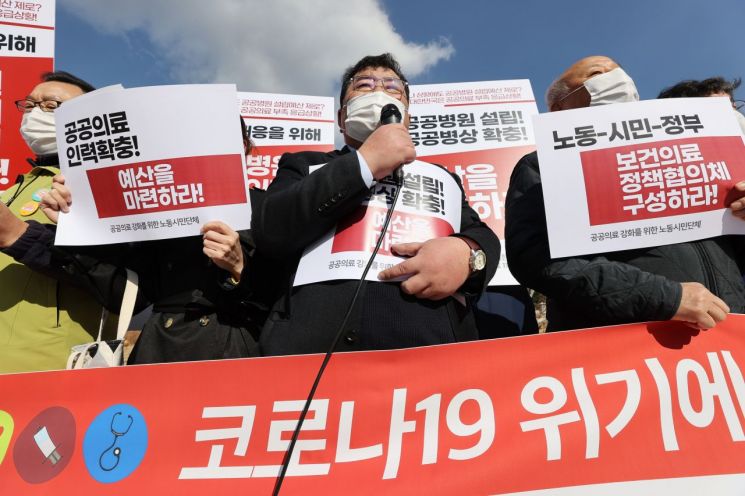 Members of labor and civil society organizations advocating for the strengthening of public healthcare held a press conference on the morning of the 3rd at the Blue House Fountain Square in Jongno-gu, Seoul, announcing the launch of "Beep Beep Public Healthcare 119." They are urging the establishment of public hospitals, securing budgets for expanding public hospital beds, and exemption from preliminary feasibility studies for the establishment of public hospitals.
 Woo Seok-gyun, Co-Representative of the Association of Doctors for Human Rights, argued that at least two new public hospitals should be built per metropolitan local government, and all local medical centers nationwide should be expanded to have 300 to 500 beds or more. He also proposed specific policy measures such as placing national university hospitals under the Ministry of Health and Welfare, establishing a corporation dedicated to supporting public hospitals, expanding the quota for national medical schools, and implementing mandatory service at public hospitals.
Until now, policy measures to strengthen public healthcare have involved assigning or inducing public functions to private medical institutions. However, recently, demands to physically expand infrastructure itself have become more active. The National Health Insurance Service (NHIS) emphasized in a recent report that "the public healthcare development plans implemented so far have limitations in solving problems" and that "public medical institutions should take the lead in reorganizing the medical delivery system."
The NHIS believes that public hospitals should lead by presenting standard treatments and models while reducing disparities in medical services between regions. Since issues such as health insurance finances and reforming the medical delivery system cannot be addressed separately, increasing public hospitals to lead these efforts is necessary. Specifically, they argue for dividing the country into medical service areas and establishing public hospitals at the level of general hospitals with 300 or more beds, along with supplementary measures such as exemption from preliminary feasibility studies and differential allocation of national subsidies.
According to the NHIS, the cost of establishing a public hospital with 300 to 500 beds is estimated at around 200 billion KRW. Operating costs are not very high compared to other social overhead capital since income is generated through health insurance medical services. The NHIS stated, "The cost of establishing a public hospital is comparable to building 4 to 7 kilometers of highway, about 100 daycare centers, 40 to 50 kindergartens, or around 30 elderly care facilities." They argued that investment in public hospital personnel and facilities should be guaranteed, management autonomy ensured, and an institution dedicated to management tasks should be established to comprehensively manage and support these hospitals."
© The Asia Business Daily(www.asiae.co.kr). All rights reserved.
![User Who Sold Erroneously Deposited Bitcoins to Repay Debt and Fund Entertainment... What Did the Supreme Court Decide in 2021? [Legal Issue Check]](https://cwcontent.asiae.co.kr/asiaresize/183/2026020910431234020_1770601391.png)