[Asia Economy Reporter Lee Chun-hee] # Kim Mo (25, female) became independent at an early age due to domestic violence. While attending university and making a living through part-time jobs, Kim heard that the household support obligation condition for housing benefits had been abolished and knocked on the door of the community service center, but the staff's response was cold. The reason was that under current law, unmarried youth under 30 are considered part of the same household as their parents and therefore cannot receive housing benefits.
# Hong Mo (24, male) asks every time he looks for a part-time job whether he can avoid being covered by the four major social insurances. Although he left his hometown and maintains an independent livelihood while preparing to enter university in Seoul, if his part-time income is reported, the household income increases, causing his parents in his hometown to be excluded from receiving housing benefits. Hong also inquired at a nearby community service center after hearing about the abolition of the household support obligation for housing benefits, but was told there was no such provision.
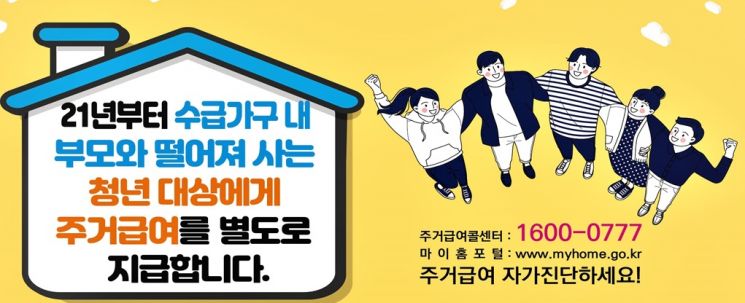
In the future, it is expected that young people in their 20s living separately from their parents will also be able to receive housing benefits.
The Ministry of Land, Infrastructure and Transport announced on the 19th that it will conduct a pre-application for one month starting from the 1st of next month in preparation for the implementation of the youth housing benefit separate payment system next year.
Currently, unmarried youth under 30 who live alone apart from their family and maintain an independent livelihood are excluded from receiving housing benefits even if they meet the payment criteria for a single-person household. This is because under the National Basic Living Security Act, if unmarried, even if the resident registration is separated and livelihood and housing are different, they are considered to form the same household as their parents.
Youth under 30 must earn income above 40% of the median income or get married to be considered separated from their parents' household. However, if they exceed the income standard, they also exceed the housing benefit eligibility amount, and it can be difficult for low-income youth to get married. As a result, youth under 30 have effectively been in a blind spot for housing benefits.
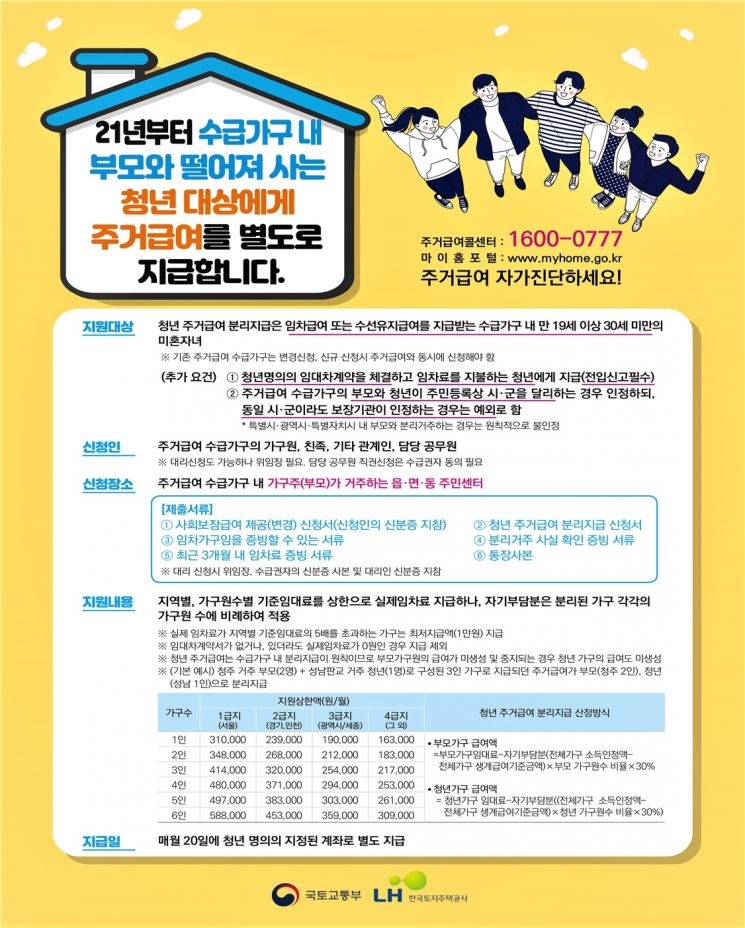 Youth Housing Benefit Separate Payment System Promotional Poster (Provided by the Ministry of Land, Infrastructure and Transport)
However, from January next year, unmarried youth in their 20s like Kim and Hong are expected to be able to receive housing benefits as the youth separate payment system will be operated.
The target group is unmarried children aged 19 to under 30 within housing benefit recipient households who live separately from their parents.
Since this system is implemented within the framework of the current housing benefit system, all income and payment criteria are calculated by summing the entire household. To receive benefits, the recognized income of all household members within the beneficiary household must be below the housing benefit selection standard (45% of median income). Next year's housing benefit selection standard is 1,792,778 KRW per month for a 3-person household and 2,194,331 KRW for a 4-person household.
The calculation of rental benefits also applies the standard for a 3-person household rather than separately applying the standards for parents (2 persons) and youth (1 person). If the combined household recognized income is below the livelihood benefit selection standard, the full standard rent (or actual rent) is paid; if the recognized income exceeds the selection standard, the amount paid is the standard rent (or actual rent) minus the self-payment portion.
However, the self-payment deduction rate, currently 30%, is divided again by the number of household members. Two-thirds of the 30% is applied to the parents, and one-third of the 30% is applied to the youth.
In principle, for separate payment, the city or county where the parents and children live must be different. However, exceptions are allowed if the distance takes more than 90 minutes by public transportation, if living separately within a metropolitan city with both urban and rural areas, or if the youth has a disability.
Also, in line with the system's purpose of supporting housing stability for youth who inevitably live apart from their parents for schooling or job seeking, the reasons for separate residence and the fact of rent payment via bank transfer will be verified to strengthen proper benefit management. Youth who wish to receive benefits must prove the reason for separate residence with certificates such as employment or enrollment certificates and four major social insurance subscription certificates. In cases of unavoidable separate residence for other reasons, benefits can be provided through fact verification by the welfare agency.
The Ministry of Land, Infrastructure and Transport is operating this pre-application period considering that it takes time for income and housing surveys from the actual benefit application to final payment before the system is implemented next year.
Applications can be made anytime even after the pre-application period ends. Applications can be made by visiting the community service center in charge of the parents' address. Online applications through the 'Bokjiro' system are also planned to be implemented in the first half of next year.
Kim Jeong-hee, Director of Housing Welfare Policy at the Ministry of Land, Infrastructure and Transport, said, “Since abolishing the household support obligation standard in housing benefits in October 2018, which dramatically resolved blind spots in housing welfare, this time by supporting rent for youth living separately from their parents, the housing benefit system will take a step forward." He added, "We will continue to pay attention to discovering housing support policies that can provide practical help to young people entering society to alleviate housing insecurity.”
© The Asia Business Daily(www.asiae.co.kr). All rights reserved.
![User Who Sold Erroneously Deposited Bitcoins to Repay Debt and Fund Entertainment... What Did the Supreme Court Decide in 2021? [Legal Issue Check]](https://cwcontent.asiae.co.kr/asiaresize/183/2026020910431234020_1770601391.png)
















