Successful Test of New SM3 Block 2A Interceptor Missile
Following ICBM Test Launch, Demonstrates Nuclear Deterrence Chain
[Asia Economy New York=Correspondent Baek Jong-min] The 'SM3 Block 2A' interceptor missile, jointly developed by the United States and Japan, successfully intercepted an intercontinental ballistic missile (ICBM). Analysts suggest this demonstrates the response capability in preparation for expected provocations from North Korea ahead of the inauguration of the Joe Biden administration.
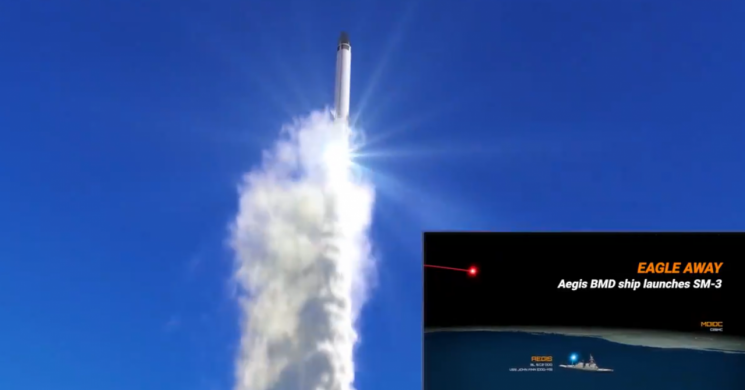
John Hill, Deputy Director of the U.S. Missile Defense Agency (MDA), announced on the 16th (local time) that a simulated ICBM launched near the Marshall Islands in the Pacific was intercepted near Hawaii by an SM3 Block 2A missile fired from a U.S. Navy Aegis destroyer.
The United States had previously announced plans to conduct an SM3 Block 2A missile test within the year. The test was conducted after the presidential election concluded, yielding successful results. Prior to the election, in September, the U.S. also conducted a Minuteman III ICBM launch test to demonstrate nuclear deterrence.
North Korea experts in the U.S. anticipate that North Korea may carry out provocations such as missile launches ahead of the Biden administration's inauguration.
The SM3 Block 2A missile is the latest sea-launched ballistic missile interceptor. It is expected to serve as a countermeasure for defending the U.S. mainland against ICBMs that North Korea has developed or is developing.
The SM3 Block 2A was jointly developed by the American defense contractor Raytheon and Japan's Mitsubishi Heavy Industries. It boasts top-tier interception capabilities with a maximum range of 1,550 miles (2,500 km) and a maximum interception altitude of 620 miles (1,000 km).
Raytheon welcomed the successful test, stating, "The SM3 Block 2A has demonstrated its capability to counter long-range ballistic missile threats."
© The Asia Business Daily(www.asiae.co.kr). All rights reserved.

















