Concerns Over Military Operations at End of Term... Secretary of State and Joint Chiefs Chairman Strongly Oppose
Worries Since Recent Mass Dismissal of Senior Defense Officials... Burden on New Government?
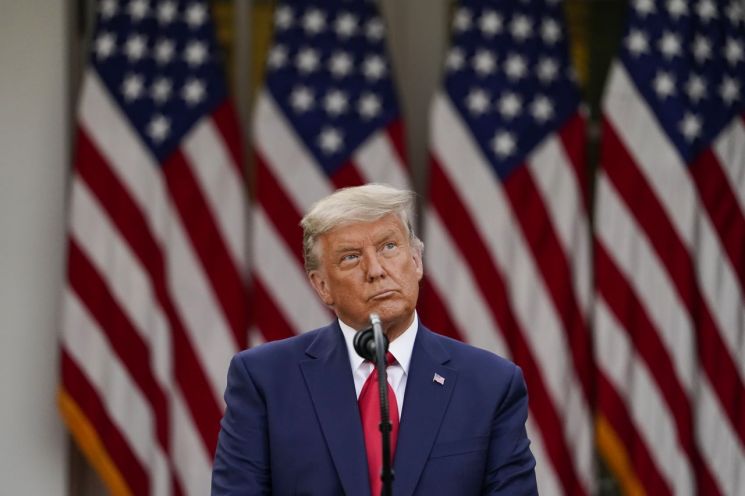
[Asia Economy Reporter Hyunwoo Lee] It has been reported that U.S. President Donald Trump recently considered a military operation to attack Iran's major nuclear facilities to prevent Iran from developing nuclear weapons, but his aides strongly opposed and dissuaded him. This is interpreted as a strategy to overcome the lame-duck situation at the end of his term. There are concerns that Trump might again advocate attacking other hostile countries before his term ends, which could pose a significant burden for the transition team of President-elect Joe Biden ahead of the power transfer.
On the 16th (local time), The New York Times (NYT) cited statements from four current and former officials, reporting that President Trump proposed attacking Iran's major nuclear facilities during an internal meeting with senior national security aides held in the White House Oval Office on the 12th. The meeting took place less than a day after the International Atomic Energy Agency (IAEA) reported that Iran possessed 2,442 kg of low-enriched uranium, more than 12 times the limit set by the nuclear agreement (JCPOA - Joint Comprehensive Plan of Action).
Some aides said the meeting was held on the day the IAEA report was released to discuss the Iran issue. According to these officials, President Trump asked his aides about possible options during the meeting and subsequently proposed the plan to attack Iran's nuclear facilities. Vice President Mike Pence, Secretary of State Mike Pompeo, Acting Defense Secretary Christopher Miller, Chairman of the Joint Chiefs of Staff Mark Milley, and other senior aides all strongly opposed the escalation in the final phase of the term and dissuaded President Trump from pursuing the attack plan.
According to the NYT, after Secretary Pompeo and Chairman Milley explained the potential risks of expanded military intervention, the option of attacking Iran with missiles was excluded from the discussion, and the meeting participants left the room. However, officials said President Trump might still be considering options to strike Iran's assets or Iranian proxy forces such as the Shiite militias in Iraq.
It is interpreted that President Trump, facing a lame-duck situation at the end of his term, proposed attacking Iran as a way to overcome it. The NYT reported that after a large number of senior Defense Department officials were dismissed recently, hawks on Iran filled the vacancies, raising concerns within and outside national security agencies that President Trump might initiate military operations against Iran or other hostile countries in the final phase of his term.
The NYT pointed out, "An attack on Iran may be unpopular among Trump supporters who mostly opposed deeper involvement in Middle Eastern issues, but it could severely damage relations with Iran and make it much harder for President-elect Joe Biden to fulfill his pledge to restore the nuclear agreement." The White House has not yet issued a statement regarding the reports on the review of the Iran attack plan.
© The Asia Business Daily(www.asiae.co.kr). All rights reserved.
![Clutching a Stolen Dior Bag, Saying "I Hate Being Poor but Real"... The Grotesque Con of a "Human Knockoff" [Slate]](https://cwcontent.asiae.co.kr/asiaresize/183/2026021902243444107_1771435474.jpg)











