IHO Agrees to Change Haedo Map Standards at June 16-18 General Assembly, Develops New Standard 'S-130'... Argument for Exclusive 'Sea of Japan' Label Likely to Weaken
'S-23' Dispute Remains Only in Publications... Government Accelerates Efforts to Promote East Sea Label Globally
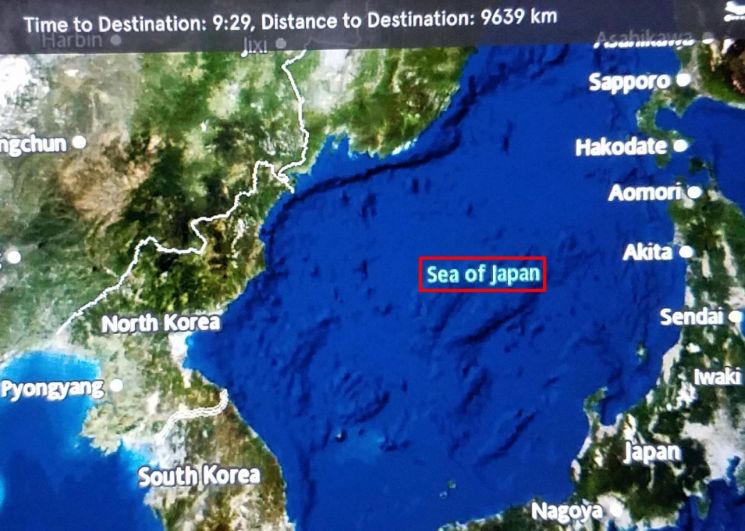
[Asia Economy Reporter Lim Cheol-young] The International Hydrographic Organization (IHO), which serves as the standard for naming seas worldwide, is introducing a numbering (code) system instead of names in its standard nautical chart book. According to this new notation method, Japan's logic of exclusively labeling the East Sea as the "Sea of Japan" is expected to weaken.
According to the Ministry of Foreign Affairs on the 17th, the IHO agreed to introduce "S-130," a revised edition of the nautical chart book "S-23," following discussions at the 2nd International Hydrographic Organization Assembly held via video conference on the 16th regarding the "Informal Consultation Results on the Future of S-23." The core of "S-130" is to assign identification numbers to seas instead of names. The current IHO Assembly, attended by 65 of the 93 member countries, began on the 16th and will continue until the 18th.
Japan has long labeled the East Sea as the "Sea of Japan" based on the first edition of S-23 published in 1929 and has insisted on the exclusive use of "Sea of Japan." The South Korean government has advocated for dual notation of the East Sea and Sea of Japan since 1997, but this was not reflected. Subsequently, in April 2017, during the IHO Assembly, consultations with North Korea and Japan began. However, as the parties failed to reach an agreement by last year, the IHO Secretary-General proposed a method of labeling seas with "unique codes" instead of names. This proposal accelerated discussions and was adopted by consensus among member countries.
North Korea did not speak directly in the public discussions but has positively evaluated the Secretary-General's proposal in informal consultations. At this Assembly, Japan stated that it had no additional comments beyond the written opinion expressing support, while the United States and New Zealand expressed support and pledged to provide the necessary technical assistance for developing the new notation method.
South Korea expressed broad agreement with the proposal in the report resulting from the informal consultations led by the Secretary-General on the future of S-23. It conveyed that the new standard, S-130, proposed by the Secretary-General, would promote digital forms of maritime and sea boundary notation, effectively meeting user demands in the 21st-century digital information environment and is expected to enhance accessibility and interoperability of global geographic information.
The IHO plans to announce the final results on December 1 after circulating the outcomes of this Assembly in writing. The existing S-23 is expected to be published only as a printed publication. A Ministry of Foreign Affairs official explained, "The Secretary-General's proposal clearly states that S-23 will be published only as a printed publication to show the historical transition from analog to digital," adding, "This means that no further editions of S-23 will be produced."
However, the government stated that it is difficult to predict the commercialization timeline of the newly adopted S-130. A Ministry of Foreign Affairs official said, "We have only agreed to introduce it, so it is difficult to predict when development will be completed," but also evaluated, "This means that the S-23 standard will be replaced by the new S-130, which is a result of the government's persistent efforts on the multilateral diplomatic stage."
Separately from the conclusions of this IHO Assembly, the government plans to accelerate the global spread of the East Sea notation. While only 2.8% of world maps included the East Sea notation in 2002, it is known to have increased to 41% as of this year.
A Ministry of Foreign Affairs official said, "The government is currently developing a system to monitor the status of East Sea notation online and plans to share this regularly with overseas diplomatic missions, the Northeast Asian Cultural Foundation, and the Overseas Cultural Promotion Agency to promote comprehensive corrective activities for the spread of East Sea notation online," adding, "We will actively link efforts to spread the East Sea notation with digital public diplomacy projects, taking advantage of the expansion of public diplomacy using digital platforms amid the COVID-19 situation."
Meanwhile, the Ministry of Foreign Affairs refuted distorted reports by Japanese media claiming that the "Sea of Japan" designation would be maintained. The Yomiuri Shimbun reported that the exclusive notation of "Sea of Japan" is expected to be approved at this IHO Assembly, emphasizing S-23. This is interpreted as reflecting concerns about negative public opinion arising in Japan if the Secretary-General's proposal passes.
In response, a Ministry of Foreign Affairs official explained, "The Secretary-General's proposal clarifies that S-23 will remain as a publication to show the historical transition from analog to digital and is not a valid standard," adding, "Because it remains only as a publication while the new standard is developed, it is not a valid standard."
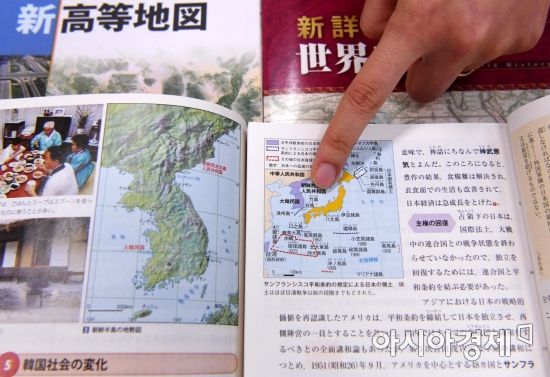 Distorted Japanese textbooks labeled as 'Sea of Japan' and 'Dokdo'./Photo by Hyunmin Kim kimhyun81@
© The Asia Business Daily(www.asiae.co.kr). All rights reserved.
















