Discussion on Advancing Trade and Investment, Inclusivity, Digital Economy, and Innovative Sustainability
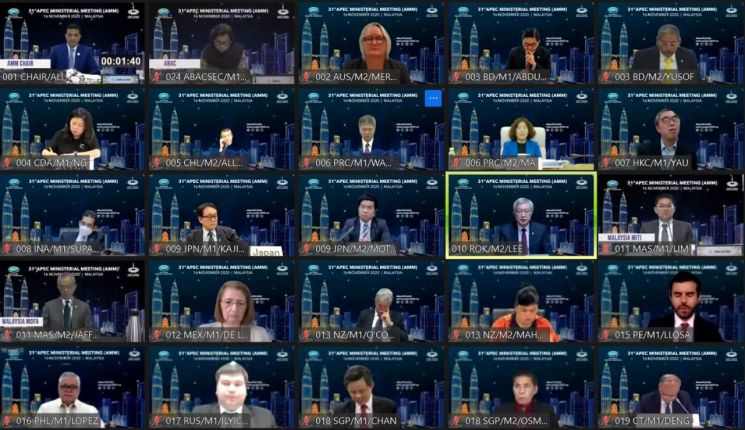
[Asia Economy Reporter Lim Cheol-young] Lee Tae-ho, Vice Minister of Foreign Affairs, and Yoo Myung-hee, Chief Negotiator of Trade at the Ministry of Trade, Industry and Energy, attended the 31st Asia-Pacific Economic Cooperation (APEC) Ministerial Meeting (AMM) held via video conference on the 16th, where they confirmed their commitment to joint response against the novel coronavirus disease (COVID-19) and jointly adopted a ministerial statement.
APEC (Asia Pacific Economic Cooperation) is the world's largest economic cooperation forum, including 21 member economies such as the United States, China, Japan, and Russia, aiming to facilitate trade and investment and build an Asia-Pacific economic community. The meeting, hosted by Malaysia as the chair country this year, was attended by foreign and trade ministers and vice ministers from the 21 APEC member economies.
At this meeting, foreign and trade ministers reaffirmed the member economies' commitment to joint COVID-19 response and discussed △ ways to advance trade and investment discussions △ inclusiveness, digital economy, and innovative sustainability, based on which they adopted a joint ministerial statement.
The statement includes △ facilitation of movement of essential goods and essential workers △ support for reform of the World Trade Organization (WTO) △ welcoming the adoption of the APEC Post-2020 Vision △ promotion of implementation of the Internet Digital Economy Roadmap for digital economy and technological innovation △ attention to the 2020 Economic Policy Report focusing on structural reform and women’s empowerment △ and strengthening cooperation for sustainable development.
The Post-2020 Vision is an initiative to establish a new vision through 2040 as the deadline of the Bogor Declaration (1994), which set APEC’s goal of achieving free trade and investment in the region by 2020, approaches. Its core elements are △ regional economic integration, achievement of the Free Trade Area of the Asia-Pacific (FTAAP), and structural reform in trade and investment △ promotion of innovative technology development, improvement of digital infrastructure, and activation of data flow in innovation and digital economy △ pursuit of qualitative growth, inclusive human resource development, and response to environmental issues in inclusive and sustainable growth.
Chief Negotiator Yoo Myung-hee presented three cooperation measures in Session 1 to advance discussions on COVID-19 response and trade and investment within APEC. She emphasized the need to seek effective measures to ensure that trade-restrictive non-tariff measures do not become permanent barriers to the smooth trade of essential goods. Regarding the facilitation of cross-border movement of essential workers, she stated that continuous cooperation, such as voluntary sharing of member economies’ policies on essential worker movement based on Korea’s proposal, will contribute to enhancing human connectivity within the region.
Yoo also stressed that realizing the APEC Post-2020 Vision requires continuing efforts toward trade and investment liberalization while ensuring that benefits reach small and medium enterprises and vulnerable groups, and that WTO reform to restore the multilateral trading system’s function should be prioritized.
Vice Minister Lee Tae-ho emphasized in Session 2 that “inclusive and sustainable qualitative growth” is crucial to overcoming the crisis, especially as vulnerable groups face greater difficulties due to COVID-19. He noted that “discussions on structural reform and women’s empowerment are actively taking place at the APEC level” as part of promoting inclusiveness, and expressed hope for continued cooperation to expand women’s economic participation.
As part of efforts to ensure inclusiveness in overcoming the COVID-19 crisis, he mentioned Korea’s contributions to the international community, including efforts to develop treatments and vaccines. He then highlighted that the digital economy is a key element of innovation to turn the COVID-19 crisis into an opportunity, and Korea expressed active willingness to participate in discussions to revitalize the digital economy, including △ promotion of consumer protection △ utilization of personal data △ and cooperation on personal information protection.
He also called for cross-border cooperation for the transition to a green economy and social structure. Vice Minister Lee announced Korea’s declaration of carbon neutrality by 2050 and introduced the 2nd P4G Summit to be held in Korea next year to strengthen international solidarity for “build back better and greener.”
A Foreign Ministry official explained, “The government will help normalize economic activities of our industries by facilitating the movement of essential goods and essential workers in response to the prolonged COVID-19 pandemic,” adding, “As a founding member of APEC and a key contributor leading the cooperative agenda, Korea plans to continue leading discussions and pursuing international cooperation in multilateral and plurilateral international forums including APEC to enhance its international standing.”
© The Asia Business Daily(www.asiae.co.kr). All rights reserved.
![User Who Sold Erroneously Deposited Bitcoins to Repay Debt and Fund Entertainment... What Did the Supreme Court Decide in 2021? [Legal Issue Check]](https://cwcontent.asiae.co.kr/asiaresize/183/2026020910431234020_1770601391.png)